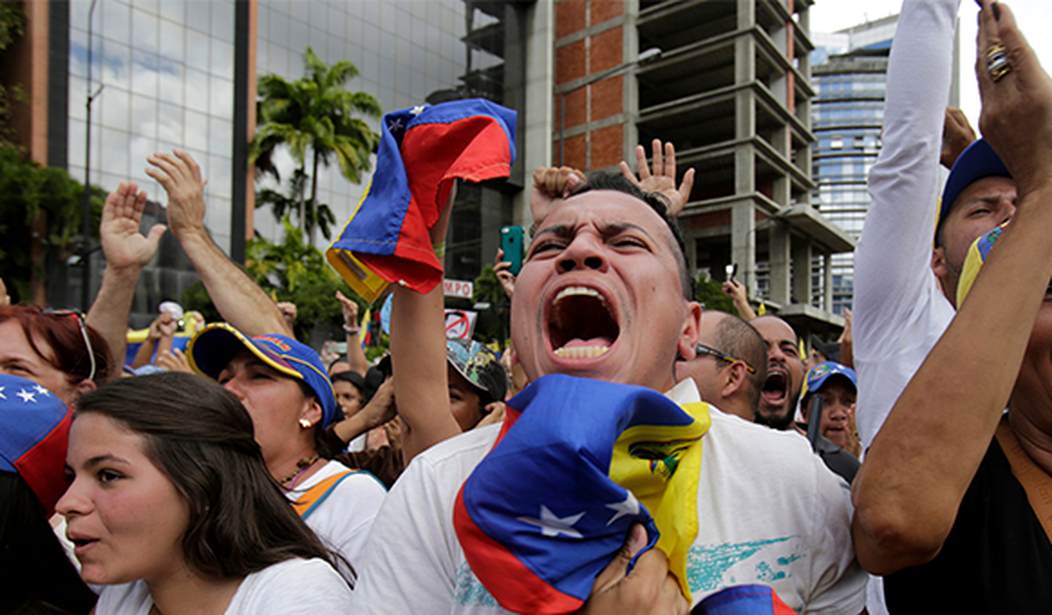

In the days immediately following the capture and arrest of Nicolás Maduro, Venezuelans from Argentina to Texas to France publicly celebrated what is likely the beginning of the end of decades of tyranny in that country.
But as I noted that first week, you didn't really see Venezuelans inside Venezuela celebrating. They were too scared. They saw what happened last time they took to the streets — thousands of their fellow countrymen were locked up, tortured, or disappeared for merely protesting Maduro stealing the election. And that wasn't the first time it had happened under the current regime.
Since January 3, Colectivos, pro-regime paramilitary groups, have been in the streets, looking for any signs of celebration of Maduro's arrest. Even our government warned United States citizens to leave or stay out of Venezuela a couple of weeks ago because of this, claiming there were roadblocks and checkpoints set up, looking for anyone with any U.S. ties.
But despite all of this, there's a small but important change taking place as I type.
Related: Here's Why People Aren't Celebrating in Venezuela
If you've been following along, you know that the release of the political prisoners has been a major issue since January 8, when the regime promised to release a "significant amount." While that's happening in small numbers, it's not happening fast enough for the family members and friends who have waited months, and, in some cases, over a year and a half, to know if their loved ones are even still alive.
When the announcement was made earlier this month, by both the regime and Donald Trump, people began gathering outside the detention centers, waiting. When it became clear that this wasn't going to happen quickly, they began holding vigils with candles, flowers, and pictures of those being held hostage. As is the case in these situations, patience wore thin, and a handful began protesting, shouting at police and even chanting outside the Public Ministry, demanding the release of the remaining prisoners.
As I said in a previous article, these people are a lot braver than any so-called "protester" in Minneapolis right now. They are staring real tyranny in the face and saying we don't care anymore, knowing the potential consequences.
Familiares de presos políticos protestaron en el Ministerio Público para exigir su liberación https://t.co/4Af8BkYFm2 pic.twitter.com/vhEPUXOFGS
— Monitoreamos (@monitoreamos) January 20, 2026
But here's something that's also happening: Young people are joining them.
University students are joining hands with the families of these political prisoners and lending their voices and demanding their release in a very public way. They're refusing to accept the slow response and claim that speaking out is the ethical thing to do. And they're not just speaking out in the streets of Caracas — they're taking to social media to ensure the world knows what's really going on.
A year ago, this would have been impossible. Today, it's still incredibly risky, but with Trump on their side, they see opportunity.
One of the young women leading this movement is Rosa Cucunuba. She's a 22-year-old law student and vice president of the student group Federación de Centros Universitarios (FCU) at the Universidad Central de Venezuela (UCV), Venezuela's main public university.
Cucunuba is making social media videos and standing with the families outside the detention centers, demanding the release of all political prisoners. "Powerful words from within the heart of the beast, from Caracas itself, where almost no one dares to speak out," according to the media outlet El Mundo.
El Mundo points out that Cucunuba, who is aligned with opposition leader María Corina Machado' Vente Venezuela party, is smart — she speaks perfect English and Italian, which she taught herself — but more importantly, she's brave, emerging as the voice of a generation of Venezuelans, much like Machado did back in the days of Hugo Chávez. Despite the potential for harassment and repression, she refuses to remain quiet.
"Since January 3rd, an opportunity, a door, has opened — thanks to U.S. pressure — for the release of political prisoners," she told El Mundo before explaining that the movement is growing.
But people are coming out and joining in. The change since January 3rd has been impressive. We've broken the silence. Those of us on the inside realize it's growing. The student leadership at the UCV took the lead, and other universities are following suit, like Simón Bolívar, the Catholic University, and Monteávila. A young woman from this private university was even willing to speak to the media. I thought, wow , we're getting there. We've taken a huge step. It's clear that not everyone is joining in person, but we're even receiving donations: food, canned goods, clothes for the families who are staying overnight. In this very difficult situation, Venezuelans are showing they can rise to the occasion, despite everything.
She also talked about what it was like to approach the police outside one of the detention centers for the first time:
We went up to the entrance of the detention center; we had never done that before. And their response was to put up a police barricade to prevent us from going up. It's one thing to see it and another to live it; it's heartbreaking. Our call is for people to empathize with the cause; it's not just a cause for the families, it's for all Venezuelans. We have to raise our voices so that the country and the world realize what is happening.
When asked if she's scared that she could end up detained, she said that, of course, no one is immune to fear, and even admitted that she's had to go into hiding at times, but what came next was very powerful.
But in the end, what scares me most is not living in a democracy. I was born and raised in this system.
Think about that. This young university student and her entire generation have never known what life is like outside of Chavismo. They only thing they have known is tyranny, socialism, starvation, economic collapse, watching older friends and family flee the country, and constant fear of the very people who were supposed to protect them.
They've been waiting for their moment, and Trump has given it to them. What comes of it remains to be seen, but for the first time in a long time, there is hope, and it is growing, slowly but surely. These kids could be what saves their country's future.
--------------------------------------------------------------------------------------------------------
For those of you keeping up with the release of political prisoners, I do not have a recent total. Despite what the regime says, it's still fairly low, but Foro Penal is reporting that they think about 80 people were released on Sunday morning, which is a big jump and excellent news. I want to leave you with this video of one of them surprising his young daughters after his release. It totally made my day.
A political prisoner of the Chavista regime in Venezuela was released after more than a year in captivity.
— Emmanuel Rincón (@EmmaRincon) January 25, 2026
He surprised his two young daughters by arriving disguised as a bear. pic.twitter.com/5ToM9wtxnD