







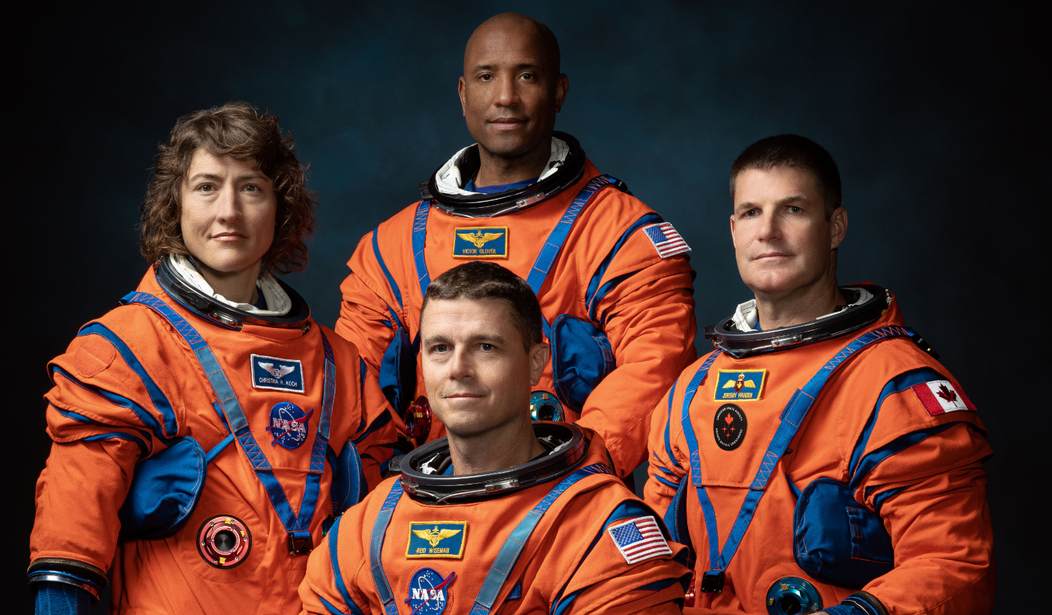
In the past few days, NASA finally rolled its SLS rocket and Orion capsule to the launchpad for the first dress rehearsal countdown in preparation for the Artemis II 10-day manned mission that sometime this spring will slingshot four astronauts around the Moon and back to Earth.

That dress rehearsal countdown will also include fueling the rocket, which will have to go smoothly before NASA sets a date for the actual launch. At the moment, the agency has a series of launch windows available, from February 6 through April 6. While it hopes to launch early in that window, that hope is not guaranteed. In preparing for the unmanned Artemis I mission in 2022, NASA had to do this practice countdown multiple times because of fuel leaks and other issues. The same could happen during the new Artemis II dress rehearsal countdown.
If you read any of the press stories about this roll-out, listed below, that’s about all you would know, other than the fact that this is the most ambitious and greatest thing NASA has ever done in decades and that the agency is doing everything possible to make sure the flight is safe and goes off without a hitch.
NOT!
In reading all of the stories below, I felt like I was reading the state-run presses of China and the Soviet Union.
- ABC/AP: NASA’s new moon rocket heads to pad ahead of astronaut launch as early as February
- CBS News: NASA hauls Artemis II moon rocket to launch pad for February flight
- Reuters: NASA rolls giant SLS rocket to launchpad for second Artemis moon mission
- UPI: NASA moves Artemis II rocket to launchpad ahead of mission to the moon
- New York Times: NASA’s Giant Rocket Completes Slow Roll Toward Artemis II Moon Voyage
- Forbes: NASA Rolled Out Artemis —Here’s Why It Matters
- BBC: ‘We’re ready to go,’ Nasa crew say as rocket inches closer to launch pad
- NPR: NASA’s Artemis II craft meets the launch pad ahead of crewed lunar orbit
- CNN: 4 astronauts will soon take an unprecedented path to the moon. But why aren’t they landing?
- Florida Today: NASA’s Artemis II moon crew will see views ‘human eyes have not seen’
- Scientific American: NASA’s Artemis II mission to the moon is inching toward the launch pad
- Space.com: NASA rolls Artemis 2 rocket to the pad ahead of historic moon launch
- Space News: SLS/Orion rolls to pad for Artemis 2
- NASASpaceflight.com: Artemis II rolls out to LC-39B for first crewed lunar mission since 1972
- GeekWire: ‘The start of a very long journey’: NASA’s Artemis moon rocket makes slow trip to its launch pad
- CollectSpace: NASA rolls out Artemis II rocket to launch pad for flight to the moon
- Canadian Press: Jeremy Hansen ‘pumped’ about historic trip around the moon
- Japan’s NHK: NASA’s Artemis moon rocket moved to launch pad
- Australia’s Sky News: Huge NASA rocket reaches launch pad after painstaking 1mph journey
The write-up of every one of these so-called news outlets is cloying and worshipful. The worst examples are those that focus on the ridiculous quote by one astronaut, “We are very likely going to see things that no human eye has ever seen.” This may be true (four humans will see the Moon from a new perspective), but it is hyperbole of the worst sort. Not only have humans circled the Moon before, but unmanned orbiters have also mapped the entire globe at a resolution far better than anything that will be visible to the Artemis-II crew.
Furthermore, these media reports repeat without any questioning NASA’s very false claim that it has done everything possible to make sure this flight is safe. CNN, for example, finds a planetary scientist at Brown University, James Head, to reinforce this point, who says quite inaccurately and clearly from ignorance the following:
Head also believes that the Apollo and Artemis programs are linked by the rigorous approach to testing each component before mission deployment. “The Artemis spacecraft, this is only the second time it’s flown. You don’t want to rush things,” he said. “Just like Apollo, you test every element one step at a time. That’s why it’s not landing, because it’s the first time it’s been essentially tried. So, it makes complete sense. It’s just how NASA does missions, to ensure not just human safety, but mission success.”
Head is, without doubt, one of the world’s premier planetary scientists. On that subject, he knows more than anyone. On manned space, however, he is woefully uninformed. The testing programs of Apollo and Artemis could not be more different. Before the Apollo 8 first lunar orbital mission in December 1968, NASA had launched its Saturn V rocket twice already, supported by dozens of other ground and launch tests. It had tested its Apollo capsule unmanned in space several times, and also flown one 10-day manned mission in Earth orbit, Apollo 7, to make sure its systems worked effectively before risking a Moon trip with humans aboard.
With Artemis, NASA has done none of those things, or if it has, it has done it tentatively and not sufficiently. SLS has only launched once. It has not been tested as rigorously as Apollo tested the Saturn V. It remains a large unknown.
More significantly, Orion will be flying humans using a life support system that has never been tested in space at all. Before sending Artemis II to the Moon, NASA intends to hold the capsule in Earth orbit for several hours to check the system out, but that is certainly not the same as the two-week mission of Apollo 7.
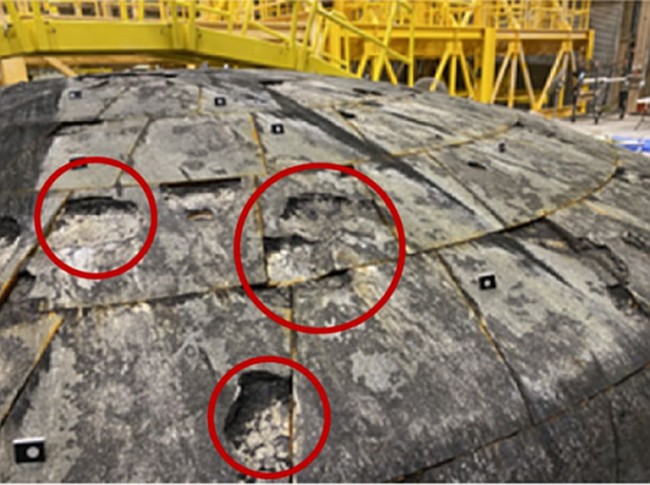
And then there is Orion’s very questionable heat shield, which on Orion’s only test flight in 2022 came back from the Moon with significant unexpected damage (see image to the right). In reviewing that damage, NASA’s inspector general concluded that “In our judgment, the unexpected behavior of the heat shield poses a significant risk to the safety of future crewed missions.”
Yet NASA has made no revisions to this flawed heat shield design. It has merely changed the capsule’s trajectory as it dives back into the Earth’s atmosphere at 25,000 mph, hoping this change will reduce the stress to the heat shield and prevent it from failing.
Only one article above (Marcia Dunn’s write-up for ABC/AP) even mentioned the heat shield, but did so in a way that made it seem the problem had been fixed entirely. None of the above articles mentioned the untested life support system. Even the media outlets that focus on space-related matters (Space.com, Space News, CollectSpace, NASAspaceflight.com, and Geek Wire) ignored these issues.
Yet without reporting these details, none of these so-called news outlets is telling their readers the full story. Instead, they act as propaganda outlets for NASA and the government.
To put this launch in the correct context, these facts have to be mentioned. Artemis II is flying a very dangerous mission on technology that is not fully tested, and has shown in the few tests previously flown that this technology has flaws that NASA’s engineers do not fully understand.
That’s the real story. It is a tragedy that only here (and at my website Behind the Black) can readers find this out.



Join the Conversation
VIP members get the ability to comment on articles.