







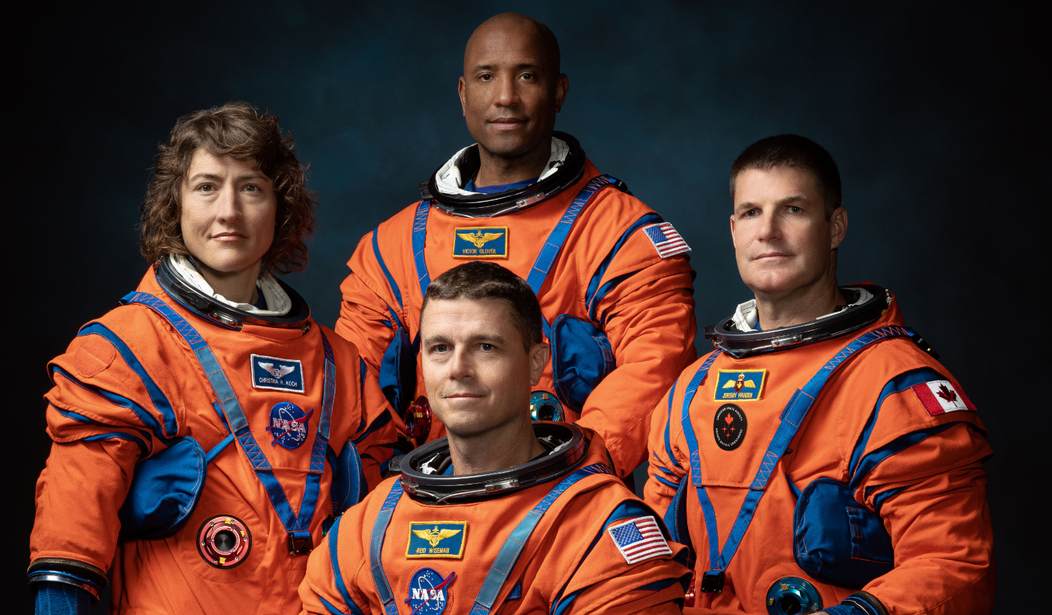
It is now very evident that Congress, President Donald Trump, and NASA Administrator Jared Isaacman are firmly committed to getting Americans back on the lunar surface as quickly as possible, and to do so using both NASA's Space Launch System (SLS) rocket and its Orion capsule. Congress has demanded in legislation that both the rocket and capsule fly on a minimum of three lunar missions. Trump has repeatedly reiterated his insistence that we beat China back to the Moon by landing Americans there by 2028. And Isaacman has said publicly since his confirmation that the fastest way to meet Trump's goals is by using both SLS and Orion.
According to the present plan, the next mission, Artemis II, will launch no later than April 2026, with SLS sending an Orion capsule carrying four astronauts around the Moon and back to Earth. Artemis III will then follow in 2028, landing three astronauts on the lunar surface. This tight schedule is necessary in order to meet Trump's desire to achieve that new American manned landing by 2028 — ahead of the Chinese — and thus setting the groundwork for the initial components of a permanent manned base by 2030.
I am writing now to plead with both President Trump and NASA Administrator Jared Isaacman to please reconsider this schedule. Take the crew off the Artemis II mission in the spring, and fly it as an unmanned mission around the Moon.
I am suggesting this because right now it appears that NASA, the President, and Congress are all repeating the same mistakes NASA made in 1967 with the Apollo 1 launchpad fire that killed three astronauts, as well as in 1986 with the space shuttle Challenger disaster that killed seven astronauts. In both cases, there were clear and obvious engineering issues that said both the Apollo capsule and the space shuttle were not ready to fly, but the pressure of schedule convinced managers at NASA to look the other way, to place those scheduling concerns above fundamental engineering principles. In both cases, people died when the engineering issues were ignored.
It presently appears that the same circumstances exist today with Orion: serious engineering issues that everyone is ignoring because of the need to meet an artificial schedule.
First, some background: In 2022, on the Artemis I mission, Orion was launched unmanned around the Moon and back to Earth. Upon return, however, engineers discovered that the capsule's heat shield had not performed as expected and, in fact, showed significant damage, with the loss of large chunks. After two years of review, engineers were still unsure of the root cause of the problem, though they had theories.
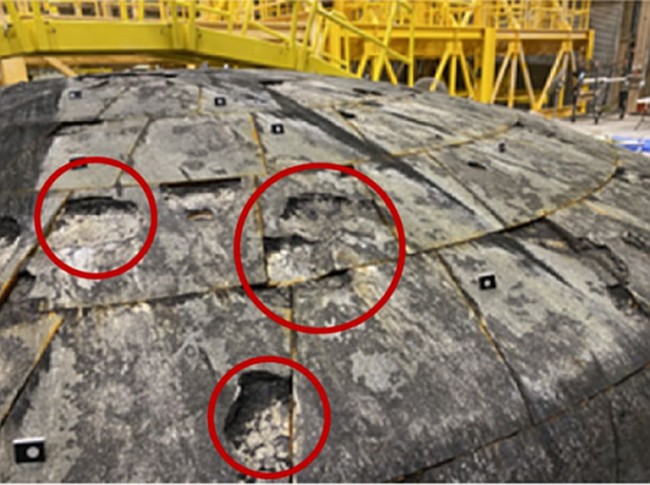
Replacing the heat shield with a different design would add years to the schedule. To keep its schedule, NASA managers decided in late 2024 that by changing the capsule's flight path as it entered the Earth's atmosphere, they could reduce the stress on the shield, thus avoiding that long delay.
An Inspector General report issued only a few months earlier, however, challenged this strategy, most ominously:
No matter the path forward, like with any engineering system, changes to the heat shield design or its operational use can lead to unintended consequences and introduce residual risks. For instance, altering Orion’s reentry path can create more stressing conditions that exacerbate the char loss phenomenon or introduce new failures or unknowns into the system. Without understanding the residual effects of introducing design and operational changes, it will be difficult for the Agency to ensure that the mitigations or hardware changes adopted will effectively reduce the risks to astronaut safety.
The report added, "In our judgment, the unexpected behavior of the heat shield poses a significant risk to the safety of future crewed missions."
The inspector general was not alone in his concerns. Many engineers, both in and out of NASA, have raised these questions.
In response, NASA has done everything it can to hide its own August 2024 heat shield report, issued by some of those engineers. When the agency was required to release the report due to Freedom of Information requests, it finally did so but literally redacted every word. All the public got was 61 pages that were almost all covered with black boxes.

A risky heat shield, however, is not the only issue. Orion's environmental system, the equipment that provides the astronauts with the air they will breathe, has never been tested in flight. NASA is going to test it for the first time on Artemis-2, using those four astronauts as guinea pigs. If a private company like SpaceX had dared to suggest NASA fly astronauts on a Dragon capsule with a similar untested environmental system, NASA would have automatically balked.
SpaceX, however, didn't suggest such a thing because it knew it was a foolish idea.
Similarly, if SpaceX had offered a similar improvisation for a questionable Dragon heat shield, NASA would have said, "No!" most emphatically.
Yet the agency is driving ahead with a manned Artemis II, despite these real concerns. Schedule has once again trumped engineering, with the real possibility that doubtful engineering could once again end up killing some American astronauts.
And so, I beg both President Trump and Jared Isaacman to reconsider their plans. Put aside the schedule so NASA can test on Artemis II both the capsule's environmental system as well as its revised re-entry trajectory without risking any lives. If both work this spring, the change will simply mean delaying the Artemis program by one flight. Artemis III can do the manned lunar fly-around in 2028, and Artemis IV can do the landing a year or two later.
That extra time will also give both SpaceX and Blue Origin the time they need to properly develop their manned lunar landers. Rather than press them to fly before they are ready, give them that breathing space to get things right, before risking people on their ships.
I admit this delay might give China a chance to land on the Moon before NASA, but so what? The United States has already landed on the Moon six times! We don't have to prove anything.
More importantly, based on all indications, it is very unlikely that China will be ready to do its own landing by 2030. The risk of getting beaten by the Chicoms, even with this suggested year or two delay, is slim at best.
Let engineering and good common sense dictate what happens. Do that, and we will not only get back to the Moon successfully, we will do it in a more robust manner, making the establishment that that lunar base more likely, and much sooner.
Enjoying PJ Media?
Get exclusive content and support independent journalism with 60% off a PJ Media VIP membership. Use promo code FIGHT and join today.



Join the Conversation
VIP members get the ability to comment on articles.