


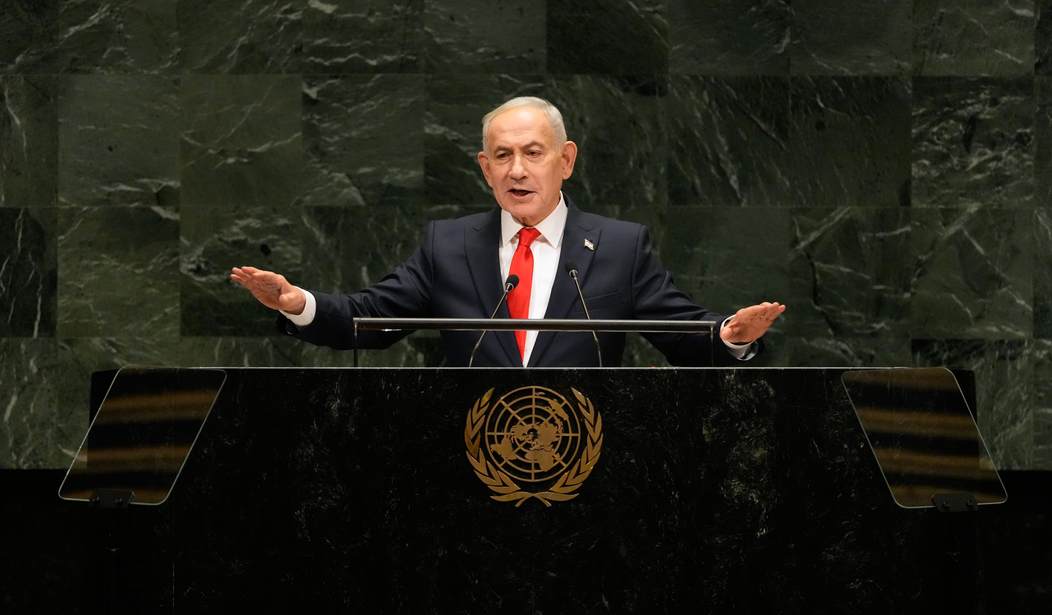
For Israeli Prime Minister Benjamin Netanyahu, Tuesday's election was a watershed. Netanyahu's coalition of religious conservative and right-wing parties got more votes than the change bloc led by former Israeli Army Chief of Staff Gadi Eisenkot.
But the 53 Knesset seats won by the Netanyahu coalition fell short of the 61 seats needed to form a government outright. Eisenkot's parties only won 48 seats.
Israeli President Isaac Herzog, tasked with choosing who will take the first shot at forming a coalition government, will almost certainly allow Eisenkot his chance. The change bloc leader has more options for success than Netanyahu, but the wily prime minister has played this game before and has been persuasive in convincing unlikely partners to join his coalition.
The Arab-Israeli parties are the wild card. They won a record 19 seats, and for the first time, they turned out in large numbers to vote. Eisenkot has promised to include only parties in his coalition that will maintain Israel's "national character" and oppose Hamas, which would appear to rule out the Arab parties; the Joint List, an ideologically diverse alliance, and Raam, a pragmatic Islamist party.
Eisenkot might try to dislodge a few of the more moderate deputies from the Arab parties, but he needs 14 of them. He's not likely to find that many Arabs willing to serve in an Israeli cabinet.
Would Eisenkot go back on that promise? If he does and fails to create a government, another election is likely by spring, at which point Netanyahu would brand him a traitor and end his political career.
Could Eisenkot tempt some of the conservative religious deputies to abandon Netanyahu?
In a potentially significant development Friday, Israeli journalist Yishai Cohen of Kikar HaShabbat reported that Rabbi Dov Lando, a leading ultra-Orthodox religious authority, had instructed lawmakers from Degel HaTorah, part of United Torah Judaism, to open discussions with the opposition.
According to the report, the objective is to reach an arrangement protecting the status of yeshiva students amid the longstanding dispute over mandatory military service.
Channel 12 reported that figures within the ultra-Orthodox party were considering allowing an Eisenkot-led minority government to survive through outside parliamentary support, potentially breaking with Netanyahu.
"Our votes are not in Netanyahu's pocket," party figures told Channel 12, according to a translation of the Hebrew-language report.
Attracting the religious parties to his coalition comes with a cost. The primary reason the religious parties are angry with Netanyahu is that he won't guarantee a draft exemption for seminary students. It's a fraught issue in Israel, as secularists strongly oppose the exemption, especially during wartime. Eisenkot risks losing support among moderates and liberals if he makes any promises to the ultra-Orthodox parties about the draft.
Netanyahu won't treat with the Arabs, and the feeling is mutual. For him to cobble together another coalition, he will need to entice defectors from some in the change bloc in order to continue serving as prime minister. This would take some powerful persuasion, since the whole point of the change bloc was to defeat Netanyahu and send him to jail or into retirement.
One source told Fox News, "Opposition leaders are approaching coalition negotiations with patience and experience rather than treating the inconclusive results as a defeat, arguing that the next government could depend on their ability to forge partnerships that previously seemed unlikely."
What might look good on paper could collapse when it came time to vote in a new government. That's why the most likely outcome, in my opinion, is another fake "unity government" where Netanyahu and Eisenkot take turns as prime minister.
A national unity government involving Likud and Yashar would offer a more straightforward mathematical route to a majority, but would require Eisenkot to reconsider his campaign pledge not to join a Netanyahu-led government.
For Netanyahu, the lengthy coalition formation process could provide additional opportunities. If Eisenkot receives the mandate to form a government but fails, President Isaac Herzog could assign the task to another candidate, potentially giving Netanyahu another chance to assemble a coalition. If successive efforts fail, Israel could face another election
Despite the obstacles, the source familiar with opposition discussions pointed to [Naftali] Bennett and [Yair] Lapid's experience navigating complex coalition negotiations as an important asset.
"They've both played this game many times. They know it, and they're not rattled," the source said, according to a translation of the Hebrew-language conversation.
Both Bennett and Lapid joined a coalition government from June 2021 to December 2022, so at least they're familiar with the mechanisms of power that would have to be shared.
If all else fails, Herzog could call for new elections. That's the least desirable outcome for Eisenkot, who would be shunted to the sidelines, allowing Netanyahu to govern until at least the spring.
Recommended: You're Not Scared Enough About the Left's Agenda If It Wins in 2026 and 2028
Editor’s Note: Every single day, here at PJ Media, we stand up and FIGHT, FIGHT, FIGHT against the radical Left and deliver the conservative reporting our readers deserve.
Help us continue to tell the truth about the Trump administration and its successes. Join PJ Media VIP and use promo code FIGHT to receive 60% off your membership.
Join the Conversation
VIP members get the ability to comment on articles.