





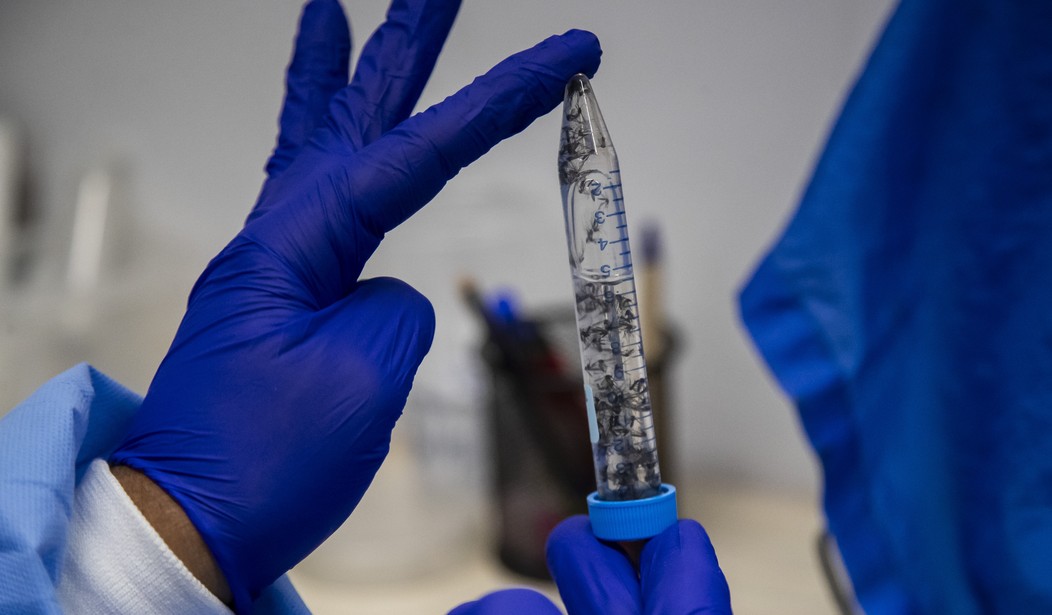
A 28-year-old woman who worked at the Russian Antiplague Scientific Research Institute in Irkutsk province, Siberia, died Friday "after contracting 'pneumonia of an unknown cause,' the region’s governor, Igor Kobzev, said Monday," according to The Wall Street Journal.
Alarm bells began to ring, and the internet speculation industrial complex went into high gear. The woman, Daria Shipilova, was described as a "lab technician." The Atlantic reports that "A local official said that the hospital where she was treated has been placed under quarantine; local media, meanwhile, reported that several hospitals were under quarantine." Axios reported that the State Department was monitoring a “suspected plague outbreak” in Russia.
Wait, what? Plague?
Russia is notoriously circumspect about its biological research. It's a hangover from the days when the Soviet Union maintained the largest stockpile of deadly pathogens on the planet.
This led to some embarrassing and deadly consequences. Often referred to as the "biological Chernobyl," the accidental release of anthrax spores in Sverdlovsk in 1979 remains the deadliest known accident in history.
Technicians at Military Compound 19 in Sverdlovsk (now Yekaterinburg) removed a clogged air filter on an exhaust pipe connected to a drying machine for anthrax spores but failed to replace it before the machine was turned back on. Spores were blown downwind into a surrounding neighborhood and ceramic factory. At least 68 to 105 civilians died of inhalational anthrax. The Soviet government initially blamed contaminated meat, but President Boris Yeltsin acknowledged the military origin in 1992.
So we can all be forgiven if we look at this latest incident from an "antiplague institute" with a somewhat jaundiced eye.
Secretary of State Marco Rubio said the U.S. is monitoring the incident. “I don’t think it’s cause for alarm, but it is cause for focus and cause to just keep an eye on it,” he said on a trip to Iceland on Monday.
What we know so far isn't that concerning. But then, neither was a few sick people in Wuhan.
The Atlantic:
Igor Kobzev, the governor of the Irkutsk region, said in a statement on Friday that other people—local media later reported the number as 200—may have been in contact with a resident who contracted an “especially dangerous infection,” and were placed under medical observation. He did not identify the resident as Shipilova or say that the person had died. The public-health agency told state media that “no micro-organisms linked to her professional activity were identified in the patient’s samples” and that no contacts have experienced “health changes related to infectious pathology.” Meanwhile, an aluminum factory in the same town as the laboratory imposed a mask mandate for its more than 2,000 employees, The Wall Street Journal reported.
The lack of Russian transparency has fed the rumor mill, and speculation is currently in overdrive. Is it really pneumonic plague? Or could it be something cooked up in a military biological lab?
"Because transmission between humans is relatively difficult, the Russian government’s response to the mystery death from pneumonia—placing 200 people under medical observation—is “really incongruent with what you would expect for plague,” Amesh Adalja, an infectious-disease physician at Johns Hopkins University, told The Atlantic's Jacqueline Munis. "Daniel Jernigan, the former director of the CDC’s National Center for Emerging and Zoonotic Infectious Diseases," told Munis, "that response was 'above and beyond' what is typically required for plague cases."
Very quickly, though, some scientists, security experts, and media outlets began speculating that whatever killed Shipilova was not traditional pneumonic plague, but a dangerous pathogen that had been somehow altered in the lab. The fear is that the pathogen could be resistant to antibiotics or other treatments, making it harder to prevent an outbreak. No evidence so far suggests that’s true or that the Irkutsk lab was modifying plague bacteria to make it more dangerous. Still, the host of unanswered questions surrounding this case has paved the way for conjectures about links to biological weapons and for conspiracy thinking about government collusion and vaccine companies set to profit off a plague pandemic.
Indeed, it's our recent experience with the pandemic that colors our attitudes toward the entire incident. We don't trust the "official" story, and for good reason. Dr. Fauci funding of "gain-of-function" research at a lab where military research was also being conducted was kept from the public and Congress for more than a year.
Despite presenting itself as a civilian institution, the Wuhan Institute of Virology (WIV) had collaborated on secret projects with the Chinese People’s Liberation Army (PLA) since at least 2017, according to a State Department fact sheet released in January 2021.
The document explicitly noted that U.S. government agencies (such as the NIH/NIAID, directed by Dr. Anthony Fauci) and other donors had funded civilian bat coronavirus research at the WIV, raising concerns that U.S. tax dollars may have overlapped with or been diverted toward Chinese military-linked research.
It's not likely that Fauci's NIAID-funded research at the Siberian lab is where the lab technician caught an unknown pathogen and died. But it's worrying that the Russians aren't being more transparent about what killed the lab tech and whether it was a pathogen found in the lab.
"The gap between what is known and what is imaginable is where speculation flourishes," writes UnHerd's Filippa Lentzos, "Covid demonstrated just how politically destructive that gap can become."
Lentzos adds:
We do not know whether Shipilova died from plague. We do not know whether she was exposed to anything at the Irkutsk institute. There is no proof that the pathogen involved was engineered, nor that this episode reveals a Russian pandemic-weapons programme. But nor should the world have to choose between taking Moscow’s assurances on trust and imagining the most frightening alternative.
What is needed now, then, is quite mundane: a clear diagnosis; an account of what Shipilova was working on; confirmation of whether a lab incident occurred; the results of testing and sequencing; and, ideally, sufficient independent scrutiny to make those findings credible. Essentially, we need informed transparency.
"Transparency" of any kind would be welcome by all.
Editor's Note: The Democrat Party has never been less popular as voters reject its globalist agenda.
Help us continue exposing Democrats' plans to lead America down a dangerous path. Join PJ Media VIP and use promo code FIGHT to receive 60% off your membership.



Join the Conversation
VIP members get the ability to comment on articles.