It's one of the great mysteries of science. Modern humans have been walking the Earth for 250,000 to 300,000 years. But it wasn't until 40,000 or 50,000 years ago that humans demonstrated remarkable cognitive and creative abilities.
The creation of cave paintings, personal ornaments (bead jewelry), animal carvings, and musical instruments (such as bone flutes) appeared "suddenly" in the fossil record. ("Suddenly" is a relative term when discussing periods measured in thousands of years.)
There was a transition from basic stone handaxes to specialized compound tools made of bone, antler, ivory, and wood, including harpoons, needles, and spear-throwers (atlatls).
The development of fully syntactic language, abstract thinking, and symbolic representation, allowing complex information and stories to be passed across generations, also emerged. This is based on tracking genetic mutations linked to speech and motor control and on understanding the symbolic nature of cave paintings and body ornamentation.
While some scientists argue that a proto-language existed much earlier, the widespread appearance of complex tools, symbolic art, and long-distance trade around 50,000 to 70,000 years ago leads many researchers to identify this period as the definitive emergence of fully syntactic, modern human language.
Was there a sudden genetic change that occurred around 50,000 years ago that rewired the brain, enabling complex language and abstract thought? Many contemporary archaeologists argue that the transition was not the result of a sudden mutation, but rather the gradual accumulation of knowledge, social connectivity, and population density reaching a critical threshold in Africa before expanding worldwide.
Or was it something else?
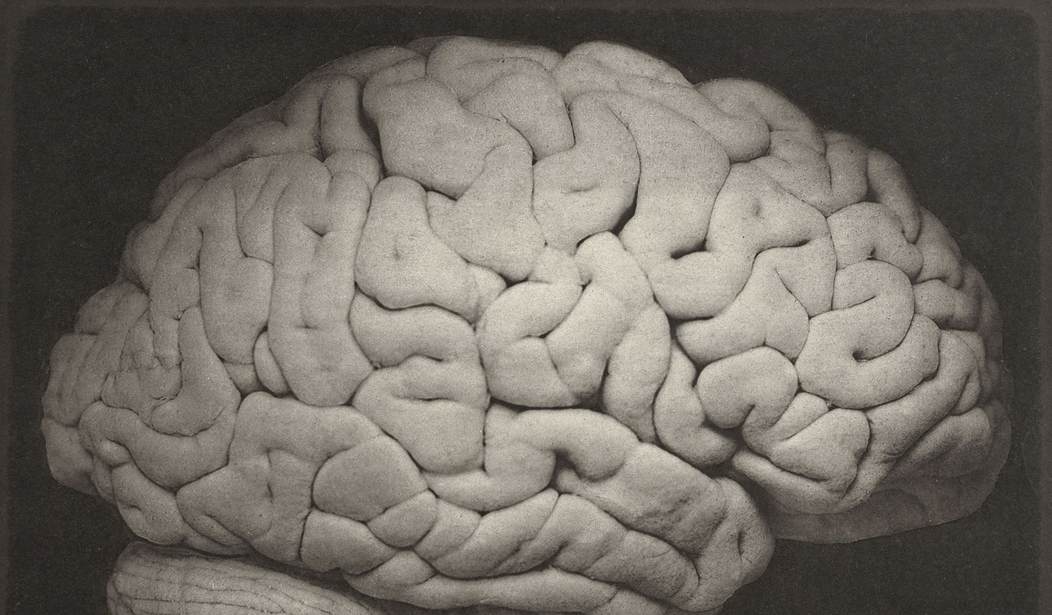
Research psychologist Robert Epstein believes that the brain is a kind of "transducer" connected to the "other side" or "another dimension" from which we receive "information that shapes our consciousness," as reported by Popular Mechanics.
It's not as radical a theory as you might think at first blush. “All the sensory organs are transducers,” says Epstein, founder and director emeritus of the American Institute for Behavioral Research and Technology. Eyes turn light into signals our brains read; ears transduce waves of air pressure; and nose receptors translate chemicals in the air.
“The only thing I’m adding to this, the only small thing I’m adding to this, is that the brain itself is a transducer making a different type of connection," Epstein claims. Connection to what?
Epstein calls it neural transduction theory, or NTT.
This is where things get a little sticky. Epstein calls it "OS," which could mean operating system or "other side," or perhaps refer to whatever happened when that Great Leap Forward in human cognition occurred 50,000 years ago.
Popular Mechanics:
But if such a connection exists, what might actually travel through it? For Epstein, perhaps information, inspiration, genius—or even the reason the human species got “uplifted” to a higher intelligence in the first place.
Here’s where Epstein invited his audience to think back in time some 50,000 years. Something strange and unprecedented happened then, he said. Anatomically modern humans had come into existence far earlier, yet for millennia they lacked the later explosion of art, language, and abstract thought, the characteristics that we associate with modern humans. Then, according to NTT, a human infant was born whose brain made not merely a transductive connection but an “optimal connection” to a higher intelligence, Epstein said—a connection that “dramatically uplifted our own intelligence.” If the trait was heritable and offered an enormous survival advantage, Epstein continued, it could have spread rapidly through the human population.
Mainstream evolutionary biology views behavioral modernity as the result of biological evolution and cultural accumulation. While that is normally the prevailing explanation, the speed of the Great Leap Forward is the variable in that theory that opens the door to NTT and other theories.
Tapping into a higher consciousness to drive humanity forward is a radical idea and may never be provable. It may be a case of squeezing facts into a preset theory, an obvious trap for many scientists.
But Epstein may have found a way to test his theory.
Epstein, who was the last doctoral student of legendary Harvard behaviorist B.F. Skinner, has tried to show just how far the idea of transducers connecting us to another realm can stretch. In an embargoed preprint 2026 paper written with Liancheng Zhao, then a research intern at Epstein’s behavioral research and technology institute in California, the pair developed what they call the Epstein-Zhao diagrams: simple sketches depicting hypothetical channels between the brain and the OS. By varying a few properties—whether information travels toward or away from the brain, the “bandwidth” of the connection, its distortion, or whether the connection is broken—the diagrams propose NTT explanations for phenomena that otherwise seem to have little in common.
Their list ranges from ordinary consciousness, dreams, unconsciousness, genius, schizophrenia, and intrusive thoughts—and onward into far more controversial territory, including telepathy, past-life memories, terminal lucidity, and communication with the dead. The list was approaching 90 different phenomena as of July.
Finding an explanation for all those phenomena using NTT or any single theory of consciousness doesn't track. The Great Leap Forward was about expanding our cognitive abilities. It's just too much of a stretch to believe in contact between our brains and some sort of portal that gave us the ability to see past lives or communicate with the dead.
I try to keep an open mind about a lot of things. Telepathy is possible in a small number of humans. Communicating with the dead? No thanks. What if they tell us it sucks to be dead? The point is, opening our minds to possibilities is always a good thing. Consider them, examine them, use critical thinking skills to determine their validity, and discard them if they don't make sense.
Whether our brains are self-contained biocomputers or transductive receivers, the Great Leap Forward transformed our species from simple survivalists into artists, storytellers, and dreamers. And if Epstein is right, we might not just be living in this universe—we might be broadcasting from another one entirely.