





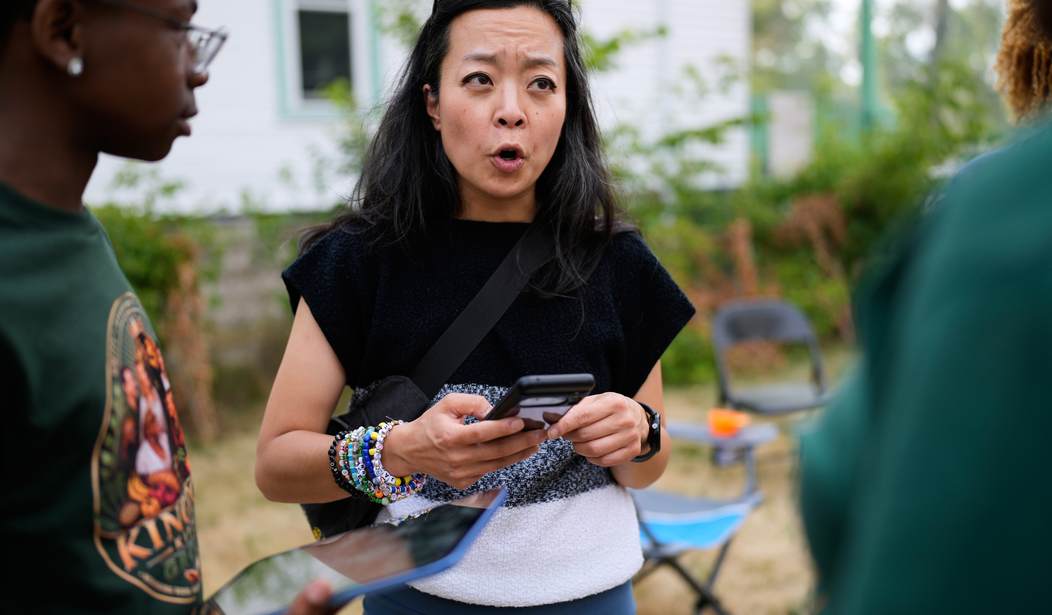
On Tuesday afternoon, I posted an article about the Wisconsin Democratic primary and how the almost certain winner, state senator Francesca Hong, could help the GOP define the midterms as a choice between "common sense and crazy."
When I wrote that article, Hong was ahead by 20+ points in some polls. The Marquette University Law School poll, one of the most respected and historically accurate pollsters, performed a final survey of Wisconsin voters July 22-27, and Francesca Hong received 38%, while Milwaukee County executive David Crowley received 7%.
On election day, Hong got 39.3% of the vote. But Crowley received 39.8% to win the nomination. What happened?
Polling in general has been in disrepute ever since 2016, when pollsters missed the final wave of support for Donald Trump in the last 72 hours of the race from unpolled Trump supporters.
It had nothing to do with bias. It was a massive methodological error. The pollsters' turnout models were off by a wide margin. Trump voters were a new phenomenon, and pollsters were asking both the wrong questions and talking to the wrong people.
The Wisconsin Democratic governors' race as well as the Michigan Democratic Senate contest, where Abdul El-Sayed vastly underperformed, making it a far closer race than any of the polls suggested, demonstrated polling's ongoing problems with trying to model a dynamic electorate.
Crowley had actually dropped out of the race in July, only to re-enter the race nine days later after Lt. Gov. Sara Rodriguez ended her campaign. That was an "X" factor that pollsters wrestled with until the race was over.
The Marquette poll was within the margin of error for Hong's support. But the poll also showed that 34% of voters were undecided, an unusually high number. Older voters were both the least supportive of Hong and the most undecided age group.
“It is well known that voters in Wisconsin tend to make up their minds, tend to start paying attention to primary elections pretty late in the game,” said Anthony Chergosky, an associate professor of political science at the University of Wisconsin-La Crosse.
The poll's turnout model also got it wrong. The pollsters believed younger voters would turn out in far greater numbers than they did. Instead, the turnout was typical of a Wisconsin primary, where voters tended to be older.
"Another unusual aspect of the race was the very late endorsement of Crowley by Gov. Tony Evers, says the Marquette pollster in an interesting post-mortem. "In our final poll, more than one-third (36%) of Democratic primary voters said that this endorsement made them more likely to support Crowley." Evers had a sky-high approval rating of 85% among Wisconsin Democrats.
Even after an internal poll found that Mr. Crowley was trailing Ms. Hong last week, his campaign manager predicted that polls would not reflect the primary results.
In a memo to supporters on Aug. 5 obtained by The New York Times, the campaign manager, Garren Randolph, argued that Wisconsin surveys overrepresented voters between the ages of 18 and 45. In some cases, polls expected twice as many young voters as actually showed up to vote in 2018 and 2022. Ms. Hong was strongest among young voters, according to the internal poll.
Across elections, primary voters tend to be older, and Wisconsin is no exception. Older voters and moderates were also more likely to remain undecided until close to the end, Mr. Franklin said, based on his polling data.
"Pollsters have long grappled with what is known as nonresponse bias, where certain voters may be more likely — or less likely — to respond to a poll," writes the Times. A similar phenomenon was probably at work in Michigan, said Adam Carlson, a Democratic pollster, who speculated that the “main driving factor” behind the polling miss was "selective responsiveness of voters."
“El-Sayed’s supporters were more fired up and willing to take polls down the stretch, but more enthusiasm does not necessarily equal more votes,” Mr. Carlson, the founding partner of Zenith Research, wrote in a post-mortem analysis on Monday.
The pollsters were spot on in estimating Hong's support, and certainly didn't overestimate her supporters' enthusiasm. What they missed was the surge of undecided voters moving strongly to Crowley. Like Trump in 2016, the DSA is a new phenomenon, and pollsters will have to figure out how to measure races where radicals are running more accurately.
Related: Mamdani Burns Through New Yorkers' Goodwill as the Grim Realities of Governance Hit
Editor’s Note: Every single day, here at PJ Media, we will stand up and FIGHT, FIGHT, FIGHT against the radical Left and deliver the conservative reporting our readers deserve.
Help us continue to tell the truth about the Trump administration and its successes. Join PJ Media VIP and use promo code FIGHT to receive 60% off your membership.
Join the Conversation
VIP members get the ability to comment on articles.