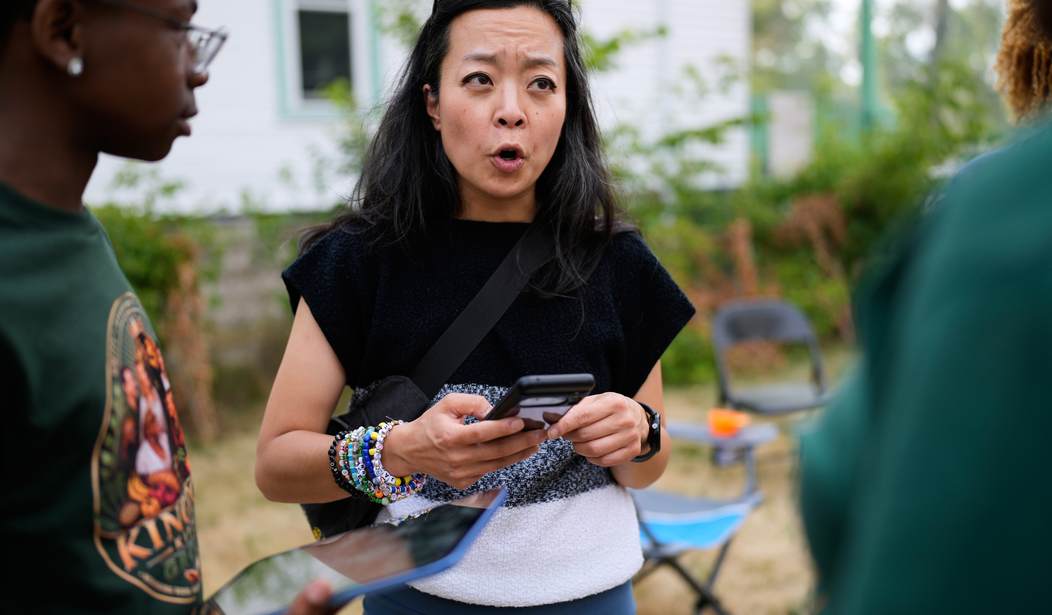
Everyone thought that Wisconsin's Democrat primary for governor was going to be a coronation for Democratic Socialist Francesca Hong. Every poll leading into Tuesday’s vote had her cruising to victory over Milwaukee County Executive David Crowley (D-Wis.) by roughly 20 points. One survey, released just days before the election, had Hong at 46% support to Crowley's 23%.
Then the actual voters showed up.
Crowley won. He beat Hong by about 3,000 votes, a true nailbiter. And to her credit, Hong, surprisingly, conceded without dragging her party through a bitter recount fight. Crowley now heads to the November general election to face Rep. Tom Tiffany (R-Wis.).
Was the fix in? I'm not ready to rule out shenanigans by a party establishment that clearly did not want a Democratic Socialist bound to lose the general election as its gubernatorial nominee. But there is another possibility worth entertaining, and worse for Democrats: their base isn't as fired up as the polls think it is.
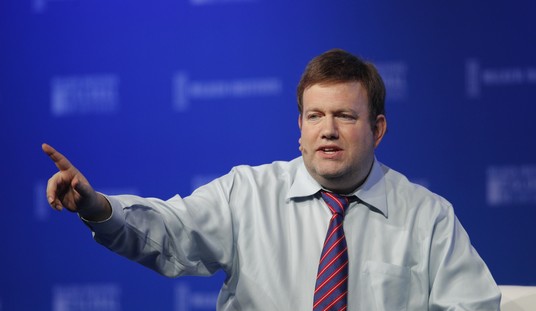
One could say the polling was just wrong, and that would be an understatement. For sure, there are plenty of experts weighing in and the verdict on polling isn’t good. Election analyst Larry Sabato was among the first to question the accuracy of primary polling after the Wisconsin result, and pollster Frank Luntz said he agreed with him. Not everyone is convinced this was a fluke, though. Echelon Insights pollster Patrick Ruffini pushed back on the doom-and-gloom read, arguing that primary polling is a tough nut to crack. “The election was polarized for and against her and polls are still a crude measure for consolidation, which only happens at the very end," Ruffini said.
ICYMI: Election Night Chaos in Wisconsin Raises Some Uncomfortable F-Word Questions
Maybe. But CNN data analyst Harry Enten has a different, and more interesting, theory: the polls simply had too many young voters in their models.
"You kind of look at the polling, you go, ‘Hey, wait a minute, maybe these polls had too many younger folks in them,'" Enten said on CNN. "You've got to look at these results and say, ‘Hey, wait a minute, maybe, Johnny, maybe these polls are overestimating how much that Democratic Socialism is rising within the Democratic Party,' because in two key statewide races in a row, what we've seen is the lefties being vastly overestimated. And in the case of Wisconsin, the Democratic socialists being vastly overestimated by 20 points."
I don't buy Enten's underlying premise that Democratic Socialism's rise within the party is being overestimated. Look at the races nationwide where socialist candidates are winning. The socialist wing of the party is rising and gaining power. But Enten is onto something when he points to the possibility that young voters are being oversampled, and that detail should worry Democrat strategists far more than it seems to right now.
Young voters who actually show up for a primary tend to be the most politically engaged people in their age bracket, the ones most likely to also show up in November. If they were largely absent from the real Wisconsin electorate despite pollsters assuming they'd turn out, that's an enthusiasm problem behind the modeling problem.
Democrats are counting on young, left-wing voters to carry them through the midterms. If pollsters keep building models around a level of youth engagement that isn't actually showing up on Election Day, general election polling could be systematically overstating Democrat support all the way into November.