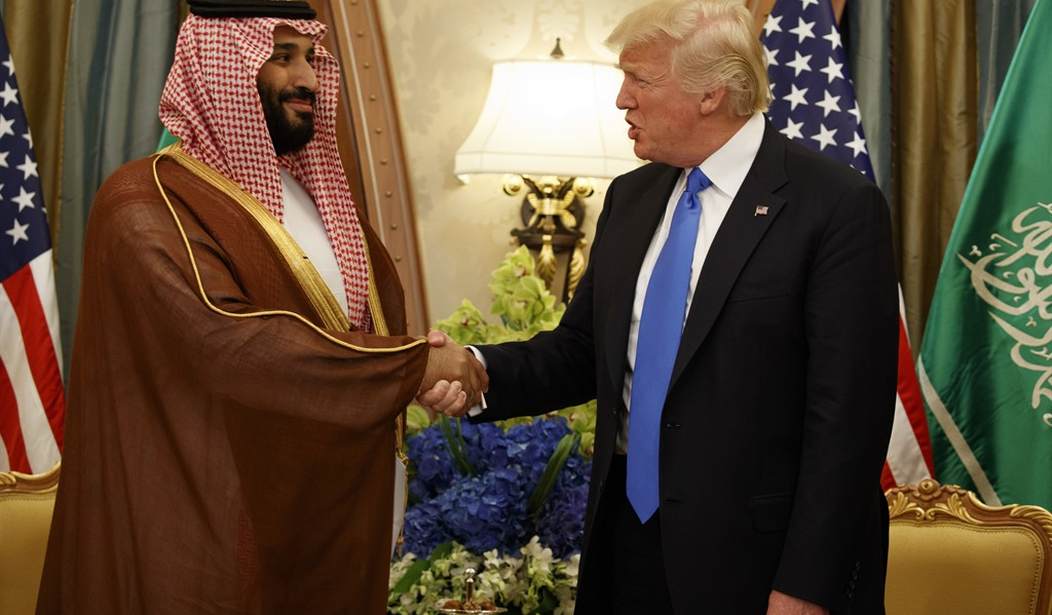

The U.S. and Saudi Arabia will sign a historic agreement that would allow American companies to build and operate nuclear power plants in the Kingdom and give the Saudis permission to run their own nuclear fuel manufacturing plant.
Negotiations for the deal began under the Biden administration but were halted after the October 7 attacks on Israel.
Prospects in Congress are iffy. Ever since the murder of Jamal Khashoggi, a Washington Post columnist who was assassinated inside the Saudi consulate in Istanbul in October 2018, Democrats have been especially cool toward our relations with Crown Prince Mohammed bin Salman (MBS), the Kingdom's prime minister and day-to-day de facto ruler.
Donald Trump has been looking to bring Saudi Arabia into a regional alliance aimed at curbing Iran's appetite for mischief for years. The stumbling block has always been Israel. But the Abraham Accords and a dose of realpolitik regarding Iran's ability to enrich uranium to 60% forced a reassessment by MBS about its attitude toward Jerusalem.
The 2020 Abraham Accords established a blueprint for Gulf-Israeli security cooperation. Concurrently, Iran's escalation of uranium enrichment toward 60% (nearing the 90% weapons-grade threshold) heightened security urgency in Riyadh, driving MBS to pursue closer security alignment and nuclear assurances with Washington and informal ties with Jerusalem.
Allowing Saudi Arabia to enrich its own uranium might be a sticking point for many in Congress. And the lack of a formal inspection regime by international bodies like the IAEA could also be a problem.
Before uranium enrichment could begin, a joint US-Saudi team would explore whether it is warranted and commercially viable, and Americans would build the facility without transferring the sensitive technology to Saudi Arabia.
The deal otherwise bars Riyadh from developing its own enrichment technology or purchasing it from other countries for a decade, according to the Wall Street Journal, which first reported the deal’s approval.
The agreement includes limits on what inspections might be carried out on the Saudi program, according to the officials and sources, which may draw skepticism from lawmakers.
The kingdom is notably not required to sign a standard agreement called the Additional Protocol with the International Atomic Energy Agency, like the United Arab Emirates did in 2009 when it signed a “gold standard” nuclear cooperation deal with the US, an official said. The Saudis long balked at signing the protocol over concerns that it could theoretically allow inspectors to enter the holy city of Mecca or royal palaces.
MBS has pledged to pursue a nuclear weapon if Iran ever builds one. Since Iran is now much farther away from achieving that goal, it shouldn't be a huge problem for Congress.
Non-proliferation advocates are another story.
“A bad U.S. nuclear deal with Saudi Arabia is coming for congressional review — inexplicably, carried over from the Biden administration,” wrote Andrea Stricker, a nonproliferation scholar at the Foundation for Defense of Democracies, a national security think tank.
“Congress should block it. If it does not, one hopes the policy will be reversed by a subsequent administration before too much damage is done in terms of watering down safeguards, setting negative precedents for other states, and failing to contain the spread of enrichment and reprocessing — which we just put back in the box in Iran via force.”
Saudi Arabia is a dictatorship, ruled by a strongman (MBS). Very little real power is vested anywhere in the Kingdom outside of the Royal Family. It should be remembered that factions inside the Royal Family aided Osama Bin Laden and helped finance the attacks on America on 9/11.
How stable are they? Is it prudent to assist a state that could potentially be overthrown by Islamists? I'm sure Congress is going to want answers to those questions and many more.