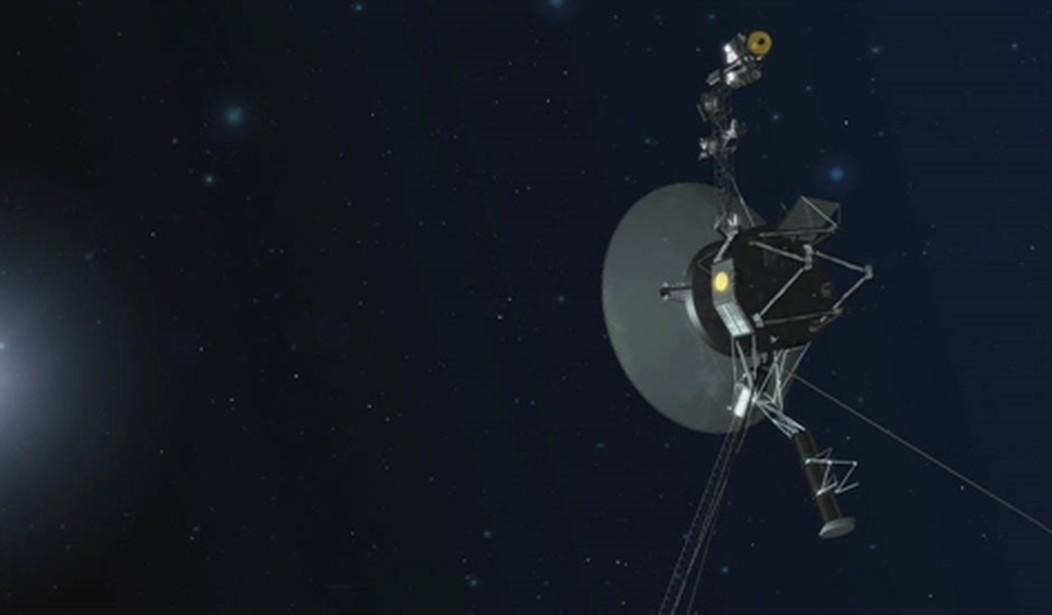

The Voyager 1 spacecraft launched from Cape Canaveral on Sept. 5, 1977, on a first-of-its-kind mission to explore the outer planets of Jupiter, Saturn, Uranus, and Neptune. Its twin, Voyager 2, was launched a few weeks earlier on Aug. 20. Voyager 1 was on a faster trajectory, allowing it to reach Jupiter and Saturn ahead of its twin.
The missions were designed to last only four and a half years, according to NASA. They said something similar about the Mars rover Curiosity, which was launched in 2011 and was only supposed to work for two years. It's still going strong.
As are both Voyager spacecraft. For 49 years, both crafts have gone through storms of charged particles, been blasted by the tiny dust particles found in the rings of Saturn, and been exposed to the massive radiation near Jupiter. That they're still alive and sending their observations back to Earth is surely one of the most amazing technological feats in human history.
NASA likes to maintain the myth that they perform tech wizardry with less and is a careful steward of taxpayer money. In this case, they have been proven right.
The Voyager 1 is now 15.7 billion miles from Earth. That we're able to maintain a tenuous contact with the tiny craft is a minor miracle. Voyager's radioisotope thermoelectric batteries (a tiny pellet of plutonium that decays and generates electricity) have been powering the spacecraft and will continue until perhaps 2030.
To extend the life of those batteries, NASA has been gradually shutting down instruments and experiments since the 1990s.
"Engineers at NASA’s Jet Propulsion Laboratory (JPL) in Southern California sent commands Friday to turn off Voyager 1’s Low-Energy Charged Particles (LECP) experiment, a long-running instrument that has operated almost continuously since the spacecraft launched," reports Fox News. It was another nail in the coffin for Voyager 1 as NASA oversees the slow, gentle death of the most extraordinary probe humans have sent into outer space.
Through the Voyagers, we learned of Jupiter’s turbulent atmosphere, the tilted magnetic field of Uranus, a rotating storm on Neptune called the Great Dark Spot, and Saturn’s dynamic rings. We also discovered 23 new moons of the outer planets and found that these moons were not the dead, frozen worlds scientists had suspected. Saturn’s moons appeared to be composed mostly of water ice, while active volcanoes on Jupiter’s moon Io spewed lava dozens of miles high. Eventually, the two spacecraft would explore not just the four giant planets, but 48 of their moons, as well as the rings, atmospheres, and magnetic fields those planets possess.
Once the Voyagers’ tour of the four planets was complete in 1990, the world’s attention faded; but the probes continued to provide remarkable insights into the dynamics of the solar system, including ultraviolet sources among the stars and the boundary between the sun's influence and interstellar space. Even today, both probes continue sending back data about the interstellar medium, the space between the stars, says Linda Spilker, NASA’s project scientist for the Voyager missions—including precise measurements of the density and temperature of the thin ionized gases it contains and the incidence of high-energy cosmic rays.
Some other notable and incredible discoveries by Voyager during its mission.
* Voyager provided the first close-up hints that Jupiter's moon Europa has a fractured, icy surface. These images led scientists to hypothesize that a liquid water ocean exists beneath the ice, making Europa one of the most likely places to search for extraterrestrial life today.
* While we knew Saturn had rings, the Voyagers discovered they were far more intricate than imagined. The probes found "spokes" in the rings, braided structures, and "shepherd moons" like Prometheus and Pandora that use their gravity to keep the ring particles in place.
* Both probes have now passed the heliopause—the boundary where the sun's solar wind meets the interstellar medium. This has allowed humanity to measure the density of ionized gases and high-energy cosmic rays in interstellar space for the first time.
There are already plans to send an unmanned probe to land on Europa and drill through the ice to reach the ocean beneath. This is a long-term project since more detailed surveys need to be performed to find out how deep the drill would have to go to reach liquid water and whether a landing on the craggy, shifting surface can even be attempted.
Until then, we've got a probe already on the way to Europa to carry out the first surveys. Europa Clipper was launched in late 2024. It's a sophisticated orbiter designed to perform nearly 50 close flybys of Europa. It will use ice-penetrating radar to determine the thickness of the ice shell and search for water plumes erupting from the subsurface. This data is a mandatory prerequisite for any future landing attempt. Those ice plumes were detected by the Hubble telescope and confirmed by the Galileo spacecraft during a flyby of Europa in 1997.
The "Age of Discovery" has had no greater hero than the Voyager spacecraft. Some day soon, they will cease broadcasting their observations and slip into darkness. But their mission may not be over. Both Voyager 1 and 2 are carrying gold phonograph records that would give an extraterrestrial a small idea of who made this ingenious probe.
It may not be the smartest thing that Carl Sagan and NASA ever did. Giving a roadmap to our home to an alien species bent on conquest would turn out to be the end of humanity.
But the impulse that created that record and hurled it out into the interstellar void was quintessentially human. That would tell any alien, friend or foe, what kind of species we are.