
I can count on one hand and still have one finger to spare how many times I went to a movie theater with my dad, and three of those times were on vacations before I was ten years old. The fourth time was one where my dad asked me several times if I wanted to see one particular movie with him. The movie was Saving Private Ryan, starring Tom Hanks and “an all-star cast.” Steven Spielberg was the director.
My dad and five of his brothers all served in World War II. He served in the Pacific, landing on islands to build runways posthaste as hostilities were winding down, but not over. In other words, he saw a lot, and some of it he never talked about. Ever.
His closest brother, my uncle Francis “Fats” O’Brien, landed on Omaha beach on D-Day. He was an infantryman who fought his way through Europe with one pause in the Battle of the Bulge, where he was wounded so badly, his own division left him for dead and advancing German troops passed over him.
Amazingly, he recovered and returned to the front with his unit, and he completed his service in Austria at war's end.
What little he said about his wartime experiences, he said to my dad, his brothers, and a couple of us nephews. I learned to fill in the blanks with his gaps of silence when he’d talk about it. To me, the silence meant death or some horrific injury. I just never could tell who died or who did the killing. But it was a very somber silence, usually followed by a change of subject.
So when I took my dad to the cineplex to see Spielberg’s instant classic, my dad, who was always talkative, was particularly chatty. He was very upbeat and as happy as I was for the two of us to actually go out to see a movie together. It doesn’t matter how old you are. It’s special. If you still have your dad, you should do it. Sooner rather than later.
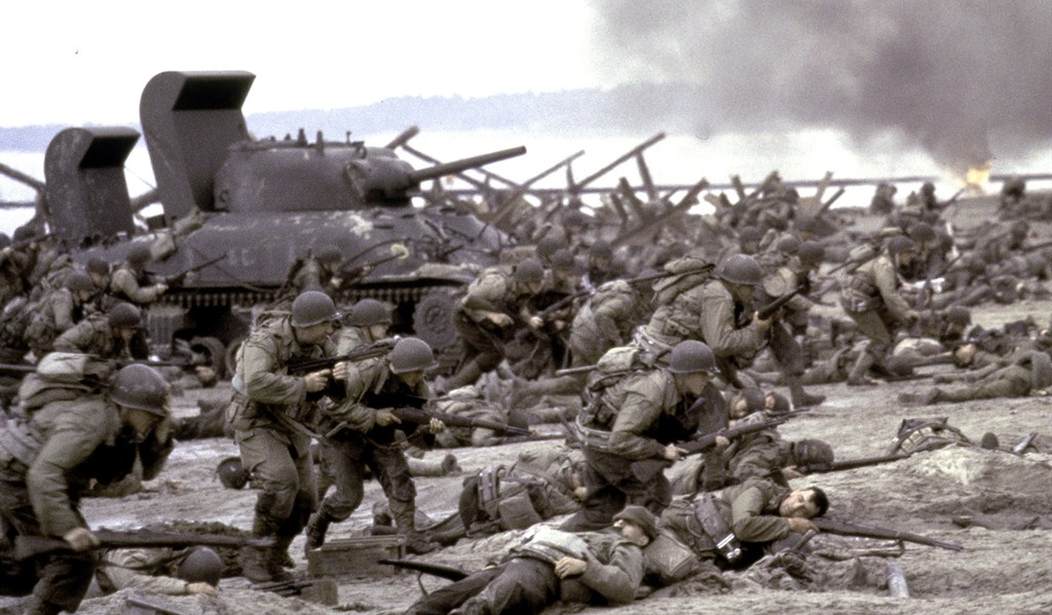
As hyped as the movie was, there is one thing we weren’t ready for, and that was the opening sequence. It’s 24 minutes long, and it takes you into the war with the same subtlety as a howitzer, and it only gets more intense from there.
Whatever mood you were in before the start of the movie, by the end of those 24 minutes, you’re now in the movie, and there’s no turning back.
The 23-minute D-Day landing in Saving Private Ryan (1998) cost $12 million, about a fifth of the film’s budget. Filmed over a month with 1,500 actors and 400 crew, it remains one of cinema’s most intense sequences.
— cinesthetic. (@TheCinesthetic) November 18, 2025
pic.twitter.com/FSi2s2n9bM
As you’d expect, the movie was one for the ages, as movies go. Great cinematography, great writing, great directing, great acting. But none of that gets at the experience of watching it for the first time with your dad who was in that war. None of it can come up to the weight of feeling the impact as a viewer, and then to look to your right and see its impact on the man who raised you.
After the movie, my dad’s mood had changed. No more talking. No talking at all. I asked him if he wanted to go to Chi Chi’s, and he said yes, out of some sort of compulsion. I still hadn’t grasped how the movie may have affected him as something more than a movie. That was until we sat down in our booth.
I ordered an appetizer, and we both ordered beers. When the order came, he didn’t touch it. Not one bite. Not one sip. He didn’t talk. He didn’t try to talk.
I thought I could find the right thing to talk about to get whatever was on his mind off his mind. I tried talking about baseball, football, his grandkids, all topics that never failed to get him animated. None of it worked.
He mentioned something about his brother Fats. It was so innocuous, I honestly can’t remember what it was. Looking back, the one thing it told me was that in watching that opening scene, his mind was with his late brother who actually lived that.
I wasn’t even halfway done with a beer before my dad as politely and respectfully asked me if I was done. I got the message, and so we left the restaurant in silence. When I took him back to his and my mother’s place we were largely quiet and the gravity of that opening scene was starting to hit me in a sort of delayed reaction. It was the same feeling you get when you’ve just left the funeral of someone who died too soon.
We never talked about the movie after that, because as slow as I was on the uptake, it was all pretty clear to me quickly after that. My dad had known what his brother went through on Omaha Beach and in Europe before this movie, but the way it was filmed, it brought it all back to him. At the same time, I think he was realizing more deeply for the first time what his brother had more fully experienced. I think he needed to talk to his brother at that moment, and that was impossible.
Not mention that my dad had his own point of reference on this. He knew firsthand what a beach full of dead soldiers looked like, smelt like, and felt like. He knew the smells of diesel, and burning oil, and death. He knew what it was like to find himself in the middle of crossfire, and to have to “hit the deck” when least expected.
When we left that movie theater, all of this was swirling around in my dad’s head, reminding him that this wasn’t a movie. It was real, and he knew it.
Movies are supposed to be entertaining. War movies are designed to try to take someone who’s never experienced the heat of battle and make them feel as if they’ve been there. And then 90 minutes or two hours later, it’s back to real life. Except for my dad, that movie was real life, for him and his brothers. This movie was no escape for him. It was the opposite. That opening scene took him back to a time and place that only he knew, and one he had spent his whole life to that point working to put behind him.
If you’re wondering how real that opening scene to Saving Private Ryan was, it was that real.