
In 1983, Michael Barkun, a professor at Syracuse University, pointed to the rise of a “New Apocalypticism” in America. He described "a secular variant of religious millenarianism," according to Roger Pielke, a leading climate change skeptic for two decades.
The "New Apocalypticism" is as religious as other Protestant millenarian traditions. But the newer version, writes Barkun, is secular rather than religious.
"This second variety grows out of a naturalistic world view, indebted to science and to social criticism rather than to theology," Barkun wrote in 1983. "Many of its authors are academics, the works themselves directed at a lay audience of influential persons — government officials, business leaders, and journalists — presumed to have the power to intervene in order to avert planetary catastrophe.”
Pielke is a different kind of skeptic in that he accepts the Intergovernmental Panel on Climate Change (IPCC) view of the underlying science of climate change, stating, "The IPCC has concluded that greenhouse gas emissions resulting from human activity are an important driver of changes in climate." On that basis, he believes it is sound policy to take action to limit greenhouse gases.
But Pielke is considered a "climate denier" because he refuses to state his belief in reducing emissions, which would supposedly save the world from disaster. He is also one of the few scientists who actually takes the time to point to the outright lies and exaggerations of climate fanatics.
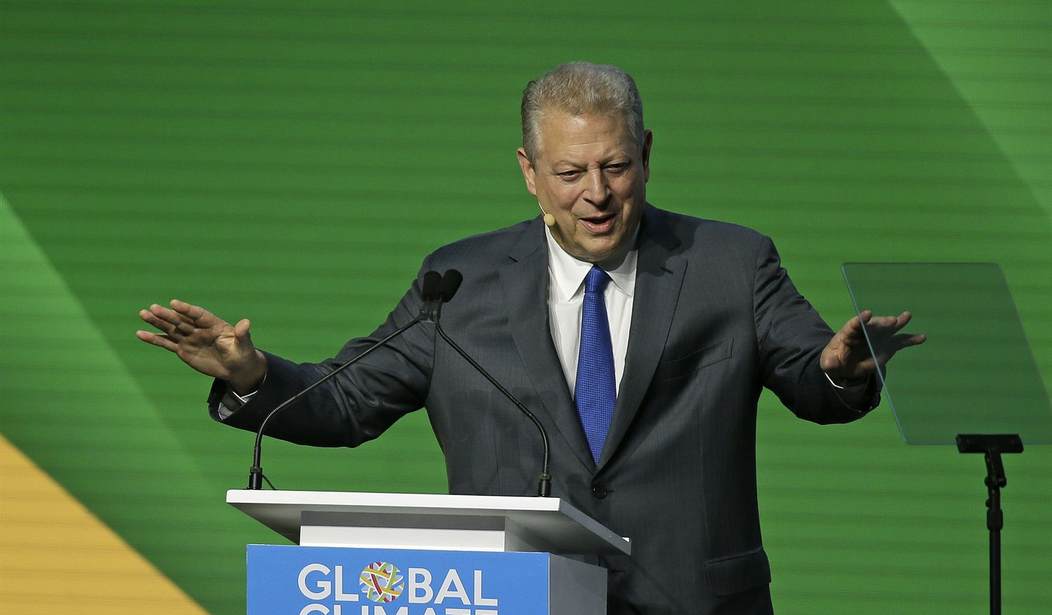
Pielke marks the beginning of the radical politicization of science in 2009, when Al Gore addressed the American Association for the Advancement of Science (AAAS). Gore told the assembled scientists, belonging to the largest association of scientists in the country, that they could no longer “in good conscience accept this division between the work you do and the civilization in which you live.”
“Leave this city after this meeting and start getting involved in politics. Keep your day job, but start getting involved in this historic debate. We need you," Gore said to rapturous applause.
Gore’s orations perfectly followed the script of the “New Apocalypticism”: The identification of an existential crisis, the diagnosis of human sin as its cause, the urgency of transformation, and the comfort of redemption for those who heed the warning," writes Pielke. "The climate science community readily embraced this script and adopted the language of believers and deniers to differentiate those with faith and those yet to be converted, and who risked excommunication."
Sound familiar?
Gore was an extraordinarily skilled evangelist and he took his message to scientists on their own terms — with a PowerPoint presentation.
But even so, An Inconvenient Truth was not really about science; it was a sermon — complete with a moral arc (with those who are evil and those who are righteous), a clear account of sin (fossil fuel emissions), a warning of coming judgment (floods, storms, tipping points), and a path to redemption (political will, renewable energy, personal responsibility). The film ends with a call to conversion.
Gore was part of a broader trend in which leaders of the scientific community were increasingly associating themselves with Democratic politics. When he stepped onto the stage in Chicago, he was already a liberal cause célèbre — and he knew exactly the choir he had assembled before him.
Gore got some things right. His claim that rising CO2 levels are warming the planet has been proved. How warm it will get, how much of an impact fossil fuels are having on the rising temperatures, and any timeline for the "point of no return" (if there is one) have all yet to be determined.
Gore was also correct about summer Arctic ice retreating (the permanent ice cap remains stable), and the retreat of mountain glaciers has been well documented. But Gore also got many predictions in An Inconvenient Truth spectacularly wrong.
On hurricanes, Gore tried scare tactics, taking the particularly active 2005 hurricane season as a warning for the future. "Ironically, for more than a decade after AIT was released, not a single major hurricane made landfall on the continental United States," writes Pielke.
Gore also claimed that melting ice sheets could produce twenty feet of sea level rise “in the near future." The former vice president dramatically illustrated his prediction with drawings of Florida being virtually underwater. "Gore’s claims departed significantly from the IPCC then and now, without acknowledging that he was advancing fringe views," says Pielke.
Gore's thesis has not stood the test of time," claims Pielke.
We are not on the brink of apocalypse. The world has continued to warm, due to accumulating carbon dioxide emissions. Of course, catastrophists are still with us, and surely always will be, but research has not supported the claims that humanity faces an existential threat. Most significantly, the most extreme climate scenarios that have dominated climate science and policy are not plausible. As a consequence, estimates of 2100 warming under “current policies” have declined from ~4°C to ~2.5°C. No one need take that from me, take it from the IPCC and UN FCCC.
No one is bothering to tell school kids, their teachers, or idiot Democratic politicians of this. It might spoil their apocalypse party.
Most types of extreme weather have not become worse. Floods, drought (hydrological and meteorological), tropical cyclones, and tornadoes have not had detectible changes according to the IPCC's Sixth Assessment Report.
This is not some climate skeptic. This is the IPCC, the foremost scientific authority on the subject. So they tell us.
When the climate science community chose to organize itself as a political movement behind a charismatic preacher, that helped turn many institutions of climate science into what Barkun described as part of the “New Apocalypticism” — a secular eschatology, in which science exists not to advance understandings in all of their complexities, but instead to confirm Manichean belief," writes Pielke.
More than any other scientific issue that has crossed into politics, nothing has done more damage to scientific credibility than the climate change scare. For that, Al Gore should receive the disapproval of history.
Perhaps someday.
Related: Former Climate Activist Perfectly Explains Why Net-Zero Leads to Disaster