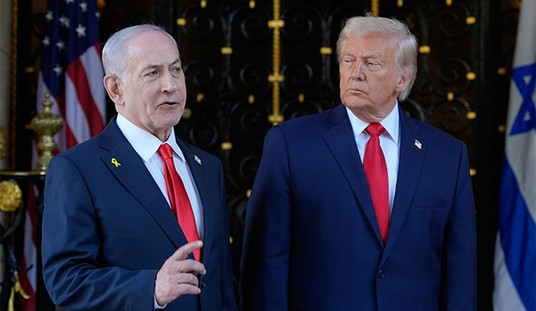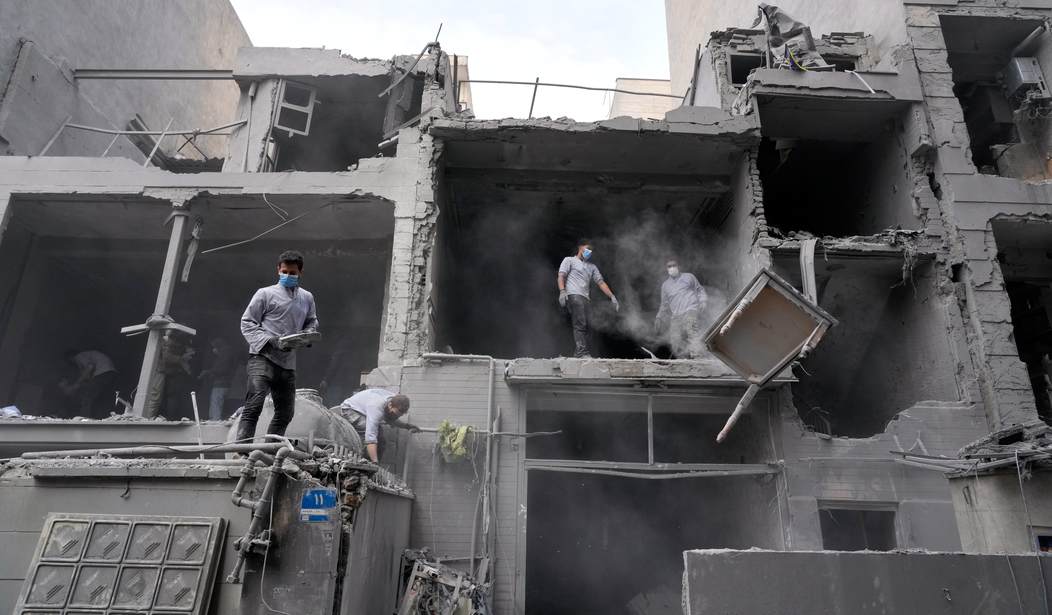

"President Trump hasn't spelled out how he wants the Iran war to end," sniffed NPR on March 6. NPR apparently hasn't read the White House statement issued five days before, where Donald Trump described "Operation Epic Fury" as "a precise, overwhelming military campaign to eliminate the imminent nuclear threat posed by the Iranian regime, destroy its ballistic missile arsenal, degrade its proxy terror networks, and cripple its naval forces." Later, the president added that the war was to "create the conditions" for regime change.
But NPR and the rest of the mainstream media ignored that statement, because if they acknowledged it, they wouldn't be able to play their "Trump has no endgame" game. It's a silly game played by silly people who aren't serious about anything, except their effort to destroy Donald Trump.
Trump sounds a lot more optimistic about ending the war. On Monday, he claimed there were back-channel negotiations involving the U.S. and Iran through several intermediaries. “Based on the tenor and tone of these in-depth, detailed and constructive conversations,” which Trump said would continue “throughout the week,” he has “instructed the Department of War to postpone any and all military strikes against Iranian power plants and energy infrastructure for a five-day period,” he wrote on Truth Social.
Iran denied that any talks were going on at all.
A senior Iranian official said that Iran "will continue to defend itself until we achieve the necessary deterrence.”
“There has not been and is not any negotiation underway, and with this type of psychological warfare, neither will the Strait of Hormuz return to its pre-war conditions, nor will there be peace in the energy markets,” the official said.
The U.S. and Israel are still at least a couple of weeks away from destroying Iran's nuclear and ballistic missile threats. Iranian proxies Hezbollah, the Houthis, Hamas, and other terrorist groups may survive, but their funding will have been cut off. And Iran's navy has been destroyed since the first few days of the war.
Conditions for regime change are something that only the Iranian people can judge. The U.S. and Israel have destroyed and will continue to destroy the means by which the Iranian regime can oppress and terrorize its people.
Of course, the media will paint the war as a failure even if Iran surrenders, so we must look to other, more objective metrics to judge the efficacy of our efforts.
According to the president, that would mean Tehran abandoning its nuclear program entirely, including handing over enriched uranium stockpiles that could be used in weapons development, and stepping back from destabilizing actions such as disrupting shipping through the Strait of Hormuz. In return, the United States would halt its military campaign, ease immediate pressure, and potentially move toward a broader diplomatic settlement that stabilizes the region.
There are signs Washington believes this scenario is achievable. Trump has delayed planned strikes on Iranian power plants, creating a narrow window for diplomacy, and says senior advisers, including Jared Kushner and Steve Witkoff, are leading talks behind the scenes. Regional powers such as Turkey and Egypt have also stepped in, suggesting early-stage mediation efforts are underway.
At this point, this would be the best-case scenario. Perhaps getting some assurances about the Strait of Hormuz would be a bonus, but given our overwhelming military success, this outcome is not only optimal, but also probable.
Another possible scenario is one that would be far more likely if a Democrat such as Joe Biden or Barack Obama were president.
"In this version, Iran signals openness or engages indirectly, while avoiding any real concessions on its core positions," says Newsweek. "Talks may be hinted at, mediated through third parties, or conducted behind the scenes, but without producing a binding agreement."
Trump isn't likely to have the patience to allow Iran to play this kind of game. In fact, if Iran tries to stall in any way, Trump will lower the boom on Iran's power grid, take Kharg Island, and continue to degrade the Basij and Revolutionary Guard capabilities to oppress the Iranian people.
Finally, an outcome that Newsweek thinks is "most likely."
"[T]he war gradually winds down without a formal agreement," goes this scenario. "The U.S. reduces its military activity, Iran eases pressure on key shipping routes, and both sides step back from escalation without resolving the core dispute over nuclear capabilities."
In other words, victory for Iran. The regime is still in power, they get to keep whatever is left of their nuclear and ballistic missile programs, and their proxies and allies across the Middle East give praise to Allah for Iran's glorious victory.
That's not going to happen, of course. But it's telling that Newsweek and most of the mainstream media would rather see Iran's nuclear and ballistic missile programs survive to threaten Israel, and eventually the United States, than to see that threat eliminated.
As long as it's Donald Trump who is blamed for the debacle, it's fine with them.