Iran is in a deep, existential crisis. Everyone agrees with that statement.
It's actually more dire than most of us believed, including me. I was firmly in the "no possibility for regime change" camp. Originally, I believed that the U.S. was operating under the assumption that the regime was close to collapse. "While Iran has most of the guns, the regime is rotting from the inside, and it may not take much of a push to cause the whole rickety edifice to collapse," I wrote on January 2.
Then came the first stage of the bombing campaign and the titanic blows delivered by the combined forces against the Iranian leadership at all levels, civilian and military. There was also a massive bombing campaign targeting Iran's military assets; the army, navy, and air force were heavily damaged.
Then... nothing. The people stayed in their homes, and Iran kept fighting, even striking out against the U.S. and our allies in the region. The Strait of Hormuz was threatened, and, as Iran knew they would, Western governments panicked.
But there has been no let-up in the bombing campaign, nor has the targeting of what remains of the leadership stopped. On March 18, the Israeli's killed Iranian Intelligence Minister Esmail Khatib. He was "responsible for coordinating the regime’s repression of the Iranian population in his role within the Ministry of Intelligence and Security, including overseeing the regime‘s crackdowns on the Winter 2025-2026 protests and the 2022 Mahsa Amini protests," according to ISW.
But it was the early Tuesday morning death of Ali Larijani, the secretary of Iran’s National Security Council, and more importantly, a leader of the opposition to the elevation of Mojtaba Khamenei to the Supreme Leader office, that has brought the regime to the brink.
Larijani was a "stabilizing figure," according to the opposition website Iran International.
"The Islamic Republic now operates less as a unified state than as a dispersed system under sustained pressure from Israel and the United States," reports Iran International. "Authority increasingly runs through provincial clerical networks, IRGC commanders and Basij structures."
Note that there's no unifying figure who can bring those disparate factions together. Larijani could have been that unifier.
Larijani was a jack-of-all-trades. At the time of his death, he was juggling three major crises.
The first was the war itself. He argued that Iran should prepare for a prolonged struggle and expand the conflict across the region and beyond, including closure of the Strait of Hormuz.
The second was a wave of domestic unrest, which began with economic grievances but quickly turned into wider protests seeking to topple the Islamic Republic. These were met with a crackdown that killed many thousands of protesters across the country.
The third was Iran's nuclear programme and stalled indirect negotiations with Washington, both of which had already been disrupted by military strikes.
His removal leaves these issues unresolved and transfers them to an as-yet-unknown successor facing an extremely fragile situation. While Iran has shown resilience, partly by disrupting global energy markets, its airspace remains open to continued strikes. Any new senior figure will face immediate risk of being targeted.
Khamenei “saw Larijani as the man who would inherit the Islamic Revolution and continue it,” said Jonathan Schanzer, senior vice president at the Foundation for the Defense of Democracies. “And that obviously has been seriously disrupted.”
Iran International suggests that what "appears as resilience may instead reflect dispersal without coordination — a system that survives but no longer acts as one."
Looking at this and other reports, Democrat Mark Penn believes that regime change is becoming more and more possible.
Making the impossible possible
— Mark Penn (@Mark_Penn) March 18, 2026
After reading so-many analyses that regime change in Iran was impossible, it seems as though the impossible is looking more and more possible.
Some of the coverage is even turning as the WSJ story on the elimination of Ali Larijari documented how…
Victor Davis Hanson also believes that there's more to what's happening in Iran than is being reported. "Put it all together, this is a surreal war, he writes. "What is actually happening is not being reported. And there’s an alternate reality that’s been constructed by the left that sees this war as politically advantageous to its agenda to recapture power in the United States."
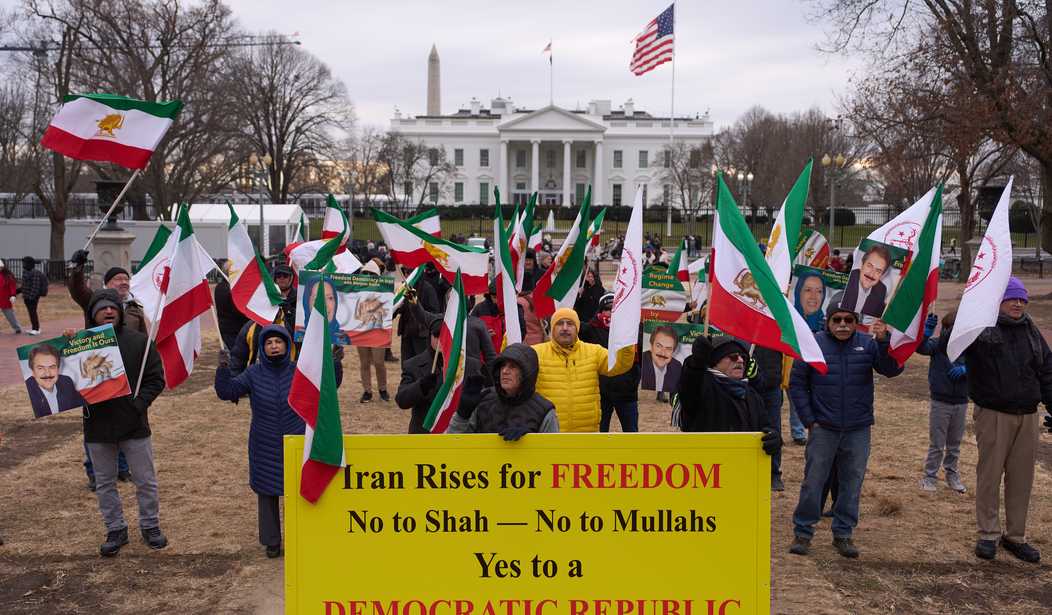
In effect, there is no Iranian government. If the Iranian people see that, they might be emboldened to take to the streets in large numbers, but not while the bombs are falling.
Iranian leaders are terrified; their military can do little except expend more precious missiles in a futile quest to inflict damage on U.S. allies. Meanwhile, the attacks on the Basij, the police, the auxiliaries, and the Revolutionary Guards continue to systematically destroy Iran's ability to enforce their will on the populace.
I'm not 100% on board with the idea that regime change is probable. But with all that's happening, it's an idea we cannot easily dismiss.