





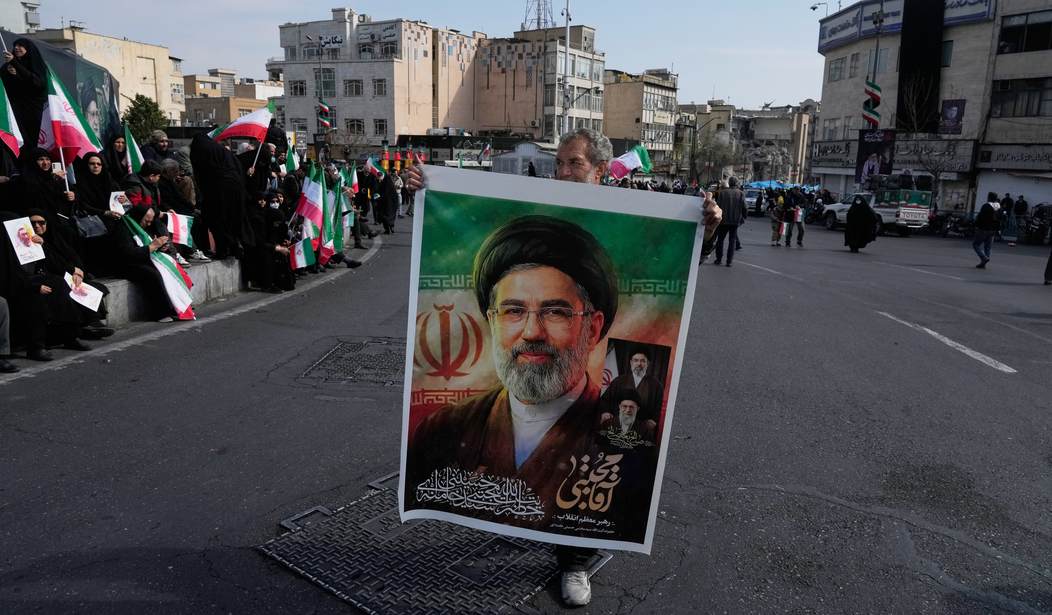
The people of Iran are in survival mode. Explosions in Tehran are constant. “The bombing is heavy,” an Iranian told The Free Press's David Patrikarakos. “And it’s frightening. But we have been frightened and terrorized for almost 50 years.”
Mehdi Yahyanejad is an activist and tech entrepreneur living in Los Angeles. He started a news aggregator site and helps smuggle Starlink terminals into Iran. The internet is blocked again, as the regime is desperate to stop any large-scale protests that might snowball into a revolution.
“Most people are disconnected,” Yahyanejad says. The state is in disarray. Senior officials are scattered and confused. “The government as a functioning entity doesn’t really exist anymore. Things are falling apart,” he said. “Many offices are running at about 20 percent capacity just to keep services going.”
After at least 30,000 Iranian protesters were butchered on the night of Jan. 8-9, the people are understandably reluctant to take to the streets.
National police chief Ahmad-Reza Radan says that demonstrating against the regime now makes protesters enemies of the state. "If anyone comes forward in line with the wishes of the enemy, we will no longer see them as merely a protester; we will see them as an enemy," Radan said in remarks broadcast late Tuesday by state broadcaster IRIB.
"And we will do to them what we do to an enemy. We will deal with them in the same way we deal with enemies," he added.
The warning was explicit and obscene. "All our forces are also ready, with their fingers on the trigger, prepared to defend their revolution," said Radan.
Iranians have become cynical over the decades. They aren't expecting much from the U.S. and Israel as far as assisting in the overthrow of the regime.
Most Iranians I have spoken to doubt there will be a full-scale invasion, though they don’t discount limited ground operations. The deeper concern is what comes after. Some fear ethnic fragmentation, Kurdish or Baluchi uprisings that could rip the country apart. For the moment, President Donald Trump seems to have backtracked on the idea of the Kurds as a form of “boots on the ground.” He told reporters aboard Air Force One: “I don’t want the Kurds to go into Iran. . . . The war is complicated enough as it is.”
Everyone is worrying about what comes next. Over the weekend, the Assembly of Experts, the body tasked with selecting Iran’s new supreme leader, chose Mojtaba Khamenei, the former leader’s son. This was dismaying among those I speak to. “What’s the point of all this if we just get more of the same?” says a young mother that I have been in contact with since the January protests; I’ll call her Shireen. Down the road, depending on the success of the war, there is the possibility that exiled crown prince Reza Pahlavi could return. According to Yahyanejad, he commands wide support, but his restoration could aggravate ethnic tensions. There could also be some kind of governance by a combination of opposition figures and technocrats from within the regime, but this idea remains vague.
What ordinary people fear the most are uprisings by ethnic minorities like the Baluchis, Kurds, Arabs, and Azeris (Azerbaijanis). The minorities may be emboldened by the government's weakness. Each of the ethnic enclaves have their own militia. They have been training for an opportunity like this for decades.
Tehran has historically been sensitive regarding these populations, often viewing the potential for ethnic mobilization or separatist sentiment as a threat to national stability. Consequently, the Iranian government has at times taken restrictive measures against activists advocating for ethnic or cultural rights among the ethnic populations.
"We don’t want a civil war that destroys the country. And that would only benefit the regime, anyway," said one Iranian.
The threats from the regime to kill protesters are being taken very seriously.
“Their words are working,” said another protester. “People still hate the regime, but we don’t want our children killed. We hope that maybe it will fall. But it doesn’t look like it yet.”
Gangs of Basij enforcers, often heavily armed, roam the streets, threatening civilians and forcing them indoors. Anyone who looks like they might be thinking of protesting is threatened or beaten or worse. There are checkpoints across every city. Known protesters are scrutinized even as they move through the streets to get basic necessities.
Is there no hope? The regime's leadership is fragmenting and at each other's throats. Under these circumstances, anything could happen.
Despite the regime’s grip on the streets, it’s known that there are serious fractures within its leadership. Since the war began, I have also been speaking to Western security officials. Almost all have a regular flow of information coming out of Iran; some have even penetrated the Iranian security services so deeply that they receive information about Iranian military decision-making almost in real time. The picture they paint of the regime is that of a system still capable of repression, but increasingly fragmented behind its facade of wartime unity. Senior figures have scattered for security reasons, communications are strained, and discipline at the top is crumbling. “Decision-making is accordingly confused,” one Western source who is across the intelligence on Iran tells me.
The election of Mojtaba Khamenei, Ali Khamenei's son, as Supreme Leader was hardly unanimous. Many objected to his election on the grounds that he lacked knowledge of the Quran and had little scholarly reputation to speak with authority on Islam. Others objected because his selection signaled a return to hereditary succession, which was one of the revolution's primary targets.
But Khamenei the Younger had carefully cultivated the Revolutionary Guards over the years, and their support was essential to the election. For all practical purposes, the Revolutionary Guards, the most hardline faction, are now firmly in control in Iran.
That means that the "Never Surrender" faction is in charge and won't be budged until someone goes in and kicks them out.
Related: Even if the Iranian Regime Is Overthrown, Its Most Dangerous Weapon Will Remain
PJ Media will give you all the information you need to understand the decisions that will be made this year. Insightful commentary and straight-on, no-BS news reporting have been our hallmarks since 2005.
Get 60% off your new VIP membership by using the code FIGHT. You won't regret it.
Join the Conversation
VIP members get the ability to comment on articles.