







Donald Trump has been rolling the dice since the war with Iran began. So far, so good. There was a tragic incident of "friendly fire" over Kuwait in which three F-15s were shot down. And six U.S. soldiers were killed in a "makeshift" military office when a drone hit it.
Otherwise, Iran's efforts to inflict massive casualties on our friends in the region or on us have gone for naught. We've also gotten lucky with targeting the Iranian regime's leadership.
Has there ever been a dumber bunch of third-world nincompoops than the dozens of Iranian government and military leaders who were buried under tons of rubble after air strikes? It defies belief. It's like they all decided to commit suicide, lined up in a nice, neat row, and got mowed down by U.S. and Israeli fighter jets.
Incomprehensible.
After allied forces killed Supreme Leader Ali Khamenei and a couple of dozen senior government and military leaders in a "decapitation strike" last Saturday, the remaining senior leadership gathered in the building housing the Assembly of Experts to choose a new leader. Once again, they must think that the United States and Israel are as stupid as they are. The Iranians obligingly lined up to be executed, and Israel said, "Thank you very much." They obliterated the building.
So, Trump luck and Iranian stupidity combined to give the U.S. a historic opportunity. Whatever leadership is left in Iran is inexperienced and probably terrified. They see it's the kiss of death to be named to any leadership position. Now is the time to finish the job and rid the world of the Iranian theocrats.
Air strikes alone will almost certainly not be enough to topple the Iranian government. What's needed are boots on the ground. And there is already a force eager to help.
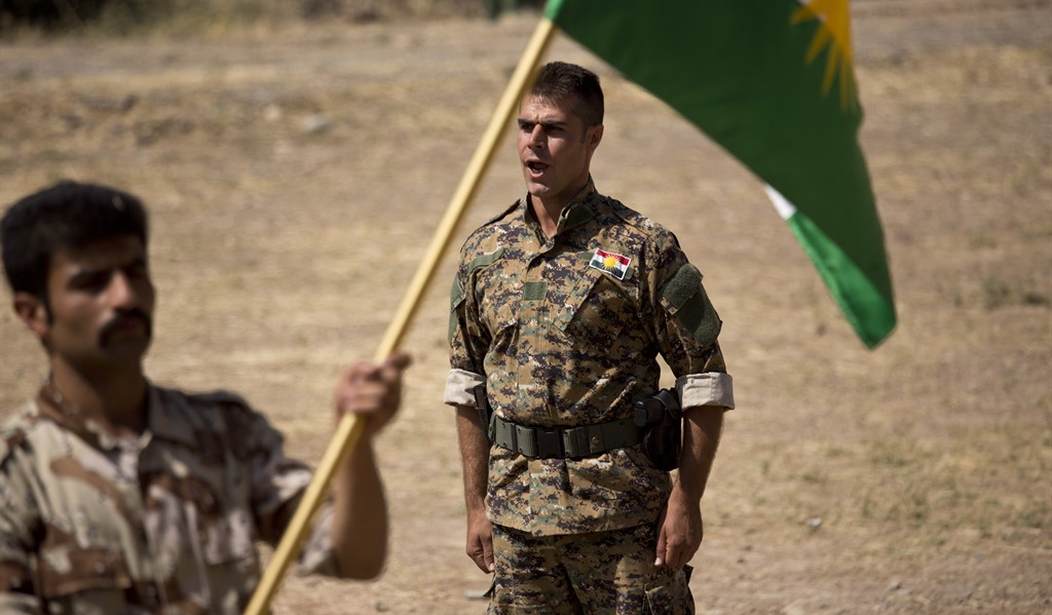
The Kurds are an ethnic group spread out over five countries. "Today, there are an estimated 25-30 million Kurds, the majority living in a region that stretches across parts of Turkey, Iraq, Iran, Syria and Armenia," reports CNN.
The Kurds in Iraq, Iran, and Syria have worked and fought with Americans since the first Gulf War in 1990-91. After helping us liberate Kuwait, they were expecting the U.S. to help them in their quest for an independent Kurdish nation. George Bush hung the Kurds out to dry, and Saddam slaughtered them.
The exact number of Kurds killed in the uprising after the Gulf War is difficult to pinpoint, but various human rights and international organizations estimate that between 20,000 and 30,000 were killed during the initial military crackdown in northern Iraq. Across both the Kurdish north and Shia south, the total number of people killed by the regime during this period is estimated to be between 25,000 and 100,000, with some Arab diplomats at the time suggesting the number could have been as high as 250,000.
An estimated 2,000 Kurds were dying every day at the height of the crisis in April 1991 due to exposure, disease (such as typhoid and dysentery), and lack of food while fleeing into the mountains toward Turkey and Iran.
Then, in the war against ISIS, the Kurdish militias joined the United States again, partnering with the U.S. military to defeat the terrorists in Syria and Northern Iraq and destroy their attempts to create a terrorist state. Then, the Kurds once again felt betrayed when the U.S. pulled out of Syria in Trump's first term.
Will they work with us once again to topple the Iranians?
The CIA has a long, complex history of working with Iraqi Kurdish factions dating back decades as part of the US war in Iraq. The agency currently has an outpost in Iraqi Kurdistan located near the border with Iran, according to two people familiar with the matter. The US also has a consulate in Erbil, the capital of Iraqi Kurdistan, and US and coalition troops are based there as part of the anti-ISIS campaign.
Some Kurds had hoped that in exchange for working with US forces, the semi-autonomous Kurdistan region of Iraq would win its independence, though that never came to fruition.
The US also leaned heavily on Kurdish forces in recent years as part of its campaign to counter Islamic State forces in Iraq in Syria. That has included taking on the responsibility of guarding thousands of ISIS detainees at makeshift prison camps in the north of that country.
What do the Kurds want in return? Something the U.S. can never support: an independent Kurdish state that would take parts of five countries and try to mash them together to form a country.
The resulting chaos would be unacceptable. Think India-Pakistan in 1947. On steroids. But that doesn't mean they can't help the U.S. in Iran now.
"Iranian Kurdish opposition forces are expected to take part in a ground operation in Western Iran, in the coming days," a senior Iranian Kurdish official told CNN.
“We believe we have a big chance now,” the source said.
One person familiar with the discussions said that the idea would be for Kurdish armed forces to take on the Iranian security forces and pin them down to make it easier for unarmed Iranians in the major cities to turn out without getting massacred again as they were during unrest in January.
Another US official said the Kurds could help sow chaos in the region and stretch the Iranian regime’s military resources thin. Still other ideas have centered around whether the Kurds could take and hold territory in the northern part of Iran that would create a buffer zone for Israel.
The idea would be for the Kurdish militias to keep the Iranian security forces busy while the people take to the streets in an effort to convince the leadership to leave.
“The Iranian people are generally unarmed as a whole and unless the security services collapse, it’ll be difficult for them to take over unless someone arms them,” said Alex Plitsas, a CNN national security analyst and former senior Pentagon official under former President Barack Obama. “I believe the US is hopeful that this will inspire others on the ground in Iran to do the same.”
There are other considerations.
“We are already facing a volatile security situation on both sides of the border,” said Jen Gavito, a former senior State Department official under Biden. “This has the potential to undermine Iraqi sovereignty and essentially empower armed militias with no accountability and with little understanding of what it may set in motion.”
As I said at the top, it would be a huge gamble: High risk, high reward. Most leaders abhor gambling, especially when it has the potential to blow up in their face.
Trump may not be a gambler, but he also wants to win. We should expect some effort to involve the Kurds in an enterprise to overthrow the leadership.
Exclusively for our VIPs: We Don't Need to Copy China to Beat Them in the Race for Rare Earth Mineral Dominance
PJ Media will give you all the information you need to understand the decisions that will be made this year. Insightful commentary and straight-on, no-BS news reporting have been our hallmarks since 2005.
Get 60% off your new VIP membership by using the code FIGHT. You won't regret it.

Join the Conversation
VIP members get the ability to comment on articles.