


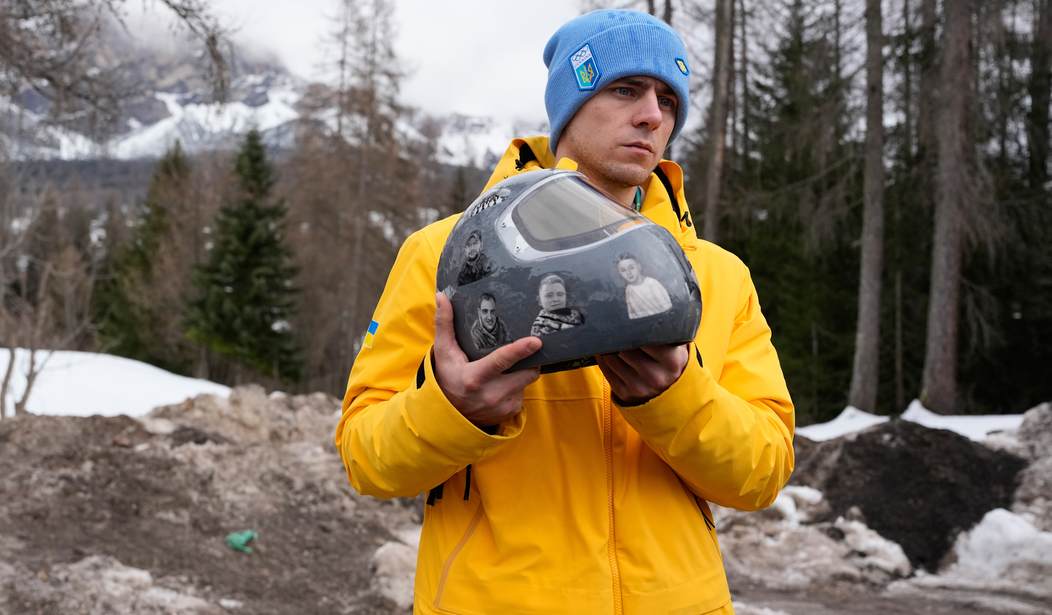
Olympic "sliding" events aren't normally in news headlines. Going down a twisting, turning, banked, icy track at 85 MPH is crazy but hardly newsworthy.
That is, unless an athlete runs afoul of the Olympic rule against making a "political statement." Then it becomes an "international incident."
Vladyslav Heraskevych, a Ukrainian athlete in the skeleton competition, was disqualified from racing at the Olympics because his helmet was festooned with images of Ukrainian athletes killed in his nation's war against Russia.
💬 Ukraine's Vladyslav Heraskevych on the disqualification over the memorial helmet: "I have no regrets... There are things more important than medals." pic.twitter.com/NRhmho1nW1
— UNITED24 Media (@United24media) February 12, 2026
For three days, Heraskevych had battled Olympic officials for the right to wear his politically-charged helmet. He and his father made the rounds among Olympic Committee members staying at a far more luxurious hotel in Milan, begging them to allow him to compete.
Then, just 45 minutes before the first heat was to begin, Kirsty Coventry, chairwoman of the International Olympic Committee (IOC), traveled to Cortina to deliver the bad news to the young man personally. Both Coventry and Heraskevych's father, Mykhailo, were in tears after the meeting.
Mykhailo Heraskevych, father and coach of Vladyslav Heraskevych, reacts to the news that his son has been disqualified from competing in the Winter Olympics. pic.twitter.com/0KF1KFI1ag
— BBC Sport (@BBCSport) February 12, 2026
Politics and the Olympics don't mix. Except when they do. Which is a lot. If there were supposed to be no political statements at the Olympics, why do winning athletes run around the track waving their national flag? Patriotism is as much a political statement as Heraskevych's helmet.
The Olympics are sodden with nationalism, patriotism, and politics. But Russia is an important member of the International Olympic Committee (bowel) movement, and the IOC mustn't remind the world of Moscow's unprovoked, naked territorial grab in Ukraine, where civilians are being slaughtered, children kidnapped, and more than a million Russian soldiers have paid for Vladimir Putin's vainglory in blood.
Needless to say, the Ukrainians are sputtering in their rage against the IOC. President Volodymyr Zelensky gave a poignant tribute to Heraskevych and the fallen athletes of Ukraine.
His helmet bears portraits of our athletes who were killed by Russia. Figure skater Dmytro Sharpar, who was killed in combat near Bakhmut; Yevhen Malyshev, a 19-year-old biathlete killed by the occupiers near Kharkiv; and other Ukrainian athletes whose lives were taken by… https://t.co/IL2tFB786l
— Volodymyr Zelenskyy / Володимир Зеленський (@ZelenskyyUa) February 9, 2026
“I’m very disappointed about this," said a spectator waiting to watch the skeleton competition. "He didn’t break any rules. He just showed the honor about the athletes who were killed by Russia. And this just shows a big corruption in this committee. I think that this is very, very, very bad decision about this. I had a big hope that he will participate. I want to cry.”
Most of her countrymen feel the same way.
“This is unacceptable,” Irinam, another spectator, says. “The war is still going. These people were killed. I’m very disappointed in this decision. I came here to see him.
“I haven’t been home since [the war started]. The war is not over. My relatives are freezing in their homes. Some don’t have electricity. Some don’t have heating. We’re just brutally invaded by this power that’s this brute force with millions of people.”
For these Ukrainian natives, who came to the sliding center to watch an Olympian represent them, while simultaneously telling a story about the tragedy in their homeland, it’s one more blow. One more heartbreak. One more instance of the world turning its back on them.
But their admiration for Heraskevych has only grown as they watched him make an incredible sacrifice.
“I think it’s even bigger than the medal,” says Kharchuk. “Because he won the medal of our heart and he is a hero in the Ukraine.”
Is displaying images of dead athletes to make a statement against the war really "political"? If you're a Russian, I suppose it is. However, I don't see it that way. Should displays to honor a dead father or mother also be banned? The Star of David is an overt political statement that not only honors the state of Israel but has always been a potent symbol of Jewish survival. Should it also be banned?
It's the IOC that decides what counts as a political statement and what doesn't. That kind of subjective determination inevitably leads to perceptions of unfairness and favoritism.
Vladyslav Heraskevych is being punished for his patriotism. To me, that's unfair.
The new year promises to be one of the most pivotal in recent history. Midterm elections will determine if we continue to move forward or slide back into lawfare, impeachments, and the toleration of fraud.
PJ Media will give you all the information you need to understand the decisions that will be made this year. Insightful commentary and straight-on, no-BS news reporting have been our hallmarks since 2005.
Get 60% off your new VIP membership by using the code FIGHT. You won't regret it.

Join the conversation as a VIP Member