
"Daddy, why is the sky blue?" a toddler might ask his father. Instead of going into a long, technical discussion of Rayleigh scattering, which is how sunlight interacts with nitrogen and oxygen molecules in our atmosphere, Dad would probably answer that "God made it that way."
God did make it that way, but how our eyes perceive the wonders of nature is a fascinating combination of optical illusions and the way our eyes process light.
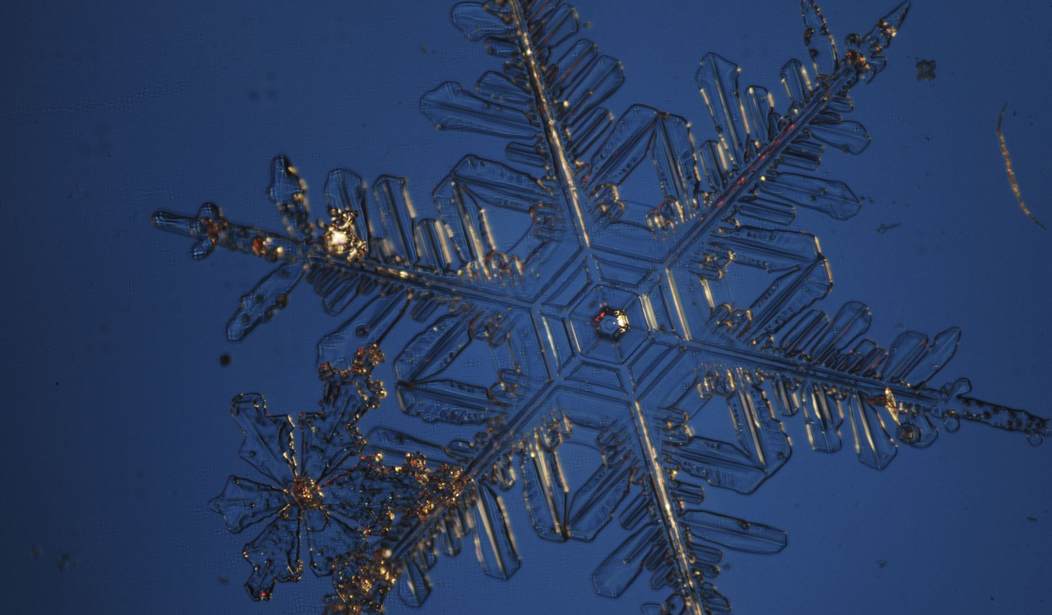
Snowflakes are simply ice crystals that form in the clouds and eventually fall to earth. They may traverse several different layers of warm and cold air, melting and reforming, before arriving on our front lawn.
We all learned in 5th-grade science that every snowflake is different. Why? When it snows, “there’s a lot of traffic on the way down,” Jonathan Belles, a senior digital meteorologist for The Weather Channel app and Weather.com told Popular Science. The air is full of tiny particles of dust, soot, and pollen that a freezing water droplet attaches itself to. Additional water vapor is captured by the water droplet. "Due to the way water molecules bond together when they freeze, a tiny hexagonal form begins to appear," explains Popular Science writer Laura Kiniry.
Eventually, the water droplet forms a six-sided crystal we call a "snowflake." So if ice is colorless, why does it appear to be white when it hits the ground? Because of their complex crystal structure, snowflakes reflect light almost like tiny mirrors.
So why isn't an ice cube white? “Sometimes with an ice cube, the light will be able to go straight through it. But with snow we’ve got this kind of broken mirror effect, with light bouncing off of all of those jagged edges," explains Belles.
Mark Serreze, the director of the National Snow and Ice Data Center in Boulder, Colorado, tells Popular Science that to understand why snow looks white, we have to look to the sun.
Popular Science:
Sunlight “emits all colors of the visible spectrum: red, orange, yellow, blue, green, indigo, and violet.” When these colors hit snow, each multi-sided ice crystal, or snowflake, scatters the colors like a tiny prism. All those colors shine equally in all directions, and our eyes, in turn, perceive all those colors colliding as white.
But why then does ice and snow look distinct, one clear and one white? “The difference between ice cubes and snowflakes is how light reacts with them,” says Belles.
“Sometimes with an ice cube, the light will be able to go straight through it. But with snow we’ve got this kind of broken mirror effect, with light bouncing off of all of those jagged edges.”
Despite its immaculate reputation, snow isn’t always white.
“Most of the time, snow does look white,” says Belles. “But things like sand grains might turn snow a little more golden brown, or snow might gain a red hue when there’s rust, or even bacteria or algae” in the air or on the ground.
Interestingly, our perception of snow changes if there's cloud cover. “For instance,” says Serreze, “they can contribute to what we call a whiteout,” a dangerous winter weather condition where snow and sky merge. This optical illusion can kill.
In a whiteout, your brain loses its ability to process depth or motion. This leads to several dangerous outcomes. Without a horizon line, your inner ear (vestibular system) struggles to keep you upright. People often feel dizzy or fall over.
Humans naturally have a slight "drift" in their stride. Without a visual landmark to aim for, you will inevitably walk in a circle, often thinking you are moving in a straight line.
You cannot see drop-offs, cliffs, or crevasses. A 50-foot fall can look exactly like flat ground until you step into the air.
Snow is beautiful and deadly. On the roads, it can be a nightmare. Sitting in front of a window looking at a show-whitened landscape has inspired more than one artist to recreate the scene on canvas.
Now you know how to answer if your child asks, "Daddy, why is snow white?" On the other hand, "Because God made it that way" works just as well.