







One of the major items on my scientific bucket list, along with confirming the existence of intelligent aliens, is solving the "hard problem" of consciousness. This term, coined by philosopher David Chalmers, refers to the mystery of why and how physical brain processes give rise to subjective, "felt" experiences (qualia).
Is it a physical process? Metaphysical? Spiritual? "Prior to the 1990s, theories of consciousness were more of a philosophical pursuit than a serious scientific one," writes Canadian psychiatrist Dr. Ralph Lewis in Psychology Today. "This was largely because scientists considered the domain of subjective experience—which is what consciousness fundamentally is—to be, well, too subjective," he adds.
Indeed, there were many reasons for the lack of research, not the least of which was disagreement on what consciousness truly is. Science was also hindered by a lack of tools that could unlock the mysteries of the human brain. Even with the advent of MRI and EEG machines that can diagnose disease, the mystery of consciousness remained hidden.
There is no lack of theories about the origins of consciousness. Did the world create consciousness, or did consciousness create the world, asks Nobel Laureate and physicist Roger Penrose. He believes "that it is not manufactured in the brain but only processed there, via an external quantum wave function sweeping through the universe that interacts with tiny protein tubes."
"These microtubules form the cytoskeleton of living cells and are especially plentiful in brain cells," writes Susan Layeh in Popular Mechanics. Penrose demonstrated in 2023 "that quantum activity in the brain could take place in these microtubules."
According to this idea, known as Orchestrated Objective Reduction theory, conscious moments occur almost constantly as the quantum wave function collapses, creating moments of conscious awareness. Hameroff names this quantum wave function proto-consciousness or “dream state” consciousness.
Their other collaborator, quantum mechanics expert Anirban Bandyopadhyay, Ph.D., calls it the music of the universe. Consciousness in the universe can be compared to a Tibetan singing bowl. When you run a mallet around the rim of the bowl, the sound grows as the vibration from the mallet resonates in the bowl. The longer you run the mallet around the bowl, the louder the song gets as the vibrational resonance increases. When universal consciousness, or the music of the universe, hits the consciousness chambers of the microtubules, the resonance grows like the mallet and the bowl.
The "music of the universe" is not as far-fetched as it sounds. The quantum universe is full of such connections, and these connections don't necessarily depend on the limitations of time and space.
In quantum mechanics, "quantum entanglement" occurs when two or more particles become "linked" in such a way that the quantum state of one particle cannot be described independently of the others. This remains true even if the particles are separated by vast distances—even light-years.
Albert Einstein famously referred to this as "spooky action at a distance."
If you think that sounds nuts, the concept of quantum entanglement has been experimentally verified and could lead to a "quantum internet" that, among other things, could create "unhackable" security.
How can we study the nature of consciousness without the tools needed to measure, to correlate, to perform all the standard scientific experimental actions that we have used for hundreds of years?
A new technology might open new avenues of exploration.
“Transcranial focused ultrasound will let you stimulate different parts of the brain in healthy subjects, in ways you just couldn’t before,” Daniel Freeman, an MIT researcher, explained in a statement. “This is a tool that’s not just useful for medicine or even basic science, but could also help address the hard problem of consciousness. It can probe where in the brain are the neural circuits that generate a sense of pain, a sense of vision, or even something as complex as human thought.”
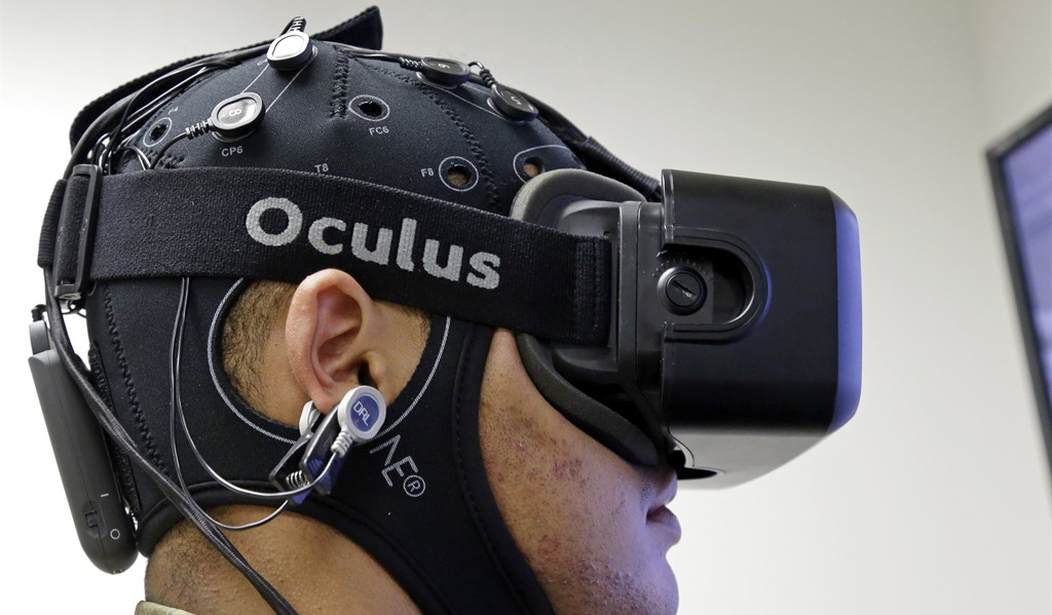
Most existing brain-monitoring technologies, such as MRI, EEG, or other forms of ultrasound, provide imaging of existing activity in the neural tissue but cannot alter it, so they can’t measure cause and effect. Meanwhile, other forms of brain stimulation, such as transcranial magnetic or electrical stimulation, have been around for a long time, but they’re blunt instruments. They can only affect large swaths of cortex. Transcranial focused ultrasound can target specific areas deep in the brain that many theories of consciousness propose are crucial—and produce imaging with much higher resolution.
Outside of brain stimulation, the only way for scientists to alter and monitor activity in specific tissues of the brain is through surgical interventions, which are both risky and invasive, presenting ethical challenges for studying healthy brains. “There are very few reliable ways of manipulating brain activity that are safe but also work,” said Matthias Michel, an MIT philosopher who studies consciousness and a co-author of the new paper.
“It truly is the first time in history that one can modulate activity deep in the brain, centimeters from the scalp, examining subcortical structures with high spatial resolution,” Freeman added. “There’s a lot of interesting emotional circuits that are deep in the brain, but until now you couldn’t manipulate them outside of the operating room.”
Does the same consciousness we experience also animate the minds of biological aliens? Does the "music of the universe" resonate with all intelligent life in the universe?
The search for the origins and location of consciousness is a search for the fundamental meaning of existence.
It sounds kind of fun when I put it that way.

![[UPDATE] Audio Appears to Confirm Talarico’s Stay at Mental Health Facility; Campaign Denies It](https://media.townhall.com/cdn/hodl/2026/257/05654322-cebe-4479-a0f1-67bd873ecc9f-536x311.jpg)
