


As bad as we might think that attacks on free speech in the U.S. are getting worse, we should contemplate the fact that, compared to Europe, we never had it so good.
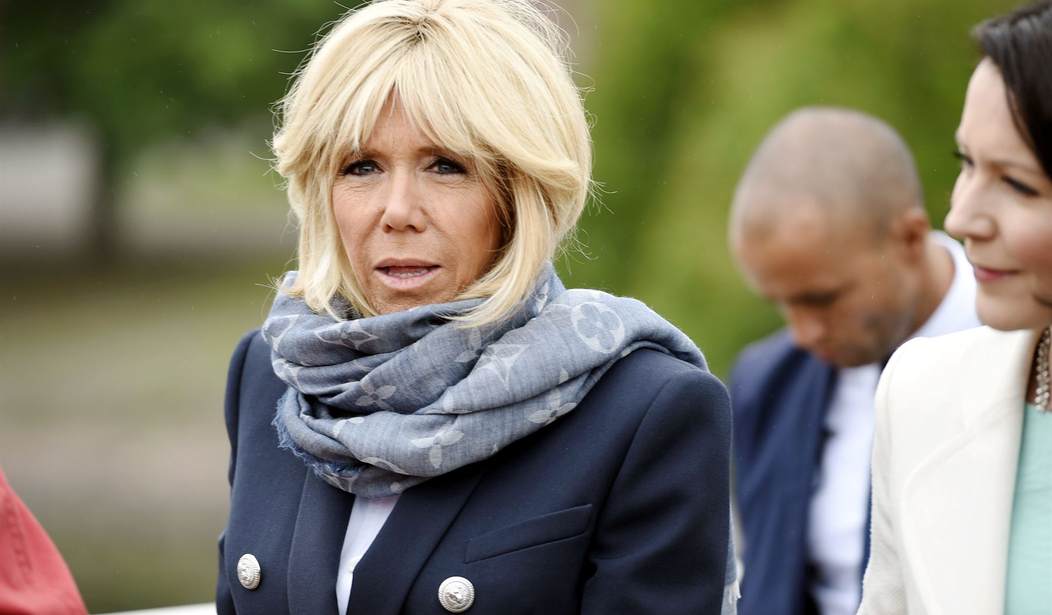
To wit: On Monday, a French court found 10 people guilty of cyberbullying Brigitte Macron, France's first lady. How an ordinary citizen can "bully" such an august person as Macron is a mystery.
The defendants were found guilty of claiming on X that "the first lady was born male and characterizing her relationship with French President Emmanuel Macron as pedophilic," according to Reason.com.
Macron met and fell in love with his wife when he was a 16-year-old, and she was his 39-year-old drama teacher at his high school. The French see nothing wrong with this, of course. "May/December romances" are the stuff of romantic fantasies in France, and most people are fine with it as long as love was involved and not just a sexual adventure.
However, the defendants all claim innocence, "saying their posts were either meant in jest or constituted legitimate debate," reports The New York Times.
Their argument didn't wash with the court. For "cyberbullying" someone who almost certainly never read the tweets or knew the defendants personally, the ten dangerous offenders were sentenced to "compulsory cyberbullying awareness training, eight suspended prison sentences, one six-month sentence to be served from home, and a six-month social media ban for five of the defendants," reports Reason.
In addition, they were fined $700 and ordered "to contribute to a total of 10,000 euros — about $12,000 — in compensation to the first lady," reports the Times. A wild guess; the defendants need that cash a lot more than Macron.
How did France get to this point where making fun of the wrong person is punished?
The French Constitution holds that "any citizen may therefore speak, write and publish freely." However, unlike the First Amendment to the U.S. Constitution, it immediately caveats this right by excluding "what is tantamount to the abuse of this liberty in the cases determined by Law."
This carveout has allowed the French government to outlaw speech acts like bullying, which it defines as "the act of bullying a person through repeated comments or behavior whose purpose or effect is to degrade their quality of life, leading to an alteration in their physical or mental well-being." Cyberbullying is defined as bullying through an electronic medium. Both are punishable by up to two years' imprisonment and a fine of 30,000 euros (nearly $35,000).
Based on the punishment they could have received, the defendants in the Macron case got off practically scot-free. But that doesn't mean that we should praise the French court for its graciousness. Comparing French and American law reveals just how unlucky the French are when it comes to their free speech rights.
Sometimes, we forget how incredibly lucky we are that our founders had the vision to include a nearly unambiguous First Amendment. It has saved citizens a lot of grief.
In People v. Relerford (2018), the Illinois Supreme Court struck down the portion of the state's cyberstalking statute that criminalized nonconsensual communications that would cause a reasonable person to suffer emotional distress because "it was not limited to unprotected threats or other criminal conduct, but instead criminalized entirely protected speech that merely deeply offended or upset others," explains Cohn. Similarly, the 3rd Circuit Court of Appeals upheld federal cyberstalking law in United States v. Yung (2022) by interpreting "'harass' to mean 'a course of conduct designed to distress the victim by threatening, intimidating, or the like,'" according to Cohn.
PJ Media has devoted a lot of effort to documenting the assault on free speech in Great Britain, Germany, the Netherlands, and the EU in general. If you haven't already, I recommend you support our efforts by becoming a VIP member at 60% off to make sure you don't miss anything of this vital debate.








Join the conversation as a VIP Member