


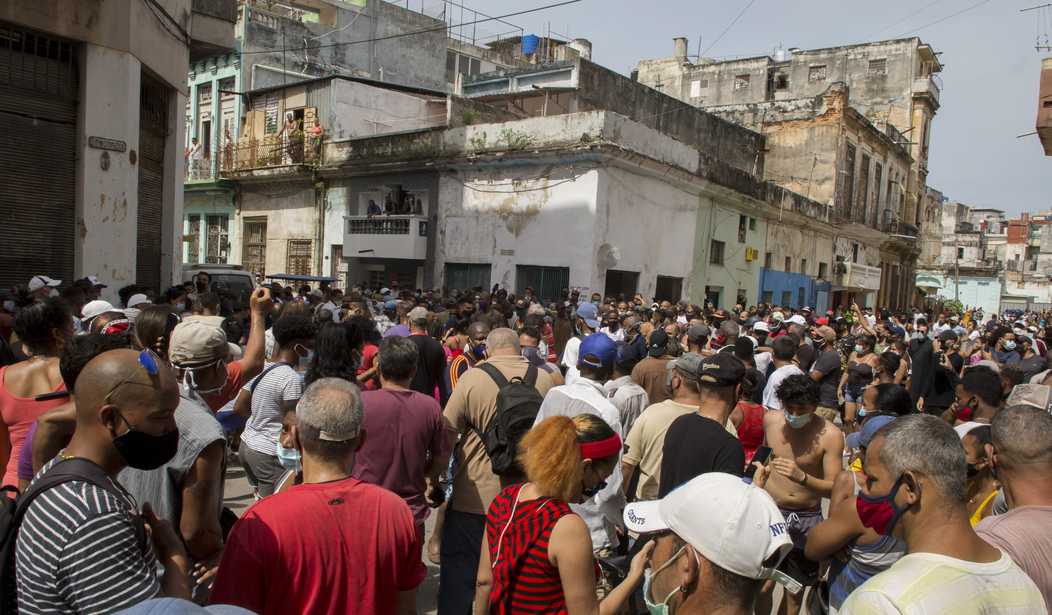
The fall of Nicolás Maduro in Venezuela has tongues clucking about a possible duplicate action to take down the Communists in Cuba. President Miguel Díaz-Canel presides over a state that has failed twice over.
Cuba's GDP has declined 11% since 2020 — "and those are official numbers, in a country where statistics have always been more poetry than fact," writes former CIA analyst and author Martin Gurri in The Free Press.
The ancient electric grid is held together with toothpicks and duct tape. The country experiences daily outages and, according to PJ Media's Sarah Anderson, even if it worked correctly, the grid was powered by Venezuela's oil, which is now cut off after U.S. Secretary of State Marco Rubio declared it "quarantined."
Sarah reports that Mexico's President, Claudia Sheinbaum, has been sending Cuba oil as a "humanitarian gesture," which the U.S. is working hard to end.
No electricity means no refrigeration, which means spoiled food. Without electricity, the pumps at the water reservoirs and purification systems don't work, and clean water becomes a luxury.
Protests against the regime are common, although small in size, as the police move in to break up any large-scale gatherings. But that doesn't lessen the simmering anger of the people at a corrupt, oppressive government.
Corruption is general. A movement that once paraded its revolutionary fervor has, in its dotage, embraced material comforts. Those with the power to do so scoop up what few dollars can be found in the country and send them overseas, just in case. The structure and character of the system has come to look more like The Sopranos than a proper Marxist-Leninist state. On rare occasions, the government bestirs itself to prosecute a high-placed official on corruption charges. Last November, Alejandro Gil, former economy minister, was given life in prison supposedly for espionage but also for “acts to the detriment of economic activity or contracting”—e.g., bribery and tax evasion. Few details were disclosed. Gil had crossed a line that was visible only to whomever deals out life and death in Cuba.
While Díaz-Canel is the titular head of the government, lurking in the background is 94-year-old Raúl Castro, whose mental and physical condition is unknown, but who is believed to be the power behind the throne in Cuba. "Few people know—or are allowed to know—whether he is active and in charge, distant but watchful, or feeble and dotty," writes Gurri. What's certain is that the Cuban state is still run for the benefit of Castro's family and the small cadre of revolutionary holdovers from the Cold War.
The fall of Maduro is likely to change that, but it will be a slow, painful process with stops and starts and probably blood in the streets. Oppressive regimes simply don't lie down and die, as we see clearly in Iran. The same process of disintegration we're seeing in Cuba is happening in Iran as the elites in the Revolutionary Guard Corps and ayatollahs in the theocracy are grabbing for everything they can carry before the ax falls.
The elites in Cuba and Iran have the instincts of jungle cats and have a survivor's knack for knowing when to run. Any endgame for Cuba will see the vast majority of government elites leave the island for their well-planned retirement.
The U.S. needs to manage the collapse to ensure that a repeat of the 2021 wave of a million Cubans coming to the U.S. will not happen. Indeed, a military move by the U.S. to prevent the mass migration of Cubans to the U.S. might be the primary motivation for Trump to end the Castroite regime for good.
It may be that Trump and Rubio opt for regime change in Cuba for immigration reasons. The presence of Cuban troops in Venezuela would provide a handy pretext, in that case. But Cuba lacks the heavy negatives of the Maduro regime, such as organized drug cartels. And it lacks the dazzling positives found in Venezuela—it has magnificent beaches but no oil or other natural resources. Trump’s attention, one suspects, will probably wander elsewhere.
Whether the U.S. helps Cuba's transition or not, the dominoes are beginning to fall. Right now, they're falling in America's favor and to the detriment of China and Russia.
How much longer that lasts will depend on how the U.S. manages these world-historical changes.
The new year promises to be one of the most pivotal in recent history. Midterm elections will determine if we continue to move forward or slide back into lawfare, impeachments, and the toleration of fraud.
PJ Media will give you all the information you need to understand the decisions that will be made this year. Insightful commentary and straight-on, no-BS news reporting have been our hallmarks since 2005.
Get 60% off your new VIP membership by using the code FIGHT. You won't regret it.


Join the conversation as a VIP Member