


There are numerous myths and falsehoods about George Washington. There was the cherry tree nonsense, a myth created out of whole cloth by an itinerant preacher named Parson Weems, who wrote a biography of Washington, portraying him as a perfect moral role model for young Americans and focusing on "private virtues" like honesty rather than just military or political achievements.
He was adjudged a terrible general; an uneducated, slave-owning planter; a self-promoting military martinet; a haughty, emotionless leader; and a man who always kept one eye on his place in history, constantly aware that he was on history's grandest stage.
That last criticism has some validity to it, but Washington never let his desire to be remembered well interfere with his immediate goals.
Two events in Washington's life refute most of the shallow criticisms of historians, demonstrate George Washington's superior qualities, and explain why he has remained the most admired American around the world. The first was his address to the conspirators in Newburgh, New York, on March 15, 1783, which stopped a coup against Congress in its tracks.
Congress had failed to deliver on its promises of pay and land to the army, and a few officers and several companies of men wanted to march on Congress in Philadelphia and take what they were promised by force.
Washington learned of the plot and convened a meeting of his officers to discuss it. He began reading a letter from a congressman to show he was working on getting the men what they had been promised. Then he stopped reading, faltering noticeably.
Concerned, the men wondered what the problem was. Then, with the impeccable timing of a consummate actor, Washington reached into his jacket pocket and withdrew a pair of reading glasses.
"You will forgive me, for I have not only grown gray, but nearly blind in service to my country," he said.
This reminder of all their shared hardships caused many in the room to break down in tears, according to eyewitnesses. His men had never seen Washington with glasses, a sign of weakness that he never allowed his men to glimpse. The coup against the United States government ended then and there.
The second event that sets George Washington apart from any other American in history was his improbable victory in Trenton, New Jersey,
In the late fall of 1776, the Continental Army was kicked out of New York by the brilliant maneuvering of General William Howe and Washington's inexperience in handling large bodies of men. Washington's 20,000 men, with whom he began the campaign, had melted away. All but 2,300 souls had been killed, wounded, or deserted.
We all know the schoolbook version of what happened next. Washington crossed the ice-choked Delaware River with his little army to attack the Hessians at Trenton, New Jersey. His victory was a shot in the arm to a flagging cause and helped assure American independence.
The full story is a little more problematic and a lot more frightening. In fact, there is every reason to believe that without Washington’s little excursions into the New Jersey countryside (not just once but again on January 3 at Princeton), the patriot cause would have died and the idea of an independent America would have been delayed — if not destroyed.
No retelling of the Battle of Trenton can be complete without mentioning the publication of "The American Crisis," an electrifying essay written by Thomas Paine and published in December of 1776 that began with the immortal words, "These are the times that try men's souls/The summer soldier and the sunshine patriot will, in this crisis, shrink from the service of their country..."
Paine's essay gave the Continental Army something vital that they had been lacking: hope.
They certainly needed it. Washington had been outmaneuvered, outflanked, and outgeneraled at every turn during the campaign in New York; Brooklyn Heights, Harlem Heights, White Plains, Forts Washington and Lee (where 3,000 Continentals surrendered instead of abandoning the indefensible forts) became a sad litany of failure for the American army.
Patriots in New York and New Jersey took advantage of General Howe’s generous offer of a pardon and flocked to the British standard. Fearing capture, the Congress fled Philadelphia for Baltimore. They placed Washington in charge of both military and civilian affairs, thus making him a de facto military dictator. Not that there was anyone or anything to dictate to. Washington himself believed the cause was lost when he wrote his cousin in mid-December, “I think the game is pretty near up.”
"Pretty near up" but not lost. Washington's excellent and underrated intelligence operation had been sending him reports about the outpost in Trenton, New Jersey. General Howe had set up a series of posts that dotted the New Jersey countryside, and Trenton was vulnerable. It was farther away from any other outposts, and the insufferably arrogant Hessians were lax in their security.
His first planned strike involved crossing the Delaware River and hitting Trenton at dawn on December 26 with three converging columns. Uniting his forces, he then proposed to move on Princeton and, if conditions warranted, the British base at New Brunswick.
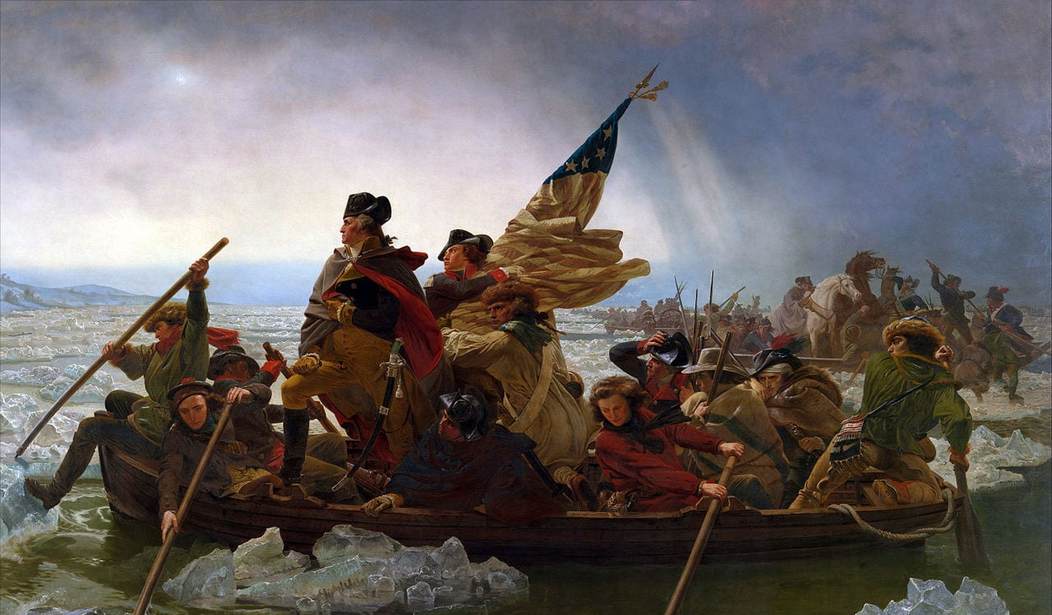
The crossing, memorialized by the German-American artist Emanuel Leutze, was even more hazardous than the painting suggests. Only the tireless efforts of the Massachusetts Marblehead Regiment manning the oars — seamen and dockworkers for the most part — managed to effect a crossing in those conditions.
Reaching Trenton around 8:00 AM, they quickly overcame the sentries and entered the town. The Hessians never had a chance and it was over in a matter of minutes. Washington had his victory and tons of blessed supplies along with 900 prisoners. But the rest of his army was still on the Pennsylvania side of the river and Washington was forced to retreat. He knew that the attack on Trenton would draw the wrath of the British, so on December 30, he recrossed the Delaware, planning to meet their attack just outside of Trenton at Assunpink Creek, where he set up a very strong defensive position.
His strategic sense was brilliant. When Howe tried to surround the Americans, Washington had 500 men maintain campfires all night while he marched his troops clear around the British and took the town of Princeton. It was a sharp battle during which Washington astonished his men by riding between lines, exposing himself to withering fire from the British.
Trenton was a shot in the arm, but Princeton was a master stroke. Washington proved to Howe that he could swoop down and attack any of his isolated posts. Howe marched his army clear out of New Jersey and back to New York City.
Washington had recaptured an entire state by fighting two skirmishes with the British and outmaneuvering General Howe.
George Washington's victories at Assunpink Creek and Princeton changed the course of the war. This reignited patriot fervor in the colonies. Enlistments in the army skyrocketed. The patriot spirit spread across the land, and church bells tolled from New England to Georgia in joyous recognition of the victories.
Two weeks earlier, the cause of American independence appeared to be lost. Washington, an inveterate gambler, had rolled the dice and come up a huge winner. There wasn't another general in America who would have taken that chance, just like there wasn't a leader in America who could have stopped the Newburgh conspiracy from bearing fruit.
George Washington deserves every accolade ever given him and then some.
Christmas is here, but the gift that keeps on giving lasts all year.
Right now, you can get 74% off PJ Media VIP with the code MERRY74—and yes, that same deal works if you want to give VIP as a gift to someone who appreciates sharp commentary, fearless reporting, and a little common sense in a world that’s running low on it.
This special Christmas offer runs through New Year’s Day, so don’t wait. Use code MERRY74 and save 74% today—for yourself or someone else.




Join the conversation as a VIP Member