





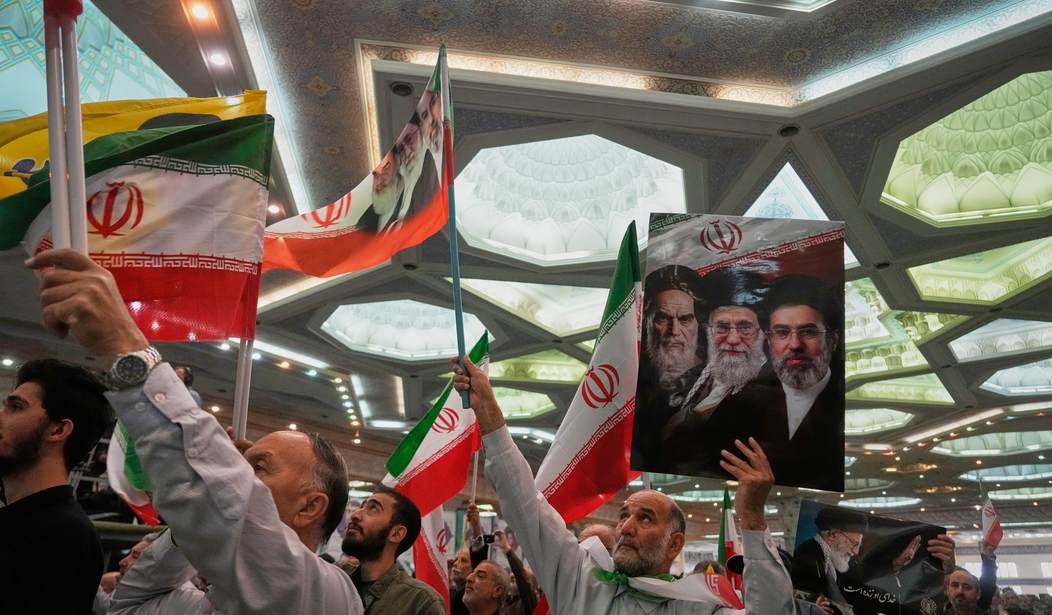
It would seem that war is just around the corner, with the U.S. attacks on some Iranian boats on Monday, and the Iranians having prepared missile-launching sites on Monday that were destroyed by other American attacks. But Tuesday and Wednesday morning provided little to no increase in rhetoric or violence, with the exception of Israel's increased operations against Hezbollah in Lebanon.
The war against Israel in the Middle East is reflected in a domestic war, as evidenced by the Jew-hatred that has been permeating our American culture in recent months. But on Tuesday, the Department of Justice filed a lawsuit against UCLA for violating the Civil Rights Act in 2024 by allowing an antisemitic learning environment, which peaked in April 2024 when masked protesters physically attacked Jewish students and blocked their access to academic buildings.
Whether it accomplishes any substantive changes or not, it is still nice to know that the DoJ is attempting to reduce the acceptance of Jew-hatred in this country.
So let us all be grateful that there are still allies who have the integrity and courage to stand shoulder to shoulder against the hate and evil that seeks to control the world.
Chazak u'Baruch
Rabbi Michael Barclay
May 27, 2026
11th of Sivan, 5786
We are seemingly again on the precipice of a more intense war, as Israel continues to intensify its actions against Hezbollah in Lebanon. Over 150 Hezbollah targets were eliminated over the last 28 hours, and Israel is preparing to work even harder to eliminate Hezbollah from the playing field, as evidenced on Thursday morning when an evacuation warning for the entire area of southern Lebanon was issued. Israel clearly wants to make sure that Hezbollah is depleted and no longer has the ability to significantly attack Israel.
Which may be incredibly important, given how the discussions between Iran and the U.S. seem to be going. But we need to remember that these discussions are like a roller coaster in the dark: there's no way to know when you're going up or down until you experience it. Similarly, there is no way to know whether we are really getting closer to war or some sort of peace deal. But all indications of Wednesday and Thursday morning seem to lead towards an increase in military action between the U.S. and Iran.
Ali Kani, Deputy Secretary of Iran's Supreme National Security Council, said that "Washington and Tehran have not yet reached an agreement on opening the Strait of Hormuz." According to him, "contacts are continuing, but Iran's enriched uranium stockpiles are not on the agenda of the negotiations." Iranian state television reported on Wednesday that if they do not have a final deal within 60 days, Iran will go to the United Nations for a UN Security Council resolution (which is less than meaningless considering that the UN has demonstrated for decades that they will try to hurt Israel at any time and in any way possible). Several Iranian channels also reported that Iran has set a new condition in negotiations with the U.S., according to which Washington will pay Iran $300 billion in reparations for the war. Qatar has already offered to "loan" $12 billion to Iran to help facilitate the rebuilding of the country, and to try to make a deal happen between the U.S. and Iran.
President Donald Trump said in a PBS interview that "Iran will not receive sanctions relief in exchange for giving up enriched uranium." In a Wednesday Cabinet meeting, the President said, "Iran very much wants to reach a deal. So far they haven't gotten there. We're not happy with what's there right now, but we'll see. Either it will happen, or we'll just have to finish the job." He also said in the interview that Iran would not receive sanctions relief in exchange for giving up highly enriched uranium. “No, no, not at all. Not sanctions relief, no."
Nuclear capabilities are still at the heart of all disagreements. Iranian reports are that the Islamic regime will never give up any enriched uranium, nor stop developing nuclear power. But Trump said on Wednesday that "if we hadn't attacked there (Iran) with the B-2 bombers, Iran would have had nuclear weapons within two weeks from that point. I won't feel comfortable if China or Russia take the uranium." On easing sanctions as part of the deal, he said: "No relief, no money, nothing."
In the midst of these "negotiations" and opposing rhetoric, there were military attacks from both sides on Wednesday and Thursday morning. Reuters reported that the U.S. military struck a military site in Iran that "posed a threat" to American military forces in the region, as well as to commercial shipping traffic through the Strait of Hormuz. And Tasnim, which is affiliated with the regime, reported that the U.S. military struck earlier in the area of the port city of Bandar Abbas, after the Revolutionary Guards attacked an oil tanker attempting to cross the Strait of Hormuz.
Rhetoric, politics, and actions are all combining in a way that demonstrates that Iran is still stalling, probably while they are rearming, while the U.S. is vacillating and seems undecided about whether or when military action will be restarted.
But our faith tradition teaches us to look towards history to understand the present in a deeper way, and today, the 12th of Sivan, is a significant day.
Biblically, this is the last day during the times of the Temple when a person could make their Shavuot offering, completing the ancient pilgrimage to Jerusalem. Today is also considered the holiday of Shavuot for Beta Yisrael, the Ethiopian Jewish community. For many centuries, they have observed the holiday on this day, counting 50 days from the end of Passover as opposed to the beginning of it. But it is in more modern times that we see an important action that directly relates to our present situation.
On the 12th of Sivan in 1912, the Agudat Israel movement was founded in Katowice, Poland, uniting Jews to address the religious and political challenges they were experiencing in Poland. They chose to address the challenges at that time, decades before World War II and the Holocaust, through establishing religious educational organizations, both for children and adults. Their belief at that time was that education would protect people and keep them unified as a spiritual community. The organization would survive World War II, on to morph into what is now a political party in Israel, as well as be the model for other Agudat Israel organizations around the world. This includes America, where Agudath Israel of America operates charitable, educational, and social service projects across North America and advocates for civil and religious rights.
What we learn can never be taken away from us, and it is one of the shields that has protected religious people for centuries. If we know our history, if we know our theology, and if we are imbued with Biblical ethics, we act in ways that are both right and righteous. In these challenging times, it is more important than ever to know what the Bible and our sacred texts teach so that we are able to navigate the troubling world that is surrounding us.
So take today and learn something new. And before you do that learning, through a book or online or with a conversation, dedicate your learning to keeping Israel and the United States safe and protected.
Like prayers, learning makes a difference in the world, more than we may realize.
Chazak u'Baruch
Rabbi Michael Barclay
May 28, 2026
12th of Sivan, 5786
Editor's Note: Do you enjoy PJ Media's conservative reporting that takes on the radical left and woke media? Support our work so that we can continue to bring you the truth.
Join PJ Media VIP and use promo code FIGHT to receive 60% off your membership.


Join the Conversation
VIP members get the ability to comment on articles.