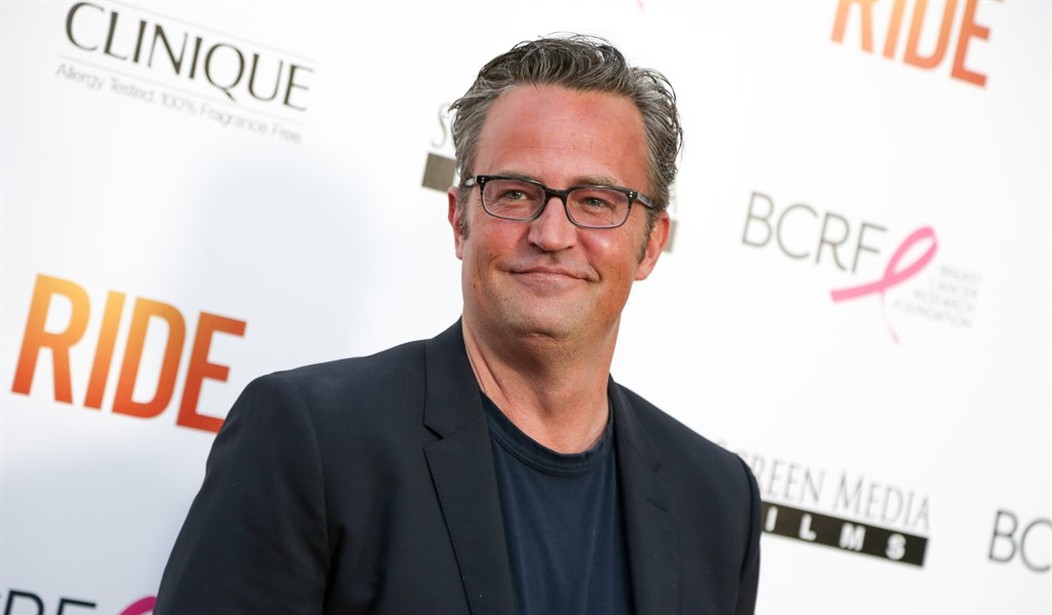
Matthew Perry was one of the most famous actors in the world, but he also suffered from severe addiction. If you read his memoir, you know that it's something he dealt with all his life, and it was much worse at some points than others.
In 2023, Perry had been receiving legal, supervised ketamine infusions for depression and anxiety, but he eventually began to source it illegally and abuse the drug, taking much more than the recommended therapeutic amount.
Ultimately, it took his life. Around 4 p.m. on October 28 of that year, his assistant Kenneth "Kenny" Iwamasa returned home from running errands and found the actor unconscious in his hot tub. He pulled him out and called 911, but unfortunately, it was too late. Perry was pronounced dead at the scene.
In December, Perry's autopsy concluded that "acute effects of ketamine" was the primary cause of death. This led to an investigation by the Los Angeles Police Department and Drug Enforcement Agency. In August of 2024, five people were charged in connection with his death. They were Jasveen Sangha, aka the "Ketamine Queen," who supplied the drugs; Erik Fleming, the middleman; Dr. Mark Chavez, a physician who was selling ketamine illegally; Dr. Salvador Plasencia, a physician who sold the ketamine to Perry; and Iwamasa himself, who not only helped the actor secure the drugs, but also injected him with them after being taught how by Plasencia.
During the last week of Perry's life, Iwamasa injected him six to eight times a day and even found his boss unresponsive on multiple occasions. On the day of his death, he gave him one injection around 8:30 a.m. and another just after noon. Around 1:30 p.m., Perry, who was in his hot tub, asked Iwamasa to "shoot me up with a big one."
While there is no doubt that these people broke the law in many ways, there has been much debate as to whether or not they should be charged in connection with Perry's death, especially Iwamasa. Many say that Perry was a grown man, and he's the only one who can be responsible for his actions.
Other current and former celebrity assistants have also spoken out on Iwamasa's behalf. Rowena Chiu, who previously worked for Harvey Weinstein, wrote an op-ed for the New York Times suggesting that the power imbalance between a wealthy, world-famous celebrity and their "less than human" assistant can blur the lines of the laws and ethics:
But when I read about Mr. Iwamasa’s indictment, I understood all too well that an assistant to a celebrity can be expected to do whatever is asked of them, regardless of ethics or legality. These requests can range from telling white lies (to, say, an irate spouse wanting to know where your boss is) to procuring illicit indulgences (such as drugs). In the rarefied world of celebrity, assistants are often not really treated like people. They’re more like accessories: barely paid, highly expendable and interchangeable.
Over the past decade, I’ve thought deeply about complicity and culpability. Is it true, as the German theologian Martin Niemöller contended, that those who did not speak out in Nazi Germany were just as culpable as the prison guards? To me, that is a false conflation. As an assistant, you’re in a double-bind: You have almost no power yet you carry a disproportionate amount of responsibility. In a fundamental sense, assistants do not belong to themselves.
Others, including Perry’s mother, Suzanne Morrison, say that if it weren’t for Iwamasa, her son might still be alive. The family had apparently known Iwamasa for two and a half decades. In 2022, he was hired to become a live-in personal assistant for Perry, though his real job was to be more of a companion and guardian to help keep him sober. He earned $150,000 a year.
In a victim impact statement, Morrison wrote that Iwamasa could have come to her or anyone else in "Matthew's orbit" and let them know what was going on and kept his job if he felt that his boss was pressuring him:
In the past, when the drugs got the better of him, he hid away so that no one would know — which of course was the signal to us that it was time to get in there and get help.
Which is why we were relieved when he took on an assistant who — he believed and we believed — understood. He had known Kenny, and so had we, for 25 years.
Mathew trusted Kenny. We trusted Kenny. Kenny’s most important job — by far — was to be my son’s companion and guardian in his fight against addiction. His number one responsibility — ensure that Matthew remained what he wanted to be: drug free. Kenny knew, should he feel unduly pressured, that with one phone call to any number of the people in Matthew’s orbit, reinforcements would be on the way, and his job would be safe.
But instead of protecting Matthew, he aided and abetted illegal drug taking, arranged for one source of supply, then another. Shot the drugs into Matthew’s body though he was not in the least qualified. He did it even though he could see, anyone could have seen, it was so obviously dangerous.
Perry's former business manager, Lisa Ferguson, accused the assistant of driving everyone else out of Perry's life so that he could be in total control of the actor and use his addiction to his advantage. Perry's stepfather, Keith Morrison, made similar accusations, saying that the family trusted him, but that Iwamasa was living a "dandy life" and enjoyed the power he had.
In the first moments after Perry's death, Iwamasa lied to the police about the circumstance and hid the evidence of the ketamine injections. Once the LAPD and DEA investigations were underway, he came clean. As part of a plea deal, Iwamasa pled guilty to to conspiracy to distribute ketamine causing death and faced up to 15 years in prison. His lawyer asked for six months in prison and six months of probation, stating, "His loyalty to Mr. Perry was paramount. He worshipped Mr. Perry, he looked up to Mr. Perry. All he did was please and accommodate Mr. Perry."
On Wednesday, Judge Sherilyn Peace Garnett handed him a sentence of three years and five months in prison, plus two years probation and a $10,000 fine. She said she didn't believe he acted maliciously — though some would disagree — but that his "conduct was reckless, not just on the day of his death but in the days leading up to his death."
Iwamasa's lawyer said it was too much. "One person had the power. One person had no power," he said to cameras outside the courthouse. But it's also a far cry from the 15 years he could have received.