





Something huge is happening inside Iran right now — and the regime's leadership knows it.
Six weeks of war with the United States and Israel, combined with a crippling naval blockade, have accelerated an economic collapse that was already years in the making. The Iranian rial hit an all-time low of roughly 1,810,000 to one U.S. dollar this week, even as a fragile ceasefire technically holds. According to the Wall Street Journal, Iran is in a “death spiral.”
The Iranian rial hit an all-time low today, 1,810,000 to one U.S. dollar. Six weeks of war with the U.S. and Israel have flooded the open market with demand for foreign currency. Reuters. pic.twitter.com/aU9FwaYiz0
— Open Source Intel (@Osint613) April 29, 2026
The paper quoted Mahdi Ghodsi of the Vienna Institute for International Economic Studies, summing it up with brutal clarity: "Living is not affordable anymore," he said. "Iran is at its weakest point."
He's not wrong. Over a million Iranians have lost their jobs since the conflict escalated. Businesses are shuttering across the country — manufacturers, retailers, anyone dependent on steel or imported raw materials. Electronics are scarce and unaffordable. Food and medicine, priced against the dollar exchange rate, are slipping out of reach for ordinary families. Residents describe hardship not seen in decades.
The regime's response? Wage hikes, subsidies, and cash handouts. Buying time with money it's rapidly running out of.
Basically, socialism — and we know how that works out.
“It is an authoritarian regime, and it can claim that resisting economic pressure is a question of national pride,” Alex Vatanka, a senior fellow and Iran expert at the Middle East Institute, explained. At the same time, “as the money dries up because of the blockade, we may find that more and more folks have no choice but to mobilize politically.”
ICYMI: Supreme Court Drops HUGE Ruling on the Voting Rights Act
Now, to be clear, this economic death spiral didn't begin with the war. Years of U.S. sanctions had already hollowed out Iran's financial foundations before a single shot was fired. But the blockade turbo-charged the damage.
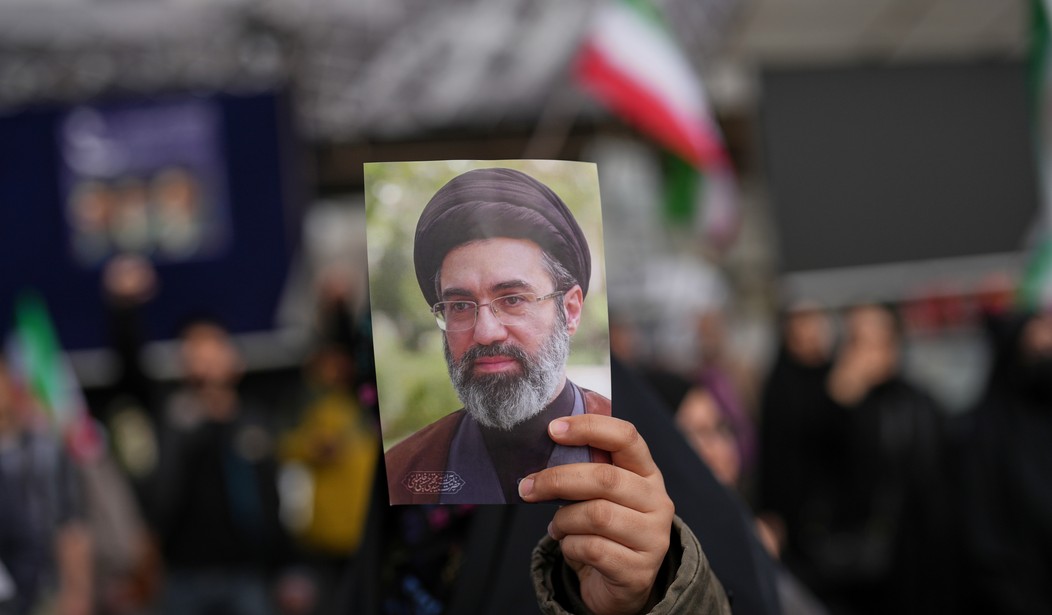
The regime is fracturing too. Ayatollah Ali Khamenei was killed on the first day of the war. His wounded son, Mojtaba Khamenei, formally holds the supreme leader position now, but he’s been MIA for weeks.
Why does this matter? Without a genuine clerical authority at the top arbitrating key decisions, rivalries among IRGC commanders could intensify. And as the perception grows that Mojtaba is a figurehead, the regime's internal legitimacy erodes further — both among elites who see an opening and among ordinary Iranians who have watched their purchasing power evaporate in real time.
The regime certainly knows how to mobilize security forces, but repeated massacres deepen public resentment rather than extinguish it. At some point, the IRGC's willingness to shoot its own people may not be enough to hold the line.
And Washington is betting on exactly that breaking point.
U.S. officials believe that while talks have stalled, Iran will eventually crack under the economic strain.
The question isn't whether Iran is approaching a tipping point; it’s how much longer the regime can pretend it isn't. It is essentially a high-stakes waiting game, and Iran's clock is running out faster than its leadership wants to admit.


Join the Conversation
VIP members get the ability to comment on articles.