
Ten years ago kids were downloading the Hamilton soundtrack to listen to the lyrics on repeat, rapping along that they were ‘not throwin' away my shot.’ Teens memorized the entire album, learning every song. That’s exactly how my 9-year-old friends and I acted in 1976 when we got our hands on the cast album of 1776.
We were late to the party. In 1969, a full seven years before the Bicentennial, the musical 1776 opened on Broadway and ran for three years before closing. New York Times critic Clive Barnes called it the “sleeper hit” of the season. It won three Tonys, including Best Musical.
In 1972, the musical went to the movies. William Daniels (later known for St. Elsewhere) starred as John Adams, the man who stubbornly encouraged his fellow Continental Congress members to adopt a resolution of independence. Stage veteran Howard Da Silva asked to reprise his role as Benjamin Franklin in the movie for his grandchildren. Ken Howard came over from the Broadway show to reprise his role as Thomas Jefferson. A young Blythe Danner played Jefferson’s wife, Martha. (Based on the production dates compared to daughter Gwyneth Paltrow’s birthday, it’s possible that she was pregnant with Gwyneth during filming.) Martha sang and danced of her love for Thomas in the number He Plays the Violin – even dancing with the supposedly stuffed-shirt Adams.
Librettist Peter Stone had to take a few liberties to give the musical its tension and keep audiences watching when we all knew the ending. The congressional meetings weren’t publicized, and the writers relied on personal accounts and letters. John Adams was never as disliked as he was made out to be for drama’s sake; Jefferson did get to go home to his wife, instead of her coming to him as in the movie, and only about 20 of the 56 signers were featured to keep the movie under three hours.
The music is the part that charmed me, then and now. Roger Sherman’s songs were made to be sung happily and in great cheer. When Franklin comes up with the idea of sending Richard Henry Lee to Virginia to convince their legislators to propose independence (because remember, no one liked Adams) Lee puns his way through a romp based on his name. My friend Jane and I fell out laughing, singing about "The Lees of Old Virginia." Do enjoy this clip, if just to see the trick horseback mount.
Joyful as it was, the show isn’t all happy singing and dancing. Throughout, there’s real tension as to whether Congress can pass the resolution and the Declaration unanimously. Watching the delegates argue, you remember that only one-third of the population was for independence. Pennsylvania delegate John Dickinson is shown as one of the leaders of those who wanted to stay loyal. He didn’t sign the Declaration and left.
The stage musical and movie don’t neglect the pain of slavery. Southern delegates threatened not to adopt the Declaration if certain phrases weren’t removed. The musical presents the issue as complex; South Carolina delegate Edward Rutledge sings of how involved Yankee ships are in the slave trade in "Molasses to Rum."
Sprinkled throughout the film are dispatches from George Washington’s army. The congressional clerk reads out increasingly dire news with each report. At one point, the courier joins another young soldier, and they remember friends who died at the Battle of Lexington in the haunting "Mama, Look Sharp."
Finally, the team of Franklin, Jefferson, and Adams managed to convince the delegates to change their votes and adopt the resolution for independence submitted by Richard Henry Lee on July 2, as Chris Queen wrote. Representative Caesar Rodney, as Catherine Salgado wrote, arrived after a furious 18-hour dash from his home in Delaware.
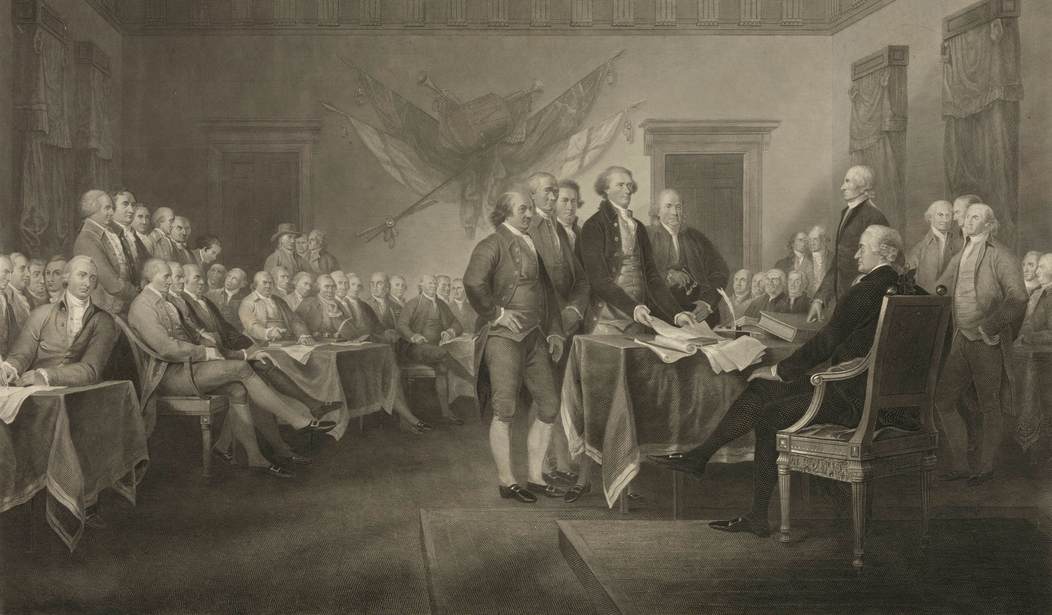
The movie ends with the majestic tolling of the Liberty Bell as the representatives sign the Declaration. Even New York’s delegation, which had instructions from its state and so “courteously abstained” from every vote, signed. The scene freezes into a painting reminiscent of John Trumbull's famous work (at the top of this column).
I can’t leave you on a solemn note. One more song, one of my favorites: this one my friend Jane and I sang over and over. After Jefferson finally finishes his draft of the Declaration of Independence, he, Adams, and Franklin ponder which bird will symbolize our nation in "The Egg." Jefferson wants a dove; Adams, the eagle, and Franklin, the turkey! (“The turkey is the truly noble bird. Native American, source of sustenance for our original settlers, an incredibly brave fellow, who will not flinch at attacking a regiment of Englishmen, singlehandedly!”) They sing a tune so catchy you will find yourself singing “chirp, chirp, chirp” right along with them:
During your Independence Day celebrations this special year, clear a couple of hours to watch this wonderful movie. I'm glad I did.