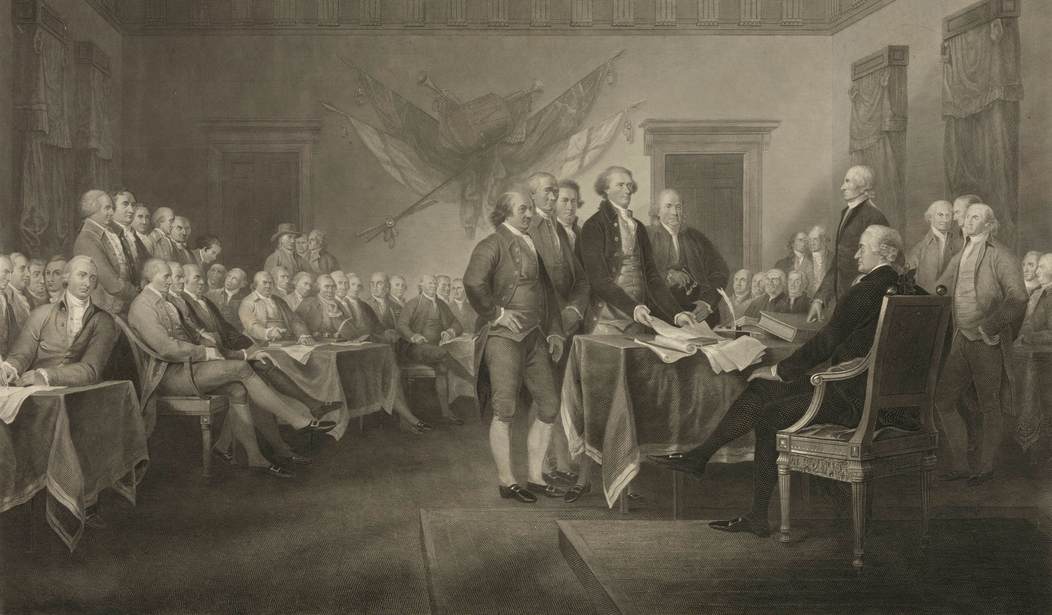

Exactly two and a half centuries ago today (July 1), Caesar Rodney mounted his horse to ride 18 hours through rain and mud to vote for independence. And every man in the Continental Congress who either voted for independence or signed the Declaration sacrificed something, great or small, for the creation of a new nation.
Looking back on the events of 1776, especially as we approach this historic July 4, we tend to see that year through rose-colored — or red, white, and blue-colored — glasses. We see that as a glorious year, and rightly so. But for those men who were fighting in the Army or serving in the Continental Congress that year, a series of defeats on the battlefield and the very real possibility of final failure darkened their minds and prospects. The British had been bestially cruel in punishing rebels in other lands, including Scotland and Ireland. And if the Americans declared for independence, they’d be infuriating the British still more.
The congressional delegates like John Alsop and Thomas Cushing who opposed independence were not visionaries, but they made some pragmatic points. A mishmash of volunteer militia and raw recruits were taking on the most powerful empire in the world (Britain). As brilliant as George Washington was, and as brave as many of his men were, there had already been discouraging battlefield defeats. The British had already committed war crimes, and they would commit more. Besides, some of the anti-independence voices argued, didn’t they all prefer gaining a few concessions and remaining British citizens?
John Adams, Benjamin Franklin, and other independence advocates pointed out the years of British offenses and refusals to give concessions. These Patriots argued that it was too late to pull back with an Army already in the field, and that Americans could only hope for freedom separate from the British empire. As Patrick Henry had put it, the choice was either liberty or death.
This was the split in Congress, with the two Delaware delegates in Philadelphia taking opposite sides and unanimity among the colonial delegations necessary for independence, when Delaware’s Caesar Rodney ignored bad health and worse weather to gallop to vote for independence.
Rodney broke the tie in his state delegation. The Continental Congress’s 13 delegations voted for independence on July 2, approving Virginian Richard Henry Lee’s resolution. Adams, who had seconded the resolution and pushed for the drafting of the Declaration, wrote in wild triumph to his wife Abigail, “The Second Day of July 1776, will be the most memorable Epocha, in the History of America.—I am apt to believe that it will be celebrated, by succeeding Generations, as the great anniversary Festival. It ought to be commemorated, as the Day of Deliverance by solemn Acts of Devotion to God Almighty.” He was right about the celebrations, but they mostly occur on July 4 when the Declaration was approved. Philadelphia is holding July 2 America250 events this year, though.
Related: John Callender: The Coward Who Transformed Into a Patriot Hero
The group of men who voted for independence and the group who signed the Declaration of Independence in August were not exactly identical. For instance, Robert Livingston, who was on the Committee of Five (with Adams, Franklin, Roger Sherman, and Thomas Jefferson) to draft the Declaration, never did sign the document. But all those men who staked their lives, their fortunes, and their sacred honor on independence either by vote or by signature were truly taking a massive risk. Arcanum Wayne Trail Historical Society states:
Five signers were captured by the British as traitors, and tortured before they died. Twelve had their homes ransacked and burned. Two lost their sons in the revolutionary army, another had two sons captured. Nine of the 56 fought and died from wounds or hardships of the revolutionary war.
Even those who survived the war and had homes intact had suffered various privations and long periods away from family, or had invested a great deal of money, in order to bring about independence. The birth of our nation came at a great cost, one we must never forget.