


If you haven't seen the Broadway musical 1776, you really should stream it this Independence Day.
It's not very accurate, and some of the portrayals of the Founders were fanciful. Some of the music is eminently forgettable.
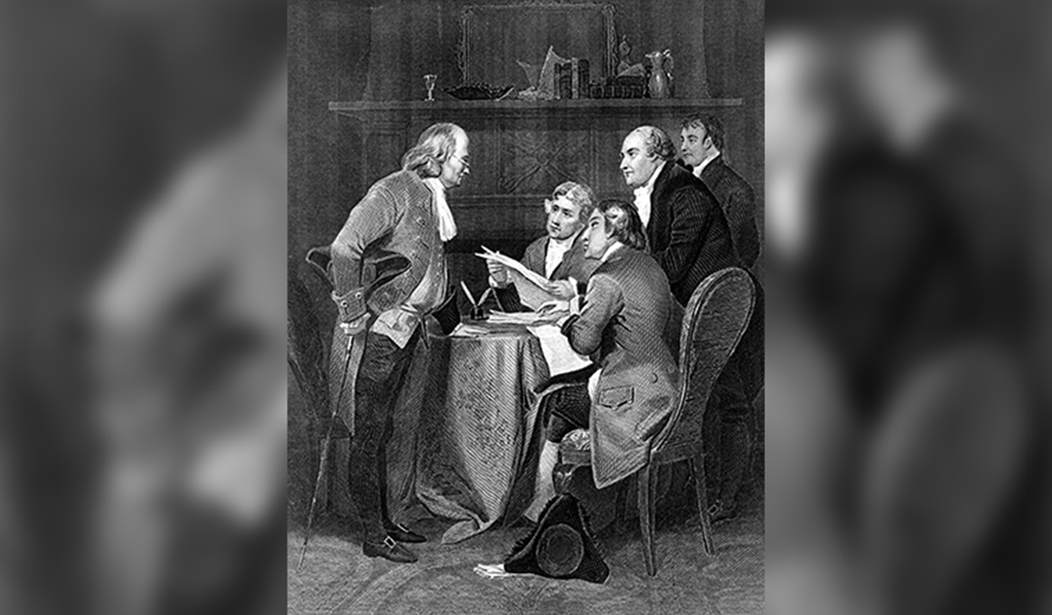
The song "But, Mr. Adams" is about the formation of the "Committee of Five" on June 11, 1776, which Congress tasked with writing the Declaration of Independence. It's a delightful bit of musical theater and fairly accurate in how it came about that Thomas Jefferson was chosen to write the Declaration.
John Adams knew that the colonies needed to proclaim to the world the reasons for taking up arms against the mother country. It would be a nice bit of propaganda, Adams thought, a uniting expedient to rally the divided colonies around the common goal of independence.
If Adams or Congress had thought for one minute that the Declaration of Independence would achieve the historical importance it has, it's not likely that the 33-year-old Jefferson would have been given the task of writing it. For independence to be achieved, many impossibilities had to come to pass. Historical serendipity could never have imagined Jefferson's handiwork would become such a shattering success.
Virginian Richard Henry Lee had introduced the resolution for independence on June 7, declaring "That these United Colonies are, and of right ought to be, free and independent States." Some opponents of independence wanted an immediate vote after it was decided that the resolution would have to be passed unanimously. Drafting a declaration would allow time for popular sentiment to coalesce around the idea of independence.
Why Jefferson to write it? The five men chosen for the "Committee of Five" — John Adams of Massachusetts, Roger Sherman of Connecticut, Robert Livingston of New York, Benjamin Franklin of Pennsylvania, and Jefferson — were all accomplished leaders. Franklin was the most famous American, thanks to his brilliant experiments with electricity, but he declined. “I have made it a rule… whenever in my power, to avoid becoming the draughtsman of papers to be reviewed by a public body,” he later told Jefferson.
Livingston and Sherman agreed to participate in the editing process but had no desire to write anything. That left Adams and Jefferson, with each thinking the other had the qualifications to write it.
Jefferson, who was only 33 at the time, actually wanted Adams to write it. Jefferson was notoriously quiet in Congress — he rarely spoke in debates — but he had a reputation for his powerful written prose, largely thanks to the 1774 pamphlet A Summary View of the Rights of British America.
Jefferson introduced the philosophical argument that would later define the Declaration of Independence: that God, not a monarch, grants human rights. He famously wrote: "The God who gave us life gave us liberty at the same time; the hand of force may destroy, but cannot disjoin them."
Jefferson didn't actually intend for it to be published as a standalone book; it was originally written as a set of instructions for Virginia's delegates to the First Continental Congress. However, his friends in Williamsburg printed it as a pamphlet, and it quickly spread throughout the colonies and even reached London.
It was precisely the powerful, poetic phrasing of A Summary View that established Jefferson's reputation as one of the finest writers in America — which is exactly why John Adams and the Committee of Five insisted that he be the one to write the Declaration of Independence two years later.
Adams's seminal argument was that "This business [the declaration] needs a Virginian." Indeed, some influential colonists already believed that if Massachusetts had tried to compromise with the crown, there wouldn't have been all this trouble. Adams was seen as a rabble-rouser and troublemaker.
The task of writing the Declaration of Independence fell to Jefferson largely by default.
In the musical 1776, Jefferson suffered a bad case of writer's block because he missed his "new" wife. He had actually married Martha Jefferson on New Year's Day in 1772, but the show needed a pretty girl, and Blyth Danner, who played the role on Broadway and in the film, fit the bill. She shows up in Philadelphia after Franklin sent for her in a wonderful scene, "He Plays the Violin," dancing with both Benjamin Franklin (Howard da Silva) and John Adams (William Daniels).
Needless to say, that's not how it happened.
Entertaining as it is to imagine Jefferson fighting through writer’s block and crumpling up paper as he began work on the Declaration, that’s not the way it went. The drafting process proceeded quickly in the second-floor rooms that Jefferson rented in a brick house in Philadelphia. He wrote on a portable wooden desk that he had custom-ordered. Despite all the speculation about what books he consulted, the answer appears to be none. “I turned to neither book or pamphlet while writing it,” he recalled. He had already read the great philosophers and absorbed their ideas. Had he not done so beforehand (do your homework, kids!), he could never have produced a complete draft in what was said to be a mere “day or two.”
Exclusively for our VIPs: The IPCC Exaggerates Climate Catastrophe, But Not For the Reason You Might Think
After the revolution and in Jefferson's later years, he was accused by Adams partisans of not having an original thought in the entire Declaration. "In 1822, annoyed by all the accolades Jefferson had received for the Declaration, Adams himself resentfully wrote, 'There is not an idea in it, but what had been hackneyed in Congress for two years before,' as told in Jonathan Horn's article in The Free Press.
Jefferson admitted as much in a letter to Adams. “I did not consider it as any part of my charge to invent new ideas altogether,” he responded. In fact, Jefferson drew on the words and thoughts of the greatest minds of the Enlightenment, including John Locke, Montesquieu, and Jean-Jacques Rousseau. He had absorbed their ideas all his life and made them part of the most important civic document in history.
The Declaration might have been considered an afterthought. It became the basis for human liberty around the world.
Editor's Note: President Trump is leading America into the "Golden Age" as Democrats try desperately to stop it.
Help us continue to report on President Trump's successes. Join PJ Media VIP and use promo code FIGHT to receive 60% off your membership.





Join the conversation as a VIP Member