


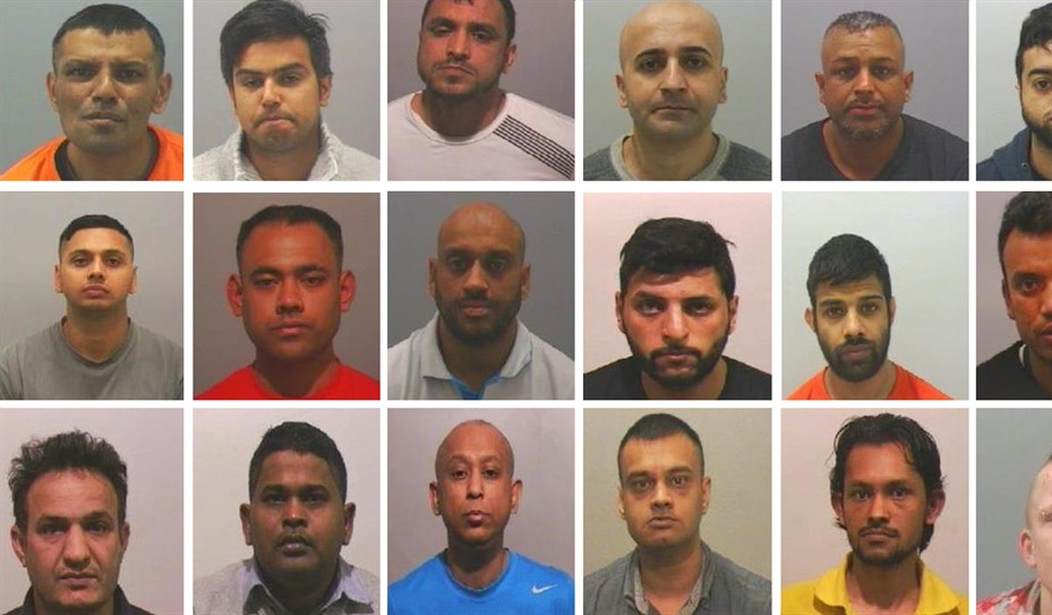
Rupert Lowe’s Rape Gang Inquiry report, published June 15, 2026, has hit Britain like a thunderclap. At roughly 219 pages of harrowing documentation, survivor testimonies, whistleblower accounts, court records, and statistics, it paints a decades-long nightmare: for well over half a century, young British girls, overwhelmingly white and from poor, vulnerable backgrounds, have been systematically seduced, plied with drugs and alcohol, violently gang-raped, trafficked, tortured, and in some cases murdered by groups of predominantly Pakistani Muslim men.
In certain documented instances, police officers actively participated in the abuse. In the far more common pattern, authorities turned a blind eye. Girls as young as 10 or 11 reported their ordeals to social workers, doctors, care home staff, teachers, and police, only to be dismissed, disbelieved, or even blamed. The scale is staggering: the inquiry estimates at least 250,000 victims across multiple towns and cities.
Yet, in the aftermath, prominent Muslim voices have rushed not to condemn the perpetrators or demand justice, but to defend the community and attack the messenger. One such response came from activist Bushra Shaikh:
Desperate stuff yet again by Rupert Lowe. Islam is not responsible for the actions of some bad people. The same way Christianity isn't. Islam sentences paedophiles and in many cases, rapists to death. That in itself proves there is no link.
— Bushra Shaikh (@Bushra1Shaikh) June 16, 2026
This man is putting the lives of… https://t.co/WyO86nvOgr
This is textbook deflection: “some bad people,” no link to Islam, and critics like Lowe are the real danger for “endangering ordinary British Muslims.” Sadiq Khan, mayor of London, has also denied that girls were raped at the hands of these Muslim gangs.
🚨WOW: Sadiq Khan personally READ reports on young girls gang-raped in London hotels by Muslims plied with drugs, threatened & abused.
— The British Patriot (@TheBritLad) June 16, 2026
YET on multiple occasions, he publicly denied grooming gangs exist in the capital.
This denial has enabled abuse.
Accountability is overdue. pic.twitter.com/YXrXkDBR7m
This reflexive denial brings us to the heart of the matter. It is not simply a disagreement over facts or politics, and it's not just a lie. It reveals a deeper fracture in what I call the language commons — our shared language and moral vocabulary. When Islamic activists deploy English words like “rape” and “pedophilia,” Western audiences hear them through a secular, post-Enlightenment filter of universal consent, child protection, and human rights. But those same words often define, within the parallel Sharia-derived moral universe, different boundaries, permissions, and priorities. This linguistic sleight-of-hand enables denial even as patterns of predation match broader strategies of hijra — conquest through demographics and community building instead of or prior to violent conquest.*
The Western Consensus
In the West and among Western peoples, the definitions of rape and pedophilia are clear, consistent, and grounded in a shared moral and legal framework. This consensus spans the United States, the United Kingdom, Canada, Australia, and most of Europe. It rests on Enlightenment principles of individual rights, consent, and child protection.
Rape means:
- Non-consensual sexual penetration of any kind.
- Consent must be affirmative, informed, ongoing, and freely given. It can be withdrawn at any time.
- Intoxication, coercion, threats, or incapacity invalidate consent.
- Marital status offers no exemption — marital rape is a serious crime.
Pedophilia and child sexual abuse mean:
- Any sexual activity involving a minor below the legal age of consent (typically 16–18).
- Children cannot consent, period. Cultural, religious, or familial claims provide no defense.
- This includes grooming, touching, penetration, or exposure to sexual acts.
Mandatory reporting laws require teachers, doctors, social workers, police, and care home staff to act on even the suspicion of abuse — no child must “cry for help” for intervention to be required. Failures to protect are betrayals of this framework, not features of it.
The Islamic Framework – Different Boundaries
The Islamic framework operates with different boundaries and permissions, rooted in classical Sharia jurisprudence (fiqh) drawn from the Quran, Hadith, and scholarly consensus across major schools of law. These definitions differ from the Western consensus, creating a fundamental linguistic fracture.
Rape in traditional Islamic terms generally refers to zina bil jabr, unlawful forced sex outside permitted categories. It does not map at all onto Western consent standards, in which we, of course, do not have permitted categories of nonconsensual sex.
- Forcible sex within marriage or with captives (“those whom your right hands possess” – Quran 4:24, 23:5-6) is often licit.
- Classical jurisprudence does not recognize marital rape as a crime in the same way; the husband has a right to sexual relations, and the wife has a duty.
- In non-marital cases, strict evidentiary rules (hudud) apply, making convictions difficult to obtain.
Child sexual abuse/pedophilia lacks a direct Western-style prohibition based on chronological age:
- No fixed minimum age of consent, like 16–18. Marriage (nikah) can be contracted for girls before puberty; consummation is generally tied to physical readiness (bulugh).
- The precedent of Aisha (betrothed at 6–7, consummated at 9 according to major Hadith collections) is normative in traditional views. Quran 65:4 discusses waiting periods for divorced girls “who have not menstruated,” presupposing prepubescent marriage.
- Acts within a valid marriage contract are not classified as abuse or pedophilia; condemnation targets unsanctioned violations, especially against Muslim victims.
These rules mean that actions Western law deems child rape are perfectly acceptable within an Islamic society. In Dar al-Harb (House of War – non-Muslim lands), additional permissions for forcible sex historically apply to captives and outsiders. And the lack of a fixed age for child sexual consent means there really isn’t such a thing as pedophilia at all, from the perspective of Islam.
Again, in the West, there is no such thing as permissible forced sex. I cannot possibly overemphasize this enough.
Grooming Gangs – Religious Overtones and the Word Gap
These differing definitions of critical core terms surface clearly in the grooming gang cases. Survivor accounts and official reports frequently note perpetrators using religious language to justify their actions. Non-Muslim girls — children — were described as “white slags,” “kaffir,” or “easy meat” — outsiders not entitled to the same protections as Muslim women and girls. Some victims reported hearing claims that sex with unbelievers carried no sin, or Quran recitations during the assaults.
In the West, these acts are unambiguously rape and child sexual abuse: non-consensual violations of minors incapable of consent. Within the traditional Islamic framework, however, the same acts are evaluated through the lenses of marriage validity, puberty markers, permitted relations with captives or non-Muslims in Dar al-Harb, and hudud rules — boundaries that do not recognize age limits or consent.
This is our linguistic fracture in action: the English words “rape” and “pedophilia” sound like universal condemnation to Western ears. But to those operating from classical Sharia categories, the result is a truthful (from their perspective) denial that these actions are rape at all. Instead, they are often viewed as legitimate, moral, and even positive actions that advance the worship of Allah through hijra and civilizational expansion.
Language Breakdown and Solutions
When the same English words carry such divergent meanings, rational public discourse becomes nearly impossible. To the Muslim ear, actions that violate Western definitions may not register as crimes at all, provided they occur within permitted categories of marriage, captivity, or Dar al-Harb relations. This produces the reflexive denial we see after every inquiry: “Islam forbids it,” “some bad people,” and accusations that naming the pattern endangers Muslims. They totally believe this, because their worldview does not see the grooming gang activities as wrong.
Linguistic defense is the one practical step most readers can take themselves. Insist on clear, precise Western definitions whenever these terms arise in public debate. Define potentially shaky words explicitly. Stay alert: many bitter disagreements stem not only from bad faith but also from people using the same words to mean entirely different things — a violation of our common language that occurs all too often today.
Require systemic clarity:
- Truth first: Mandate transparent data collection on religion and ethnicity in grooming and child sexual abuse cases. Support independent inquiries like Rupert Lowe’s and make doctrinal differences part of public education.
- Policy realism: Prioritize ideological vetting in immigration. Enforce assimilation over multiculturalism. Apply Western age-of-consent and child protection laws uniformly — no religious or cultural exemptions. End parallel Sharia systems and deport non-citizens who reject host norms.
- Civilizational self-defense: Treat hijra as the strategic settlement it is intended to be. Secure borders, promote a confident Western identity, and reject policies that weaken host societies from within.
We must stop pretending that equivalence exists where none does. Honest speech with clear, mutually agreed-upon definitions is the prerequisite for protection. Without clearly defined language, we have no way of communicating. And without communication, the only way to negotiate is through violence.
Conclusion
Our linguistic fracture runs deeper than polite disagreement. It shields incompatible worldviews behind familiar English words, leaving vulnerable girls unprotected while activists, unscrupulous politicians, and others deceive the public using words we think we understand.
I recommend that every reader download and examine Rupert Lowe’s Rape Gang Inquiry report — roughly 219 pages of documentation, survivor accounts, and evidence. At a minimum, read the introduction and executive summary. It is one of the hardest things I have ever read: utterly revolting in its detail. Yet it is necessary, in the same way that the raw Israeli documentary footage of October 7 was necessary. Only by facing the unvarnished truth can the public grasp the scale of what has happened and what continues to happen in Britain.
Reclaiming our shared language — insisting on precise Western definitions of rape, consent, and child protection — is the first and most accessible act of defense. Honest speech grounded in evidence and moral clarity remains our best tool for protecting the innocent and preserving civilization. The time for equivocation is over.
*The concept of hijra came from Muhammad’s migration from Mecca to Medina, which serves as a model for conquering lands through settlement and migration rather than (or in preparation for) violent war. Those engaged in hijra are considered mujahideen (warriors in the cause of Islam), advancing the faith’s expansion. Modern Islamist thought, exemplified by the Muslim Brotherhood’s 1991 Explanatory Memorandum, describes work in the West as “a kind of grand jihad in eliminating and destroying the Western civilization from within.” Influential personalities like Yusuf al-Qaradawi have spoken of Islam returning to Europe through da’wah (preaching) and hijra. Not every Muslim immigrant pursues this consciously, but the ideological current promotes demographic leverage, parallel societies, and gradual supremacy.
Editor’s Note: Help us continue to report the truth about corrupt politicians.
Join PJ Media VIP and use promo code FIGHT to receive 60% off your membership.




Join the conversation as a VIP Member