


I am a writer; moreover, I am primarily a writer of fiction. I am also autistic and have worked long and hard to understand humans, who in my childhood were nearly alien beings to me. For these reasons, when people do things I do not understand, I stop and try to figure them out, to put myself into their heads when possible, and work out what they are thinking when I can’t.
When an ICE agent shot and killed Renee Good in Minneapolis, I had trouble doing that. Good was a 37-year-old mother of three. She had just dropped her child off at school when she involved herself in a protest against ICE enforcement, a protest that turned deadly for her. Here was a mother, her child now bereft of both parents, participating in a confrontational activity that carried, as anyone could see, a significant risk of death. What was she thinking?
For a long while, that question frustrated me. Then I realized I had been studying its perfect paradigm my entire life: the Salem Witchcraft Trials.
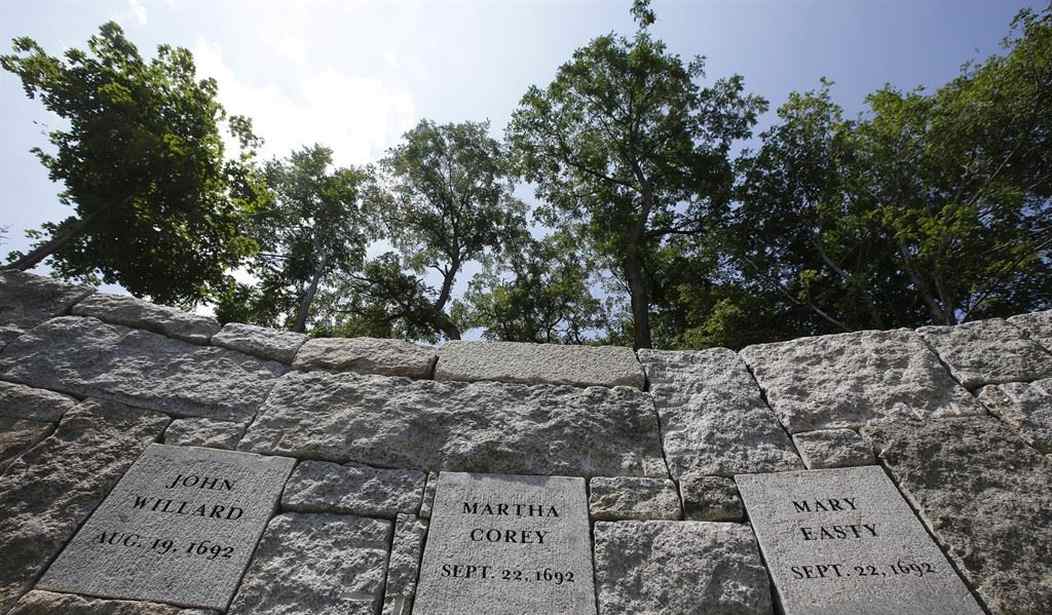
When I was ten, I discovered I shared a last name with one of the hanged “witches.” That revelation lodged itself in my imagination; later, I found that John Proctor was, in fact, my 11x great uncle. Salem became a lifelong obsession, not because of the occult trappings now sold as tourist kitsch, but because of the central historical horror: how could ordinary people — neighbors, friends, fellow church members — come to condemn and execute one another for imagined torments? What were they thinking?
The answer is not that they were uniquely superstitious. It is that human psychology under pressure has predictable, repeatable patterns that sometimes turn deadly.
Salem Is a Tourist Town Now
When I visited Salem, Mass., I was struck less by history than by noise. The place I went to for history today features tacky witch hats and plastic brooms in shop windows. Neon signs promise hexes and good luck. Ghost tours feature punchlines and goofy costumes. A tragedy has been turned into a sideshow, sold as a Halloween aesthetic.
But what happened in Salem was not cutesy folklore. It was a real sequence of arrests, coerced confessions, and executions carried out by sober, God-fearing people who believed they were acting cautiously and in the defense of their community and God. Nineteen were hanged, and one man was pressed to death. Hundreds were ruined.
The modern story reassures us that this happened because people were ignorant, backward, or enslaved to superstition. That explanation is comforting because we, living in an enlightened age of science and reason and modern values, are immune to such madness.
That story is wrong.
The people of Salem were not uniquely stupid or cruel. They were a community under strain from political instability, fear, religious pressure, personal rivalries, and war. Only a few years prior, ten percent of the colony's population had died from Indian attacks. All these pressures layered until judgment narrowed: it must be the action of Satan. Urgency took over.
The tragedy began quietly, with suffering that was believed too quickly and examined too little. A group of girls and young women, mostly single, mostly with little hope for a good future, all frightened, emotionally unstable, or simply immature, exhibited disturbing behaviors. (Yes, that parallel also does not escape me.) Their distress was real. What it meant was far less certain. But the explanations they provided aligned with what authority already believed: invisible threats, torments by invisible witches and their servants, required decisive action.
And so the girls were believed. Once that happened, the moral terrain shifted. Their suffering became ours. The accused became them. Questioning the accusations was no longer prudence; it was betrayal. Dissent was not caution; it was complicity. (And the girls, once they found they had the power to move the entire community, had no reason to change their behavior.)
The community did not lose reason all at once. Faced with fear and pain, Salem compressed a complex moral landscape into something simple enough to act on:
- Someone is hurting,
- Someone must be responsible,
- Remove the responsible party and
- The harm will stop.
That logic felt sound. The situation was urgent. The elites of that day, the ministers who mostly ran the colony, formed a special court of Oyer and Terminer to hear the cases and dispose of the witches as quickly as possible. Those who confessed and accused others were spared. Those who refused, who would not lie to save themselves, were executed. They went to their deaths praying, not because they were saints, but because they refused to buy their lives with falsehood.
This is the part that never makes it onto souvenir mugs.
Salem was not a story about madness. It was a story about moral narrowing, about what happens when fear, authority, and group loyalty converge, and responsibility is quietly outsourced to a narrative.
Salem Was Not an Aberration. It Was a Template.
Treating Salem as a freak occurrence lets us file it away as a historical error, a bad batch of people in a bad century. But the pattern is not confined to the 17th century. It is a human pattern.
Strip away the Puritan language and what remains is a recognizable structure:
- A small number of individuals experience distress;
- Authority validates that distress because it aligns with preexisting beliefs;
- Urgency replaces deliberation;
- Dissent is reframed as danger;
- Responsibility gets transferred.
At no point does anyone need to believe they are doing evil.
Salem teaches us what happens when stopping harm becomes more important than understanding it and acting becomes more important than being certain. Once that decision is made, the machinery runs largely on its own. Individuals become functions. Truth becomes subordinate to outcome. Tragedy is justified retroactively with the claim that it could not have been otherwise.
This is not a religious pathology. It is a human one.
The Shape of Modern Protest
Modern protest movements do not resemble Salem on the surface: no gallows, no spectral evidence (though often the things that are claimed are invisible), no girls having fits (okay, that may be arguable), no stern Puritan ministers. What they share instead is structure.
They often begin with something real: a death, an injury, a video clip heavy with emotion and stripped of context. People gather not necessarily because they crave chaos, but because they want to prevent the next injury. They want to stand between power and perceived vulnerability. In short, they are trying to do what they perceive is good.
That initial impulse is morally intelligible.
But modern protests also unfold inside a media and political ecosystem that rewards outrage and accelerates conflict. News organizations compete for attention. Social media influencers gain followers and status by amplifying fear and moral certainty. Activists seeking influence find platforms through escalation. Politicians exploit the chaos to mobilize voters and injure opponents. None of these actors needs to fabricate suffering; they merely frame, repeat, and magnify it.
In this environment, urgency becomes currency.
As protests grow, suffering becomes proof. Simplified narratives crowd out complexity. The world collapses into moral pairs: victim and oppressor, resistance and violence, courage and complicity. Those who question tactics are accused of siding with harm. Those who insist on process are told that process is how injustice hides. Those who ask for restraint are told that restraint kills. And the loudest voices rise to the top, not because they are wise, but because escalation is more profitable than resolution.
As in Salem, the crowd does not see itself as a mob. It sees itself as a shield.
And once that self-image takes hold, escalation no longer feels reckless. It feels righteous.
Minneapolis and the Old Geometry
When federal immigration agents arrived in Minneapolis and Renee Good was killed, the reaction followed the template almost perfectly.
For many protesters, this was not a legal debate about jurisdiction or enforcement authority. It was a moral emergency. Armed agents = oppressive force. The people gathered = vulnerability. A woman was dead.
Blocking ICE agents felt protective, not dangerous. Interfering with law enforcement felt necessary, not criminal. Physical confrontation felt defensive, not like escalation. Dissent, as always, as with Salem, quickly became suspect. To ask whether some of those arrested were violent offenders was to betray the narrative. To point out that federal agents were acting under lawful authority was to excuse violence. To caution against physical interference was to side with power.
The suffering and fear and danger were real. But so was the narrowing and simplification of the situation. It became black and white, good versus evil, defenders of society versus jack-booted thugs, today's devil.
Salem’s accused were not executed because the community hated them. They were executed because the community believed that removing them would stop the harm. Today's protesters are not driven by hatred. They are driven by the same moral compression: the belief that if we do not act now, something irreparable will happen, and urgency sanctifies cost. They are driven by fear, not evil. But the consequences, of course, become evil.
A Caution
Our natural impulse as conservatives, and as human beings who see what happened in Minneapolis as a law-enforcement incident gone tragically wrong, is to condemn the voices speaking up for Renee Good. We are naturally inclined to recoil from the chaos, to mock and dismiss the sadly very real distress. That impulse feels right in the moment, but it risks the same pattern that led to tragedy in Salem: reducing complex human suffering to binary moral conflict and outsourcing judgment to the loudest voices.
Some actors are not persuadable. News organizations, influencers, activists seeking prominence, and politicians eager to score political points fuel escalation because controversy serves them. As with certain actors in Salem, they profit from amplification, not resolution.
We cannot stop them. We can only choose not to become part of the pattern they exploit.
We honor the dead by insisting on truth rather than spectacle, process rather than panic, and responsibility rather than rage, even when others profit from refusing to do the same. We are in the unenviable position of being the adults in the room. This stance won’t dominate social media or silence every loud voice, but enough of us doing it prevents tragedy from metastasizing.
Salem did not need more certainty. It needed fewer people willing to trade judgment for urgency.
So do we.
Editor’s Note: Help PJ Media keep bringing you great cultural content that will make you think and keep you informed. Join PJ Media VIP and use the promo code FIGHT to get 60% off your VIP membership!







Join the conversation as a VIP Member