







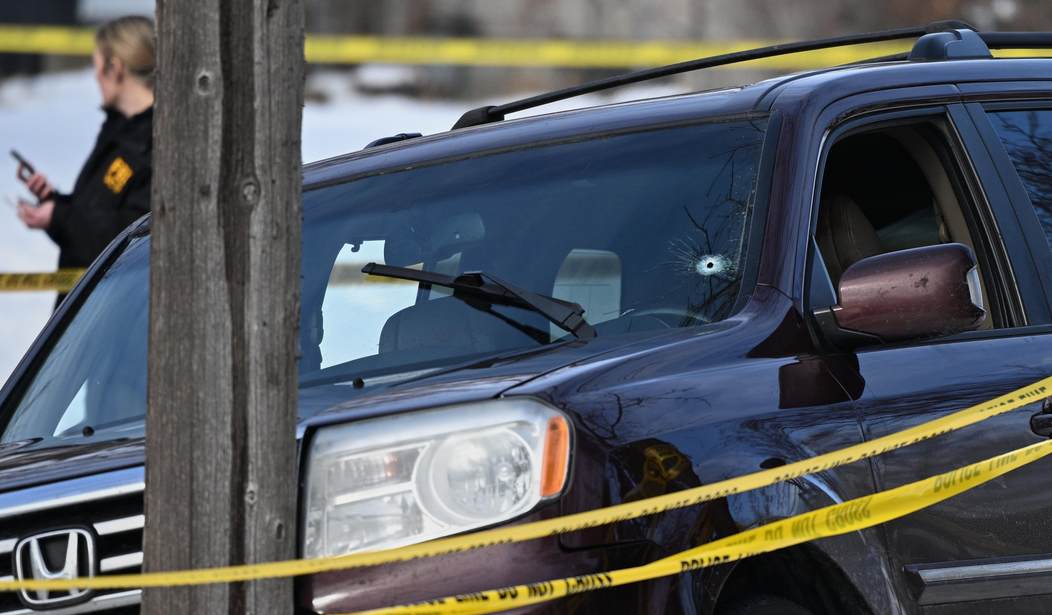
Yesterday in Minneapolis, Renee Nicole Good, a 37-year-old mother, was shot and killed after accelerating her vehicle toward an ICE agent who drew a gun when he realized he was about to be run down. That much was already clear from multiple camera angles. A car driven aggressively is a deadly weapon; this has been adjudicated in many court cases. A law enforcement officer under threat is allowed to counter with deadly force, in fact trained and encouraged to do so. To the left, this did not matter.
Within hours, perhaps minutes, Good was elevated into martyrdom. The familiar language appeared almost instantly: state violence, innocent victim, state-sponsored terrorism, proof of systemic injustice. Before most facts were known, before the blood was even dry, the moral conclusion had already been reached.
In the PJ Media virtual newsroom, the reaction was immediate and grimly unsurprised. As soon as the story broke, we knew she would be the left’s new George Floyd. That prediction was not cynical; it was observational. The wagon ruts of the pattern are so predictable it’s easy to see when a story is falling in line, and when the media is getting behind it.
Today, for good or ill, our culture manufactures meaning out of everyday incidents, provided it serves the purpose of the Media Narrative. And the words matter. The left and right fundamentally disagree on what a hero or a martyr even is.
Heroes, Martyrs, and the Collapse of Moral Categories
To conservatives and most libertarians, a martyr is someone who suffers or dies for what he believes. He chooses fidelity over safety and accepts the cost, even if it means torture and death. Jim Elliot, profiled in Chris Queen’s article today, is an example; could we make the same choice for the sake of God? A hero is someone who acts, who steps forward in danger, takes responsibility, and either saves people, dies well, or both. These are distinct and different moral achievements, neither overlapping nor interchangeable though they both require courage.
On the left, the line between hero and martyr is consistently and often deliberately blurred. Victimhood is the real qualifying condition, not courage or character. In each case, the same individual is treated simultaneously as victim, hero, martyr, moral exemplar, and stand-in for an entire class of people. Suffering, not courage, does all the moral work. Action is optional and choice is irrelevant; in fact, I don’t remember seeing a single case in which the victim-hero chose his fate.
When the categories of hero and martyr collapse, something crucial is lost to both. Martyrdom without choice is not martyrdom; it is tragedy. Heroism without action is incoherent; heroism without courage simply is not heroism. When suffering alone becomes the credential for moral authority, complexity becomes a threat rather than a fact of life. Hero-martyrs are easier to manage if they are treated as helpless, morally pure exemplars of leftist ideals and victims of the mean old Right-Wing Jack-Booted Thugs. As humans, they are complex and impure; as flat caricatures, they become Symbols.
This is why left-elevated figures require constant purification. Evidence contradictory to the narrative that is embraced by media and activists is not merely inconvenient; it is treated as immoral. Context is not “discouraged,” but rather filtered. Facts that disrupt moral clarity are minimized or dismissed outright. The goal is not understanding. It is preservation of symbolic purity.
This is not some vast conspiracy, either. For this to be effective requires only shared ideology, profit incentives, intellectual laziness, and fear. Newsrooms are culturally homogeneous, and they are sympatico with left-wing activism. Being wrong together is safer than being right alone. Meaning is assigned before verification because speed matters more than accuracy and because the narrative payoff for both newsroom and activist is immediate. Witness the GoFundMe for Good’s lesbian partner and son; as of right now, it’s nearing $1.5 million dollars. In less than 24 hours. I imagine donations coming to activist organizations are on par with that.
From Symbols to Power: How Victim-Heroes Create a Political Vacuum
The most significant consequence comes after elevation. When all you have are victim–martyr figures mislabeled as heroes, you don’t have actors, people who are rescuing others. You have instead people who need to be rescued. Someone else must act on their behalf. Victims, by definition, do not exercise agency within the story. They stand in for harm; they do not resolve it. That creates a vacuum.
Enter the politician. This structure is tailor-made for political virtue signaling. The victim provides moral urgency. The symbol provides justification. The politician steps in as protector, savior, and narrator of concern. Whether the problem is solved is beside the point. What matters is that power is exercised in the name of the symbolic class.
By contrast, the conservative actor-hero is dangerous to this system. These figures demonstrate that individuals can choose, intervene, and act without permission. They embarrass and often expose bureaucracies and make transparent the moral bankruptcy of institutions. They suggest that responsibility cannot be fully outsourced to the government, but sometimes, perhaps most times, is best held in the hands of mature, ethical individuals.
The Script Fails: Enter Donald Trump
In this light, the reaction to Donald Trump’s near-assassination was revealing. The man was shot and bleeding and in danger. His Secret Service detail was trying to rescue him, bundle him offstage. The cultural script demanded that he become a victim. The ritual space was ready: solemnity, protection, institutional guardianship, endless moral theater. Most politicians would have leaned into it instinctively.
Trump, being Trump, did the opposite. He refused the role of victim, instead taking upon himself the mantle of hero; he stood between the assassins and us. He did not crouch down, but stood tall, chanting “Fight! Fight! Fight!” He did not center his suffering, but rather his courage and defiance. He reasserted agency immediately. Not “look what was done to me,” but I’m still here. Not “you must act for me,” but I will keep acting.
That refusal to be a victim is what gave the moment its symbolic power. It was not calculated. It was instinctive. And it short-circuited the entire victim-to-savior pipeline in real time, highlighting the power of the traditional hero narrative.
A victim-based culture did not know how to process a man who chose action instead. The right, who still adhere to the traditional heroic archetypes, knew exactly how to handle it. That is why the moment resonated so deeply, even among people who could not articulate why it mattered.
In a culture trained to see suffering as the highest moral credential, choosing action instead of victimhood is an act of rebellion.
Editor’s Note: Help PJ Media keep telling the truth about the mainstream media's manufactured narratives. Join PJ Media VIP and use the promo code FIGHT to get 60% off your VIP membership!

Join the Conversation
VIP members get the ability to comment on articles.