







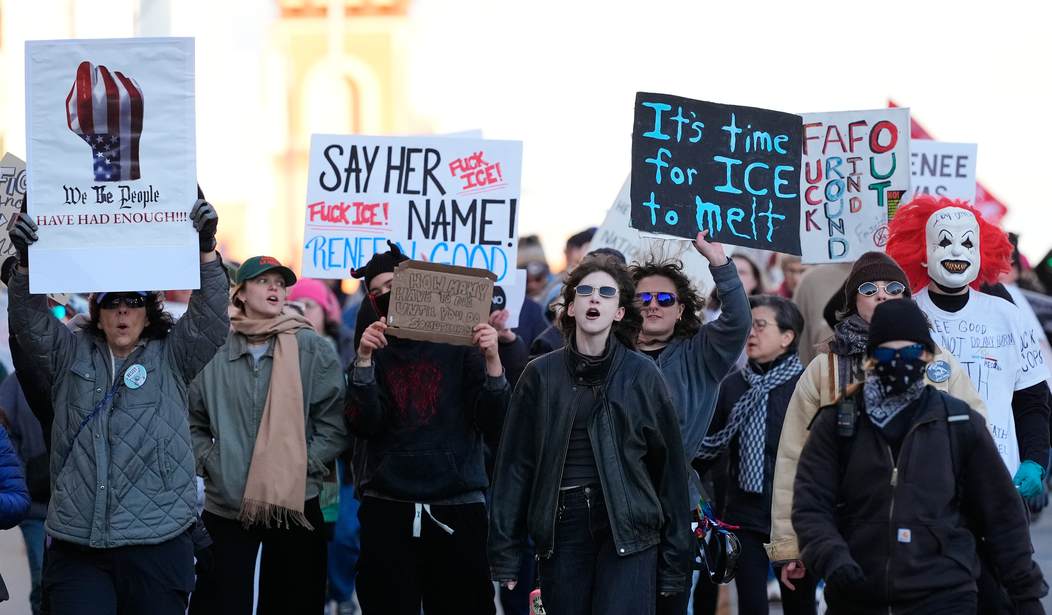
It’s been a challenge to keep up with the shifting narratives in the death of Renee Good, the woman shot and killed by an ICE agent in Minneapolis last week.
We were first told she was just a young mom who was not involved in any organized effort to impede ICE operations, and that she was merely trying to make a U-turn when she was senselessly murdered by an ICE agent (a curious claim given that Portland Avenue, where the shooting occurred, is a one-way street). This gave way to the admission that she was indeed actively harassing ICE agents before she was killed, but the shooting was nonetheless unwarranted because Good’s Honda Pilot had not struck the agent who shot her. Then, as additional videos emerged showing the Pilot striking the agent, the narrative changed yet again. Okay, we were told, the Pilot hit him, but not that hard, and it was his own fault because he shouldn’t have been standing there in the first place.
More information has come to light since I wrote about the case last week, the accumulation of which has served to put the lie to claims that Good was “murdered” and that the shooting was utterly without legal justification. CNN has assembled a timeline of the shooting using the videos available thus far, and though I would quibble with some of CNN reporter Kyung Lah’s narration, the videos offer a fairly complete look at how the event unfolded.
In debating the shooting with a friend on X this week, I said I didn’t think I would have fired at Good because I would not have been standing in the path of her car. But now that the agent’s cellphone video and that of bystanders and nearby security cameras have been made public, we can see that the agent was to the right of Good’s car until she backed up and changed directions, thereby putting him in front of it. To repeat a passage from the U.S. Supreme Court case of Graham v. Connor, which I cited in my last column, “The calculus of reasonableness must embody allowance for the fact that police officers are often forced to make split-second judgments – in circumstances that are tense, uncertain, and rapidly evolving – about the amount of force that is necessary in a particular situation.” In a matter of a second or two, the agent went from being safely out Good’s path to being directly in it.
I can recall several moments in my police career in which I found myself in tense, uncertain, and rapidly evolving circumstances, in the aftermath of which and upon calm reflection I realized I had not been standing in the most advantageous and tactically sound positions. It happens, and I am fortunate to have avoided being killed or killing someone else.
Today we know that, contrary to Kristi Noem’s assertion, Renee Good was not a “domestic terrorist,” but was instead merely doing her best to be an annoyance to the ICE agents in Minneapolis that day. One must wonder how bereft of meaning a person’s life must be that they seek it in such endeavors. No matter how long may grow the list of dangerous illegal aliens apprehended by ICE, there seems to be no shortage of lost and deluded souls who see their purpose in life as trying to protect them from arrest and deportation.
In her zeal to defend illegal aliens, Good willfully committed the misdemeanor crime of impeding federal officers, and in her desire to flee from arrest, she then committed the felony crime of assault on a federal officer. Note that the latter is a “general intent” crime, meaning that while Good may not have had the intention of running down the agent, her actions nonetheless instilled in him a “reasonable apprehension of harm.” Had she not been killed, she surely would have been prosecuted.
Yes, we all wish the agent had moved out of the way and held his fire, but consider the environment he and his colleagues were working in, with politicians in sanctuary cities and states calling their mission illegitimate and tacitly encouraging people to resist their efforts. Couple this with the many online postings explicitly calling for violence against ICE agents and it’s hardly a surprise that threats and attacks on ICE agents have increased to an alarming level.
And while we may argue about which way the front wheels of Good’s Pilot were turned or where the agent’s feet were at the time of the shooting, there remains the fact that under current law, these details don’t matter. In a 2004 per curiam decision, the U.S. Supreme Court reversed the 9th Circuit Court of Appeals and ruled that a Washington state sheriff’s deputy was entitled to qualified immunity after shooting and wounding a man who was fleeing from arrest in a vehicle. It’s worth noting that in this case, Brosseau v. Haugen, the recognized danger was not to the deputy herself, who was on the driver’s side of the car and not in danger of being run over when she fired, but rather to other police officers and bystanders in the area who might have been harmed by the fleeing driver.
No police officer wants to be the next Derek Chauvin, who was sent to prison for killing George Floyd in Minneapolis in 2020. Chauvin’s trial was a pathetic mockery of the law, as any honest observer of the justice system would acknowledge. The case was brimming with reasonable doubt as to Chauvin’s guilt, beginning with the most central fact of any homicide investigation, the cause of death. (I wrote about the case for National Review Online in June 2020, and nothing I’ve learned since then has altered my opinion.)
But while no police officer wants to be the next Derek Chauvin, neither do they want to be the next Amy Caprio, the Baltimore County police officer run over and killed by a fleeing burglary suspect in 2018. The critical events in the Renee Good shooting took place over a mere seven seconds, and the three shots were fired in less than one. It often takes just that much time – or even less – for a police encounter to go from “ho-hum” to “oh, s**t.”
President Donald Trump, Vice President JD Vance, and DHS Secretary Kristi Noem have all expressed their view that the agent is not guilty of a crime, an opinion I share but nonetheless wish they had kept to themselves. If the Justice Department does clear the agent, it will be perceived by many as a bow to the administration. Whatever decision is reached, the Justice Department owes the public a thorough accounting of the investigation and the legal grounds for its decision. Recall that when Ashil Babbitt was killed by a Capitol police officer on Jan. 6, 2020, as unlawful a police shooting as can be named, the involved officer was cleared with only the briefest of DOJ memos released to the public.
Whatever fate awaits the involved agent, there are clear lessons to be drawn from the death of Renee Good. For those who are tempted to insert themselves into police operations, there is a genuine risk of an unpleasant outcome. And if you engage in this hobby to the point that you violate the law, when a police officer tells you to stop and get out of your car, the only prudent choice is to comply. When a police officer tells you you’re under arrest, you are going to jail. The only question left to be answered at that point is if you will make an intermediate stop at a hospital. These are, quite literally, words to live by.
Editor’s Note: Support and follow PJ Media’s this new year. Join PJ Media VIP and use promo code FIGHT to get 60% off your membership.



Join the Conversation
VIP members get the ability to comment on articles.