





Hello and welcome once again. Today is Wednesday, Aug. 19, 2026 — potatoes, spicy food, and aviation all sharing the calendar, which is a strange but oddly satisfying combination.
My calendar says it's Potato Day, Aviation Day, Soft Ice Cream Day, World Photography Day, and Hot and Spicy Food Day. Eat a potato, take a photo of it, then wash it down with something that'll make your eyes water — and if you happen to glance up and see a plane overhead, that's not a coincidence; that's the whole point of today.
Today In History:
1561: Mary, Queen of Scots, just 18 years old, returns to Scotland after 13 years in France, arriving home a teenage widow following the death of her husband, King Francis II.
1848: The New York Herald breaks the news of the California Gold Rush to the East Coast, setting off a mass migration west.
1909: The Indianapolis Motor Speedway opens for automobile racing; driver William Bourque and his mechanic die on the very first day of events when their Knox car crashes.
1934: A German referendum approves Adolf Hitler's consolidation of total power under the title of Führer, with official results claiming 90% approval.
1934: The first Soap Box Derby is held in Dayton, Ohio, after a newspaper photographer spots a group of neighborhood kids racing homemade cars down a hill and decides to organize it properly.
1936: Spanish poet Federico García Lorca is executed by Nationalist forces in the opening weeks of the Spanish Civil War.
1942: Allied forces stage a disastrous amphibious raid on Dieppe, France, suffering catastrophic casualties, most of them Canadian.
1944: Paris rises against German occupation as the French Resistance, and local citizens stage an uprising that helps hasten the city's liberation days later.
1960: The Soviet Union launches Korabl-Sputnik 2, carrying the dogs Belka and Strelka into orbit and safely back to Earth, the first animals to survive a trip to space.
1991: Soviet hardliners launch a coup attempt against Mikhail Gorbachev, detaining him and rolling tanks into Moscow; the coup collapses within days, accelerating the Soviet Union's final unraveling.
2004: Google goes public on NASDAQ, opening at $85 a share.
Birthdays Today include: Orville Wright, aviation pioneer and co-inventor of the first successful airplane; Bill Clinton, 42nd president; Matthew Perry, actor (Friends); Kyra Sedgwick, actor (The Closer); Fred Durst, musician (Limp Bizkit), and Ed Driscoll, author and commentator.
If today's your birthday, too, happy birthday!! You're sharing it with the high school dropout (yes, old Orville himself) responsible for that plane sound you'll hear at least once today.
* * *
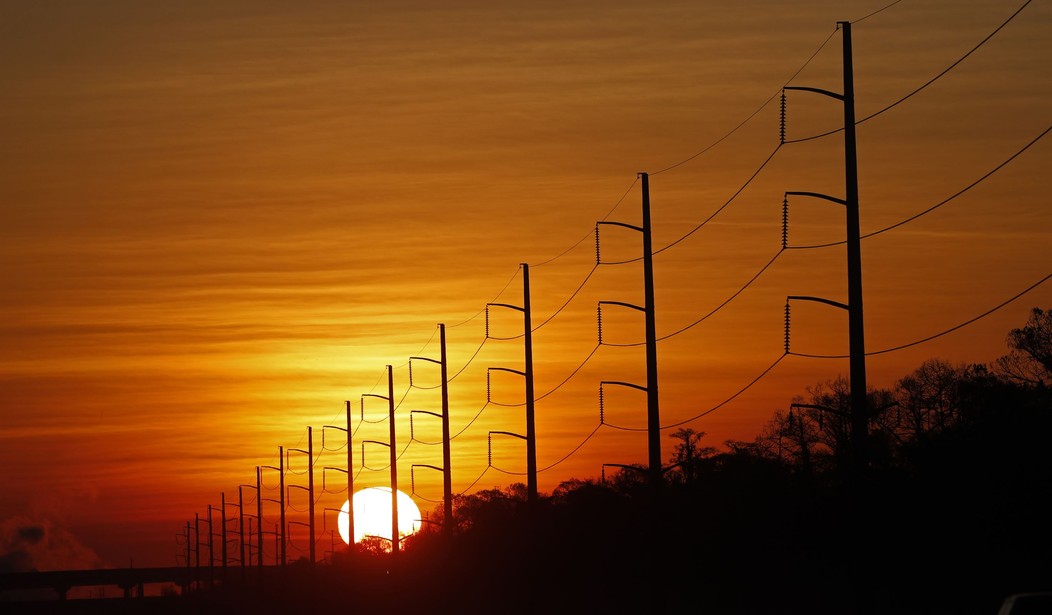
In my piece on the run-up to yesterday’s primary voting in three states, I mentioned the rub between people’s personal power bills in Florida and the power companies trying to bolster their grids for AI.
That whole thing is understandable from both sides, but there’s a wrinkle in that argument that nobody has mentioned. You just knew I had a different angle on this, now, didn’t you?
Wasn't it just a short while back that electric vehicles were the grid-killer of the moment? We got lectured, repeatedly and with great solemnity, that the national grid simply couldn't absorb the load if America actually went electric en masse. Entire white papers were written about how utilities would need to strengthen transmission infrastructure on a scale nobody had budgeted for just to keep the lights on while everybody's Tesla charged overnight.
Now? Same argument, different villain. Suddenly the grid needs a total overhaul — but this time it's because of AI data centers, not cars. And here's the part that should make your eyebrow twitch: When the conversation was about EVs, nobody on the political left seemed particularly worked up about the idea that your electric bill might climb a bit to pay for the upgrade. That was just the reasonable cost of progress, the price of saving the planet, so shut up and pay it. Swap the topic to data centers chewing through gigawatts to train chatbots, and suddenly the exact same cost-shifting mechanism gets treated like a five-alarm consumer-protection emergency.
And to be clear, this time the outrage isn't manufactured out of thin air — the numbers back it up hard. Consumer Reports tells the story of a Manassas, Va., homeowner who opened his January bill to find it had jumped from roughly $100 to $281 in a single month, practically overnight, with no explanation beyond "the data center down the road needed a bigger substation." Nationally, residential electricity prices have climbed more than 36% since 2020 — from 12.76 cents per kilowatt-hour up to 17.44 cents as of this February — with the Energy Information Administration projecting they'll keep climbing past 19 cents by next year. Dominion Energy in Virginia just filed its first base-rate increase since 1992, tacking on roughly $8.51 a month for the average household specifically to fund data center-driven infrastructure. New Jersey's own state policy lab pegs the total damage at $122 more per month, on average, compared to 2020. Some clusters near data centers have reportedly seen rates spike as much as 267%.
Here's the mechanism doing all the quiet damage, and it's worth understanding because it's the exact reason this cost-shift stays invisible until the bill lands in your mailbox: Utilities aren't billing data centers directly for the massive infrastructure upgrades those facilities require. Instead, the expense gets bundled into rates and spread across every single customer on the grid — meaning your grandmother's electric bill is quietly subsidizing the substation some hyperscale AI campus needed to keep training its next chatbot update. And in a genuinely infuriating number of cases, according to researchers at the University of Mary Washington, local residents don't even find out a data center is coming until it's already a done deal — 25 of 31 Virginia communities studied had nondisclosure agreements in place with local officials, keeping the public in the dark about size, scope, or impact until the concrete's already poured. Mind, now, all of this is by way of well-established government regulations, designed for a completely different scenario.
Now, fairness requires I tell you the counterargument. A 2026 study out of NC State, Carnegie Mellon, and other researchers found data center growth between 2015 and 2024 actually reduced average retail electricity prices nationally in some cases, by spreading fixed grid costs across a larger customer base.
A separate 2026 analysis from the Institute for Energy Research found no statistically significant correlation between data center concentration and residential electricity prices across all 50 states; areas with heavy data center density averaged 14.46 cents/kWh, virtually identical to the 14.39 cents everywhere else.
So the honest picture is more complicated than "data centers are simply looting your wallet." The damage appears concentrated in specific regions with rapid, poorly planned buildout (Virginia's infamous "Data Center Alley" chief among them) rather than uniform nationwide.
But concentrated or not, the pattern holds exactly where you'd expect it to hold worst: places where utilities committed to speculative infrastructure investment on the promise of a data center showing up, and then they got stuck holding the bag regardless of whether the project got built, delayed, or scaled back.
So here's the actual double standard laid bare: Strengthen the grid to charge your Prius, and that's a noble, unquestionable sacrifice for the planet. Strengthen the same grid to power a server farm training the next large language model, and suddenly it's an outrage worthy of congressional hearings and viral Consumer Reports exposés. Same wires. Same transformers. Same substations. Same fundamental question of who foots the bill. The only thing that actually changed is which industry gets to hide behind a halo and which one doesn't. And government — which, in reality, is what’s driving all of this — comes out playing the innocent party.
Here's the thing, though: This isn't just a data-center problem, and I've got a front-row seat to prove it.
Just up the street from where I used to live outside Rochester, N.Y., sits the old Kodak Elmgrove facility. I think I've mentioned this scenario to you at some point recently. Anyway, Amazon moved a distribution center into the place, bulldozing several of the old Kodak buildings and putting up its own. That facility runs on a level of automation that's genuinely fascinating to watch in person. As a driver, I've delivered to plenty of similarly automated operations over the years, including a food distribution center out in York, Pa., that's absolutely massive. Same basic dance everywhere: pallets come off the truck, get slapped with barcoded labels, and vanish onto a conveyor system that hauls them off to some corner of the warehouse to wait until they're needed. There's another operation outside Rochester, a manufacturing plant, running the same playbook in reverse. Stuff is going out, not coming in. In every single one of these cases, the power draw is nothing to sneeze at.
Now, about that Amazon plant specifically, I can tell you firsthand that our local power grid was weak as dishwater before Amazon showed up. Every summer storm knocked it flat. Every winter storm, too, just as reliably. We eventually threw in the towel and installed a backup generator, because waiting on the power company had stopped being a viable strategy. The running joke around there for years was wondering what would happen the day people actually started driving those electric golf-cart wannabes with delusions of car-hood.
Then, right around the time we got that generator, the local power company started hardening and building up the grid, specifically ahead of Amazon flipping the switch on their new facility. And wouldn't you know it? Since then, I honestly can't remember the power failing even once between then and my moving out. Figures.
We already know, beyond any reasonable argument, that our electrical distribution system is nowhere near adequate to handle any real growth, including something as boring and unavoidable as more people simply moving into an area. That's before you even get to whatever power-hungry industry happens to be knocking on the door next. And here's the kicker that applies no matter who's asking for the hookup: Thanks to a power generation industry regulated within an inch of its life, the utilities themselves can't cover the cost of any serious grid expansion or new generating capacity on their own, period, regardless of whether the customer showing up is an EV owner, a data center, or an Amazon warehouse full of conveyor belts. The villain changes depending on who's writing the headline. The actual bottleneck never does.
That bottleneck is the governmental stranglehold on power companies, preventing any kind of well-needed capacity increases. We’ve been playing this game for generations (pun intended), and now the bill for that expansion and the wait for the buildout to actually happen is coming due. The lesson here is to let the power companies manage their own business. Let them build up their capacity as they see upcoming demands on the horizon and bill accordingly instead of artificially keeping the monthly bills so low that expansion can never happen without bankrupting the gas and electric. At which point, of course, the government claims it’s mismanagement on the part of the power company that’s causing the problems. PG&E out in California is the prime example.
Trouble is, if past is prologue, that’s a lesson that will never be learned. We’ve been making these arguments as regards California for many decades now, and government flatly refuses to take its claws out of the backs of the power companies, unwilling to lose vote-buying potential and the ability to chant that “We’re doing something about your ‘unfair’ electric bills.”
In this case, as with so many others, it seems power to the people, by design, must receive government approval first. Is this what we had in mind?
Thought of the day: Remember that clothes show you nothing until someone’s inside of them. Then again, a lack of clothes shows you everything.
VIP members, hit the heart and let’s hear your comments. You are an important part of this conversation.
Be good today. I’ll see you here tomorrow.
Related: Eric's Daily: Pick a Lane and Stick With It
Editor's Note: The Democrat Party has been infected by socialism, and it's spreading FAST. Democrats are claiming there's nothing to worry about, but we know the truth.
Help us continue to shine a light on the socialist takeover by joining PJ Media VIP. Use promo code FIGHT to get 60% off your VIP membership.



Join the Conversation
VIP members get the ability to comment on articles.