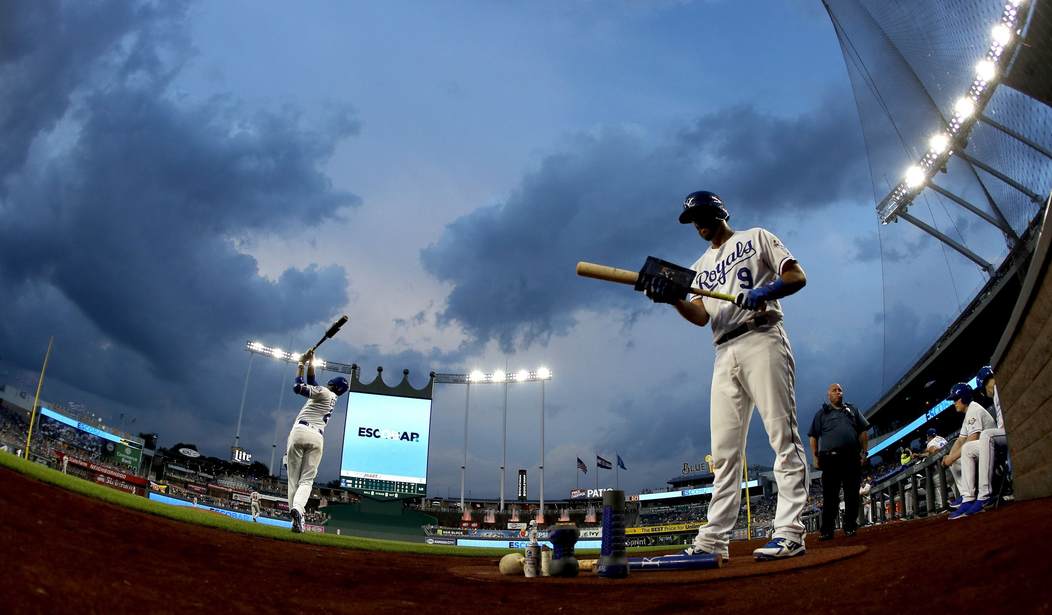

Gary Sánchez may send me into early baldness yet, which is impressive because nature already beat him to the punch by a decade.
The Milwaukee Brewers catcher has never been shy about asking for a second opinion, and MLB's new Automated Ball-Strike Challenge System gives him one.
Every fan who has yelled at a missed strike three from the couch knows the feeling. Finally, the game has a tool that answers back in seconds.
MLB brought the ABS Challenge System to the regular season in 2026 after years of testing in the minors, spring training, and the 2025 All-Star Game. Human umpires still call balls and strikes, but batters, pitchers, and catchers can challenge a call right away.
Each team starts with two challenges, keeps successful ones, and gets one in extra innings if it has run out. Managers can't help; the dugout can't whisper strategy, because the player involved has to trust his eyes.
The AI part isn't some glowing robot squatting behind the catcher and calling everyone meatsack; it's computer vision, high-speed tracking, and a mapped strike zone tied to the batter's height.
“We hear so much about AI influencing political views and fueling polarization, and here’s a case of AI being used as a consensus-building platform rather than creating division,” said Waki Kamino, a doctoral student in the field of information science, who with fellow information science doctoral student Andrea Wen-Yi Wang and other colleagues has spent the last year attending spring training games and umpire trainings, and interviewing league executives, umpires and fans. “It’s such a cool thing to see.”
So far, Kamino, Wang and a team of human-robot interaction researchers from the Cornell Ann S. Bowers College of Computing and Information Science have published two papers, and submitted a third, exploring the tension that arises when technological precision is applied to the ambiguities of human decision-making.
Hawk-Eye cameras watch the pitch, measure where it crosses the plate, and send the answer to the stadium board.
MLB's system sets the top of the zone at 53.5% of the player's measured height and the bottom at 27%, with pitch location measured over the middle of the plate.
For once, AI isn't trying to replace the whole human event. It's settling one narrow fight: did the pitch cross the zone or not? Baseball needed that kind of restraint.
A full robot strike zone would feel sterile to many fans, and traditionalists already have enough reasons to stare out the window and mutter about turf, pitch clocks, and players wearing necklaces big enough to anchor canoes.
Plus, I can appreciate those who stopped enjoying MLB because of player or umpire strikes, corporate money, and, of course, the woke disease that permeates the big leagues.
I agree with all of that, but as I've said before, baseball is near reverence for me — the history, the players, and the game. I simply love the game within the game. Not to mention that I love watching my lovely wife scrunch her eyebrows at noises I make when players can't lay off the breaking ball low and away.
The challenge system keeps the argument alive, which is important because arguing is part of baseball's furniture. The fan still gets the groan, the batter still gets the glare, the catcher still frames the pitch, and the umpire still has the plate.
Then, when a call is bad enough, the game can fix it before a 7th inning rally dies on a pitch six inches inside.
Baseball Savant's ABS dashboard has also turned challenges into a small strategy game. Some teams burn them early, while others hoard them for late innings, when one missed call changes a game.
Sánchez shows up as one of Milwaukee's more aggressive challengers, and as a Brewers fan, I respect the nerve while also wishing he'd save one for later now and then.
MLB commissioner Rob Manfred said player and fan reaction early in the season was “overwhelmingly positive,” and that tracks with the eye test. The reviews are quick, thank God, while the scoreboard reveal gives the crowd a jolt. From Sports Business Journal:
MLB Commissioner Rob Manfred said reactions to the ABS system have been “overwhelmingly positive” as his expectation was that the players “would really like it,” but he is “actually surprised … how popular it’s been with fans.” Appearing on “The Dan Patrick Show,” Manfred added when the challenge happens everybody is “kind of glued to the jumbotron,” and it is “amazing.”
Host Dan Patrick mentioned the criticism the umpire’s are getting and them being “embarrassed” or “judged by everybody.” Manfred said the umpires have “reacted with professionalism.” Manfred: “We had a lot of conversation with them about the implementation of this. … They’re right nearly 94% of the time, which is an astounding number when you think about how difficult it is.
And most of the challenges are pitches that are in or out by less than, or about, a half an inch. So you can’t be too critical of people.” He added the umpires “want the game to be as good as possible,” and thinks “they see it as an improvement in the game.” On the time it takes, Manfred said the “data shows we’re like a minute and a half longer associated with ABS.” He added, “That’s a price I’m prepared to pay."
The umpire takes the hit, but not for long; the game continues, which is more than anybody can say for the old system, where a terrible call lives rent-free in a fan's bald skull until Thanksgiving.
Traditionalists aren't wrong to guard the soul of baseball. The sport survives because it remembers itself. But bad calls behind the plate were never sacred; they were just tolerated.
If AI corrects the obvious misses without turning the game into a software demo, then baseball has found a rare piece of modern technology that knows its place.
The ABS challenge system works because it doesn't ask fans to stop loving baseball as baseball. It gives players a lever, umpires a safety net, and fans one less reason to throw a remote through the drywall.
For a sport built on inches, grudges, and long summers, that's a pretty good start.