More than 160 years after it slipped beneath the Atlantic, the Civil War ironclad USS Monitor is revealing new secrets through modern technology. Scientists recently completed detailed 3D scans of the famous warship's wreckage, allowing historians and engineers to digitally rebuild one of the most important vessels in American naval history.
The scans give researchers a far clearer look at the ship's structure and the engineering choices made by Swedish-American inventor John Ericsson, the man who designed the revolutionary ironclad.
The USS Monitor first captured national attention in March 1862 during the Battle of Hampton Roads. The Union ironclad fought the Confederate ironclad CSS Virginia in a clash that stunned naval observers around the world. Popular Science recounts:
Built in 102 days and launched in 1862, the Monitor was specifically engineered to handle the Confederacy’s own ironclad, the CSS Virginia. A pair of fire-tube boilers powered the nearly 170-foot-long vessel, which featured a prominent revolving turret armed with two 280 mm Dahlman smoothbore guns weighing 16,000 pounds each. The overall design was so unusual for the era that many critics and journalists often referred to it as the “Yankee cheesebox.” Despite this, the Monitor represented a major technological leap forward for the U.S. Navy, and many of its features were replicated for decades in subsequent monitor-class ships.
Wooden warships had dominated the seas for centuries, yet that battle proved that iron-armored steam-powered vessels would shape the future instead. Naval historians still point to that encounter as the moment modern naval warfare truly began.
The Monitor had an unusual design for its time; it sat low in the water and carried a rotating iron turret that housed two massive guns. The turret allowed the guns to turn in any direction without moving the ship. Ericsson's design broke from centuries of naval tradition and introduced a concept that soon appeared on warships across the globe.
The Monitor's career lasted less than a year. On Dec. 31, 1862, the ship encountered rough seas while being towed along the coast of North Carolina. Water flooded the vessel, and the ironclad sank early on New Year's morning in 1863. Sixteen crew members lost their lives when the ship went down, and the wreck remained hidden beneath the ocean for more than a century before scientists located it in 1973.
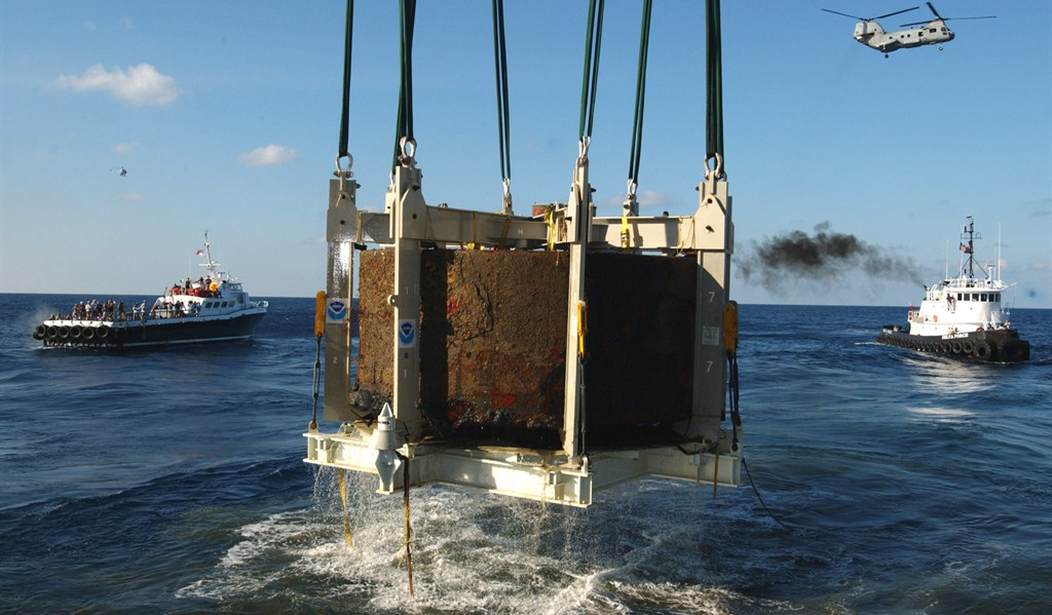
The wreckage of the ironclad was discovered in 1973 by a team of scientists from Duke University, the State of North Carolina, and the Massachusetts Institute of Technology. As part of a series of marine sanctuary laws passed by the U.S. Congress, the site of the wreck was designated a National Marine Sanctuary on 30 January 1975 and placed under the protection of the National Oceanic and Atmospheric Administration (NOAA). Owing to deterioration of the wreck from storms and other damage, some artifacts, such as the propeller shaft and hull plates, were later recovered for historic preservation. Starting in March 2001, a five-month expedition involving NOAA, the Naval Sea Systems Command (NAVSEA), Mobile Diving and Salvage Unit Two (MDSU TWO), and The Mariners’ Museum raised the ironclad's innovative steam engine and other parts recovered from the site. The following year, in July and August 2002, the gun turret was raised from the site. These artifacts were transferred to the Mariners’ Museum in Newport News, Va., for historic preservation.
Researchers later recovered several major pieces of the vessel, including the famous turret, which now sits in a conservation tank at The Mariners' Museum and Park in Newport News, Va., where preservation specialists continue the slow work of stabilizing the iron structure.
The conservation effort remains one of the largest and most complex maritime preservation projects ever attempted in the United States.
The new 3D scans represent another step forward in understanding the ship. Scientists used high-resolution imaging technology to capture precise measurements of the wreckage resting on the seafloor. Those digital images allow experts to study the ship's structure without disturbing the fragile remains underwater. The scans also help historians test ideas about the vessel's performance in combat and the unfolding of the sinking.
The digital models created from the scans allow researchers to rebuild the ironclad in ways that were impossible only a few years ago. Engineers can now examine the ship's design from every angle while historians compare the structure to surviving documents and sketches from John Ericsson's original plans. Each new layer of information brings the vessel's story into sharper focus.
The USS Monitor changed naval warfare in a single afternoon in 1862. Warships across the world soon adopted rotating gun turrets and armored hulls. Even today's modern naval vessels trace part of their design lineage back to the ideas Ericsson introduced with the ironclad.
Over a century after the ship sank beneath the waves, technology is helping historians recover details that once seemed lost forever. The ocean preserved the wreck, and digital tools are now bringing it back into view for a new generation of researchers and history enthusiasts.
Recommended: The Courage They Didn’t Teach: Phillis Wheatley and the Cost of Freedom