







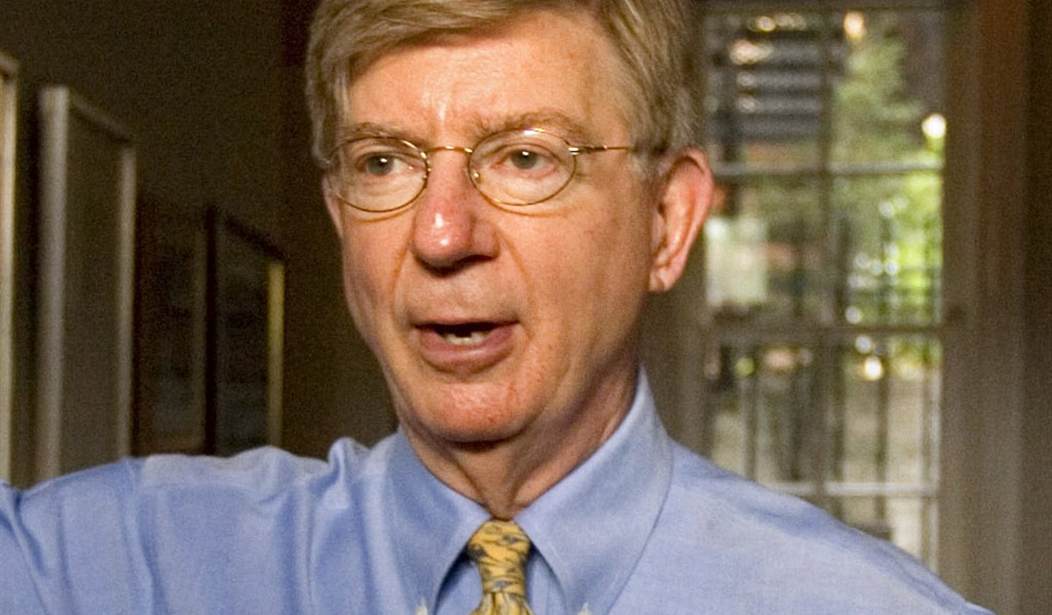
For nearly a decade, George Will stood as one of the most persistent conservative critics of President Donald Trump. The Pulitzer Prize-winning columnist, known for his bow ties and classical references, warned that Trump's style threatened institutions and norms, causing him to leave the Republican Party in 2016. Will rarely missed a chance to remind his readers that he believed the president lacked the right temperament and discipline.
That history makes his recent column all the more striking.
In the wake of Operation Epic Fury, George Will actually credited Trump with restoring American deterrence, arguing that the targeted military action reestablished credibility that had weakened in the past several years. Will framed the operation as measured, purposeful, and strategically sound.
The perhaps 30,000 protesters who perished in Iran’s streets in early January did not die in vain.
Will, a former Republican who voted for Joe Biden and Kamala Harris in the most recent presidential elections, marveled at how "Precision munitions, directed by spectacular intelligence, enabled a decapitation strategy" as the U.S. and Israel carried out Operation Epic Fury on Saturday, which resulted in the elimination of the Iranian regime's top leaders, including Supreme Leader Ayatollah Ali Khamenei.
"The U.S. action for regime change in Iran is not sufficient to produce regional tranquility. It is, however, a necessity for beginning to reestablish a precondition for a more peaceable world: the credibility of U.S. deterrence," Will told readers.
Will certainly didn't become a Trump loyalist, nor did he recant his past criticisms; instead, he acknowledged that decisive action against Iranian aggression sent a clear message. Deterrence, he wrote, depends on adversaries believing that consequences follow provocation. Trump signaled resolve when he authorized strikes after Iranian-backed attacks.
That acknowledgment stands in stark contrast to years of Will's commentary. He publicly broke with the Republican Party after Trump's 2016 nomination, urging conservatives to reject what he called a dangerous populist turn, and he endorsed Joe Biden in 2020, while arguing that Trump's conduct undermined constitutional norms. Those positions placed him firmly in the anti-Trump camp among conservative intellectuals. What happened?
Iran changed the tone.
Iran's leadership has tested American limits for a long time through proxy forces and regional pressure. The Islamic Revolutionary Guard Corps, under commanders tied to Tehran's ruling clerics, has backed militias across the Middle East.
Previous administrations relied heavily on sanctions and diplomatic pressure, but Trump chose military force after attacks on U.S. interests escalated.
Will argued that strength can steady global perceptions of American power, noting that adversaries often watch not just what the United States says, but what it does.
When words and actions align, rivals are forced to recalibrate.
That shift in tone matters because Will built his brand on skepticism towards Trump's judgment. For him to praise a military decision signals more than a fleeting agreement; it reflects recognition that policy outcomes override personal distaste.
Secretary of War Pete Hegseth defended the strikes as necessary to protect American forces and reassert stability, while Trump framed the action as a warning, not an invitation to prolonged war. The administration insisted that limited force could prevent broader conflict—something that seems less likely with Iran's attacks on bordering countries and the response it's receiving in exchange.
Will's column suggests that even longtime critics can acknowledge effectiveness when results align with strategic goals. He didn't soften his broader concerns about Trump's style, nor did he embrace the president's rhetoric, but he did credit the outcome.
Political commentary often locks figures into fixed camps, where critics rarely concede ground and supporters rarely admit flaws. Will's column broke that pattern, at least in the short term. He wrote as a man who still disagrees with Trump on many fronts, but who couldn't deny the impact of decisive action against Iran.
For fans of Will's steady drumbeat of opposition, the column reads like a pivot point. Not a conversion, but an admission. Trump's decision, in Will's view, strengthened American standing in a volatile region.
Moments like these don't erase past clashes; they show that policy outcomes force even the sharpest critics to adjust their assessments. When a longtime political opponent credits restored deterrence, people take notice.
PJ Media continues to track shifts like this one, especially when they come from voices once firmly aligned against President Trump. Right now, get 60% off a VIP membership by using promo code FIGHT at checkout. Join today and unlock exclusive content while supporting independent reporting.

Join the Conversation
VIP members get the ability to comment on articles.