







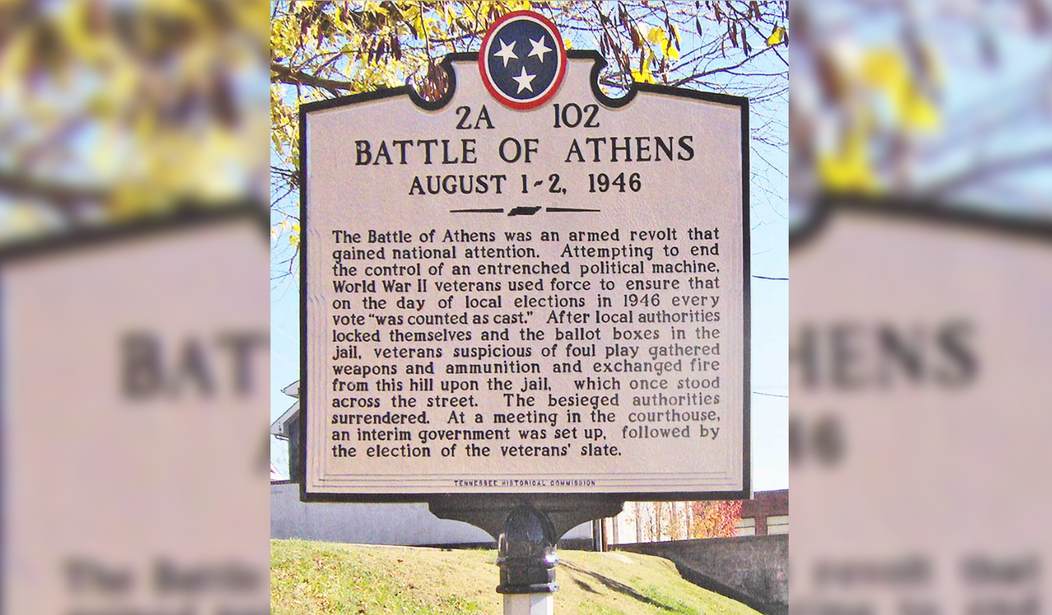
Life teaches us all hard lessons. People can be like a rope — put one under strain, and what happens? Pull too tight, and the fibers will snap; ease the pressure, and the line will hold long enough to finish your job.
In the summer of 1946, a small Southern town reached that moment, but in this case, with hands raw from war and patience worn thin.
A Town at the Edge
Beginning in 1936 in Athens, Tenn., local political power rested with a criminal ring that centered all authority around Paul Cantrell, a Democrat (of course) who ran and won the office of sheriff, and who eventually ran for state senate and won. One of his former deputies, Pat Mansfield, replaced him as sheriff.
Eventually, corruption grew to include a courthouse ring of city officials who treated elections as private property, and whose roots went back decades. Deputies were armed enforcers demanding loyalty, using minor offenses and applicable fines to create a steady cash flow and forced labor.
Political favors flowed through back rooms, and ballots were as useful as a puppy with two tails. Boxes of ballots simply disappeared, poll watchers were shoved around, and the people knew how the machine worked.
People endured because endurance felt safer than resistance.
Veterans Come Home With Expectations
Fast-forward a few years to the end of World War II, when veterans started returning. Thousands of local men had fought across the Pacific and Europe, enduring hardships that I pray our young, brave men and women will never have to face again.
Talk to any veteran, and they'll tell you how the service changed them. They lived inside systems where rules mattered, orders carried weight, and accountability followed rank. Those men guarded polling places overseas and watched dictators fear clean counts.
Back home in Athens, sheriff's deputies watched as 10% of the county's population returned, flush with various bonuses from Uncle Sam — a bountiful harvest of new lines of cash.
The returning veterans expected order at home, not intimidation, which resulted in a May 1946 veterans-only meeting. At the meeting's end, the veterans selected a non-partisan group of candidates to run for the various offices in the upcoming election: the GI Party. The group's goal was to restore honest elections, calling for basic safeguards and transparent counting.
[Editor's note: The source linked above misnames the event as taking place in Athens, Ga., yet the facts of the story are correct in the article. The event did take place in Tennessee.]
They didn't receive the response they were expecting; county officials reacted with smirks, threats, and arrests.
Election Day Breaks Trust
Without cause, deputies arrested GI poll watchers on Aug. 2, and ballot boxes vanished into a dark county jail cell, followed by ballot counting taking place behind locked doors.
What happens when a large group of people, feeling more than a little tension, aren't able to gather any facts in situations like this? People start making stuff up and spreading rumors.
Eventually, large crowds appeared, former GIs included, and gathered around the jail to demand the return of the ballots. The vets tried to negotiate the situation peacefully, aiming to use peace rather than force. Despite several warnings written on the wall, the courthouse ring refused each request. Then, using the same genius of Wile E. Coyote, doubled down.
The Night Order Collapsed
Before they locked themselves behind jailhouse doors, the veterans weren't armed. That, however, soon changed. Visiting a nearby National Guard armory, the vets armed themselves with the same weapons they had used until recently, defending democracy abroad.
There were no pre-game speeches or waving banners; the vets surrounded the jail, demanding access to those ballots.
In response, one side started shooting, and the other answered in kind. The gunfight lasted a couple of hours until the door to the jail opened, giving the ballots a breath of fresh air.
When all eyes could see, the counting resumed.
Consequences, Not Chaos
Unsurprisingly, the slate of GIs won their respective elections — no race was even close — and the corrupt regime lost its grip of control.
There wasn't a loss of life, nor did Athens descend into anarchy; it simply corrected course.
Corrupt authority retreated into the darkness because ordinary people refused to accept theft disguised as governance.
The battle of Athens stands as the most violent manifestation of a regional phenomenon of the post-World War II era. Seasoned veterans of the European and Pacific theaters returned in 1945 and 1946 to southern communities riddled with vice, economic stagnation, and deteriorating schools. Undemocratic, corrupt, and mossback rings and machines kept an iron grip on local policy and power. Moreover, their commitment to the status quo threatened the economic opportunities touched off by the war. Across the South, veterans launched insurgent campaigns to oust local political machines they regarded as impediments to economic “progress.”
The fixes weren't immediate, but the town was able to rewire its habits through consequences, not slogans, and the dirty machine never recovered.
Why Athens Still Matters
Despite the desire to paint corruption in postwar America as a foreign disease, Athens was the horn that woke everybody else, illustrating how civic rot grows fast when oversight vanishes, and fear replaces accountability.
Sunshine, as always, is the best disinfectant, so trust returned just as fast when that sunlight exposed everything.
Remember, those men were veterans returning from organized chaos and brutality, and when they returned home, they didn't want to see echoes from the battlefields. All they wanted was a count that matched the vote, while their restraint was just as important as their resolve.
What Courage Looked Like
Courage isn't something seen; it's witnessed by someone standing up for a friend, preventing another friend from driving when they want to, or holding back when all they want to do is become a berserker.
In Tennessee in 1946, courage didn't wear plain clothes while waiting for the end of the latest barrage of insults and threats. The GIs tried it the right way first; only when the rope began to fray did they pull together and hold.
The line never snapped, and when the job was finished, Athens woke up different the next morning.
And, of course, the story became the plot for hundreds of future books and movies.
Final Thoughts
Across American life, a rope lies across everyone's waist, stretching between trust and force: Keep it slack enough for the law to work and tight enough to stop abuse.
Athens found its balance when patience was exhausted, and determination emerged.
PJ Media's YUGE Christmas and New Year's sale is on — now at our lowest rate of the year! This huge sale on our VIP Memberships ends on January 1, so make sure you join the club to get our special behind-the-scenes look at the news. Receive 74% off by following this link and using our promo code MERRY74.


Join the Conversation
VIP members get the ability to comment on articles.