


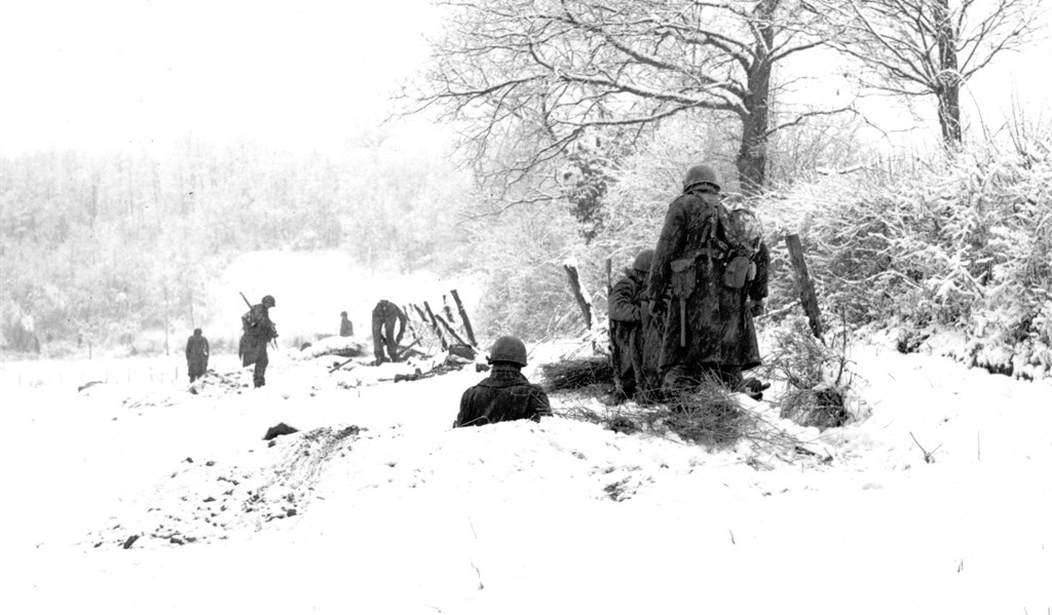
The snowfall was heavy and steady, the kind that muffles sound and hides movement. The Ardennes looked calm from a distance; inside the ring of Bastogne, that calm was a trap: roads disappeared under ice, diesel engines struggled, men had to count their ammo and wondered how long boots and fingers could last.
Resolve settled in somewhere between fear and fatigue.
Hold.
The order never needed to be repeated.
Christmas week, 1944, turned Bastogne into the hinge point of the Battle of the Bulge. The town was the center of seven major roads, which made it a critical piece of the Nazis' puzzle to change the war. German armor couldn't push west without access to that crossroads, and American commanders knew that losing Bastogne would give the enemy a gift of speed and flexibility, which was running out for them.
Holding it meant choking the offense at its narrowest point.
A Quiet Sector Built on False Comfort
The Ardennes earned a reputation as a backwater; dense forests and poor roads discouraged large operations. American units rotated into the area to recover, train replacements, and catch their breath after months of hard fighting.
Some soldiers lacked combat experience, while others carried the dull exhaustion of veterans pushed too long without rest. Leadership expected little more than cold weather and patrols.
Germany counted on that; Hitler's last major offensive aimed to punch through the Ardennes, cross the Meuse River, split Allied armies, and take ports along the English Channel. The Nazis' biggest concern was fuel shortages, which haunted the plan from the start. Allied air power loomed as a constant threat once the overcast skies cleared.
Even so, German leadership gambled everything on surprise, speed, and shock.
The offensive began on December 16 with a massive artillery barrage and rapid armor thrusts.
The Roadblock at Bastogne
While German columns surged, Bastogne became unavoidable. The 101st Airborne Division was rushed in by truck, passing by shell-shocked troops in retreat, and ordered to hold at all costs.
Paratroopers moved in without proper winter gear: Many still wore their jump boots, meant for fair weather. Ammunition was low from the start, medical supplies remained thin, and Allied aircraft were grounded by snow and fog, cutting off resupply and evacuation.
Within days, the town was surrounded by German forces, while artillery fire hammered defensive positions day and night. German infantry probed for weak points, tanks lurked just beyond sightlines, waiting for the collapse, while inside the perimeter, American soldiers tried digging foxholes using bayonets, helmets, and bare hands — made impossible by the frozen ground.
Despite lack of sleep and spreading frostbite, nobody left their post.
The 82nd Airborne Division fought nearby to slow German advances and secure flanks, actions that prevented a wider breakthrough and kept Bastogne from becoming even more isolated. Together, airborne units repeatedly denied German forces the road network they desperately needed to maintain their momentum.
The Men Who Marked the Sky
There was another unfolding flight above the frozen fields. Pathfinder teams dropped behind enemy lines to mark supply drop zones for incoming aircraft. Without their beacons, cargo planes risked scattering supplies across enemy positions or deep woods where recovery was impossible.
Jake "McNasty" McNiece was a veteran pathfinder who helped lead those jumps. Teams descended through darkness and enemy fire, landed amid chaos, and worked fast under the threat of capture or death, setting lights and signals during brief breaks in cloud cover, guiding aircraft toward friendly ground.
When the weather cleared just enough, bundles of ammo, food, warm clothing, and medical gear parachuted into Bastogne.
Those drops changed the tide of the battle; ammunition refilled empty bandoliers, morphine and plasma reached aid stations frantic for them, and food lifted the spirits of the men fighting hunger and cold.
Pathfinders rarely receive the recognition given to frontline fighters, yet their skill and nerve increased survival inside the perimeter.
“Nuts” and the Meaning of Refusal
Eventually, German commanders sent a formal demand for surrender to Bastogne; the message promised destruction if resistance continued.
Brigadier General Anthony McAuliffe's famous reply came back blunt and unmistakable.
"Nuts."
The message confused the German side until an explanation arrived, leaving no room for doubt.
That single word carried far more weight beyond humor; it signaled confidence under pressure, clarity amid chaos, and unity of purpose across the perimeter. Soldiers laughingly and proudly repeated it in foxholes and aid stations, stiffening resolve and raising morale.
Inside the town, chaplains found shattered buildings to hold brief Christmas services, medics worked without pause, and officers moved constantly between positions, sharing risk and reassurance.
Christmas passed without ceremony, yet meaning remained intact.
Patton Turns North
To the south, General George S. Patton prepared a response few believed possible: The Third Army pivoted nearly 90 degrees in brutal winter conditions, redirecting divisions north toward Bastogne, a maneuver that demanded tight coordination, aggressive leadership, and relentless movement.
Patton's tanks crawled through snow-choked roads, infantry advanced through the forest under constant threat, and supply lines were stretched thin.
Every step was a punishment because of the weather, but Patton pressed forward, driving his units day and night. On December 26, lead elements broke through German lines and reached Bastogne.
The arrival of Patton's Third Army didn't immediately end the fight, but German momentum was shattered. Fuel shortages deepened, and as the skies cleared, Allied air power returned. The German offensive collapsed under pressure it couldn't sustain, with its last reserves draining away in the Ardennes.
The Last Gasp
The Battle of the Bulge was Germany's final major offensive in the west during World War 2. After Bastogne, German forces lacked fuel, equipment, and trained manpower to mount another push.
American and Allied armies resumed their advances toward the Rhine River with renewed confidence.
Bastogne stood as the apex where preparation, leadership, and refusal to quit overcame surprise and hardship. The town held not because the weather conditions favored success, but because people chose endurance over retreat or surrender.
Final Thoughts
Snow still falls in the Ardennes, softening fields and quieting roads. Bastogne has long since sat within a ring of fire, yet there are still visible scars. When pressure closes from every direction, strength lives in discipline, cooperation, and resolve.
At Christmas in 1944, those qualities turned frozen ground into an unbreakable line, and a desperate gamble into the beginning of the end.
And into history.
PJ Media's YUGE Christmas and New Year's sale is on — now at our lowest rate of the year! This huge sale on our VIP Memberships ends on January 1, so make sure you join the club to get our special behind-the-scenes look at the news. Receive 74% off by following this link and using our promo code MERRY74.






Join the conversation as a VIP Member