





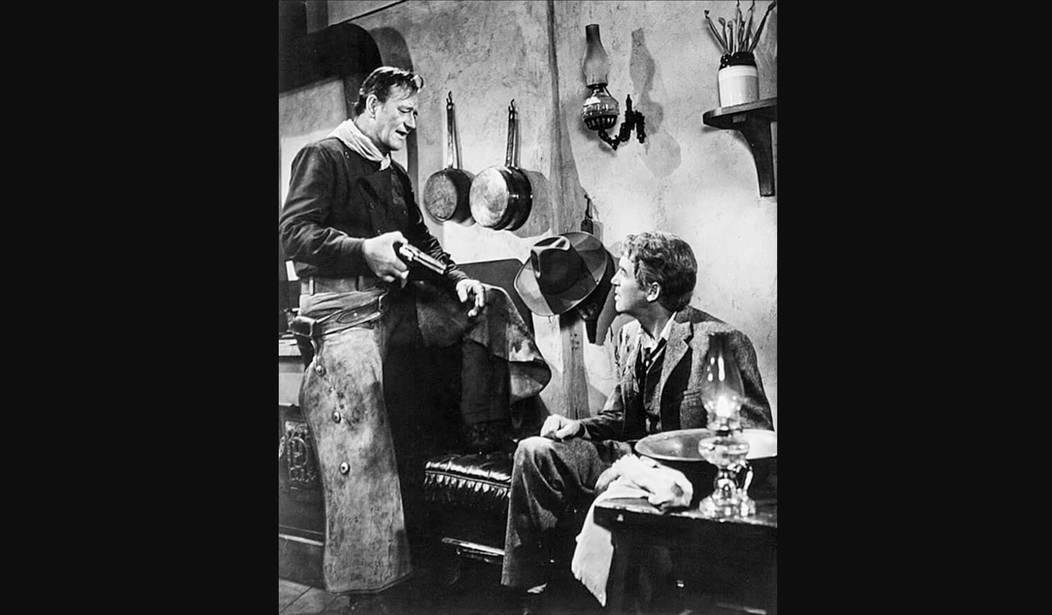
Just about any two-bit imitation of John Wayne has him calling somebody “Pilgrim.” His first and most famous use of that epithet was directed at the newly arrived lawyer from back east named Ransom Stoddard (played to perfection by Jimmy Stewart) in John Ford’s classic The Man Who Shot Liberty Valance. Stoddard is indeed a “Pilgrim,” for he has brought more than law books to this untamed part of the West.
There is a scene where there is a town meeting to select delegates to a territorial convention. As you would expect for a Western, this is convened in a saloon, and Stoddard is handed a bar bung hammer to use as a gavel, whereupon he does his best to explain Robert’s Rules of Order as moderator of the meeting.
Where was it first agreed to hold such meetings on this continent? It was aboard the Mayflower, anchored just off Cape Cod in 1620, where a covenant was signed to “combine ourselves into a civil body politick.” Ever since, town meetings of this sort have been held in small towns throughout New England. Growing up in one of these towns, I participated in many a meeting. They weren’t held in a saloon (though much of what was planned was done in the local watering hole known as the Upland Sportsman’s Club). These could also be rowdy affairs, and I am reminded of them when I watch the one in Blazing Saddles:
“You know, Nietzsche once said, ‘out of chaos comes order.’”
“Ah, blow it out your a**, Howard.”
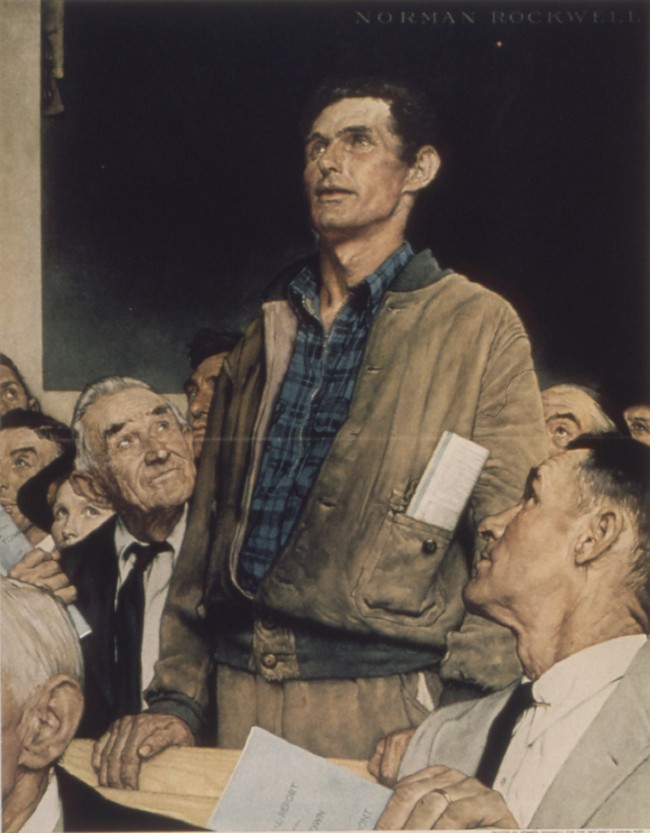
When Norman Rockwell painted his “Four Freedoms,” it was a New England town meeting he chose for “Freedom of Speech.”
Self-government, though, presupposes literacy, which is why Massachusetts Bay Colony mandated public schools by the Old Deluder Act of 1647, ignorance being a tool of that “old deluder,” Satan. Ransom Stoddard arrives in the West to find literacy lacking, and so he holds reading classes for both children and adults in a room next to the newspaper office.
In the class, he holds up a newspaper column, printed, of course, by the Shinbone Star in the next room, and tries to explain how the 1st Amendment works. He asks about the basis of our laws. His first adult student, Pompey, a black man who is Tom Donifan’s (John Wayne’s) foreman, confuses the Constitution with the Declaration of Independence, and starts with “We hold these truths to be self-evident…” Stoddard helps him finish, “that all men are created equal.” Stoddard tells him he’s “done all right.”
In his “I Have a Dream” speech, Martin Luther King, Jr. would later also blend the two documents:
When the architects of our republic wrote the magnificent words of the Constitution and the declaration of Independence, they were signing a promissory note to which every American was to fall heir. This note was a promise that all men would be guaranteed the inalienable rights of life, liberty, and the pursuit of happiness.
The ironically named Liberty Valance, a villainous gunfighter who would just as soon shoot you as look at you (and played with gusto by Lee Marvin in one of his best roles), beats the editor of the paper nearly to death for daring to publish the truth about him, and tries to burn down his press. When his terrorism as a hired gun by the cattlemen who oppose statehood, and thus the rule of law, and NOT the rule of the gun, goes too far, “the law book does no good,” and Ransom Stoddard must step out into the street with a gun in his hand…
Gene Pitney’s song, which came out after the movie, was a salute to the taming of the “Wild West, and is a throwback to when we appreciated such things.
We need to go back to appreciating such things.


Join the Conversation
VIP members get the ability to comment on articles.