





As we celebrate the 250th anniversary of our last day as colonists on Friday, the UK is giving us a huge reason to be glad that we got out from under the crown and the parliamentary system. The current leadership turnover in the Labour Party makes our republic look more sensible than ever.
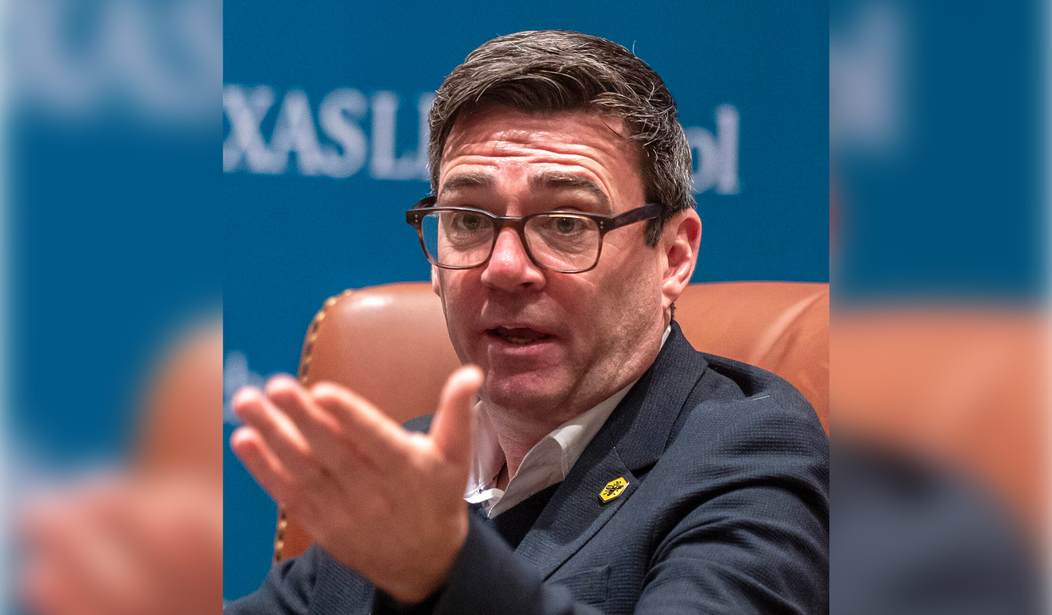
Prime Minister Keir Starmer is stepping down as leader of the Labour Party — and as prime minister along with it — and the frontrunner to replace him is newly minted Member of Parliament Andy Burnham. My friend and colleague Stephen Green pointed out that Burnham stands to drag Labour further to the left and take the UK along with him.
Related: With His Resignation, Keir Starmer Reveals How Much Labour Resembles American Democrats
The trouble is that Burnham has been awfully quiet on policy. As Michael Gove and Madeleine Grant put it on The Spectator’s Quite Right! podcast, Burnham acts like he can lead a major political party on vibes alone.
Charles Moore writes at The Spectator:
The British constitution is an admirably flexible thing, so I would not claim that Andy Burnham’s leadership campaign, and the coverage thereof, is unconstitutional, but it is certainly unseemly. Why did a BBC helicopter follow his train from Manchester to London (which arrived, of course, late) as if he were Lenin heading for the Finland Station? And why was he allowed to pre-empt his result with a mass selfie with about 200 of his supporting MPs in Westminster Hall? He is merely a new Member of Parliament, until he isn’t. Turning the place into his stage set is a way of intimidating possible challengers. If he is challenged, he will surely still become leader, but the point of a challenge is to force him to say what he means to do. So far, no one – not even, one suspects, Andy Burnham – knows what Andy Burnham stands for.
Moore suggests that Burnham might abandon the UK’s horrific net zero climate policy. The biggest blowback to that might happen at home; Burnham’s wife is on the board of an NGO and an EV company executive who expresses a “passion for sustainability and the green economy” and for “championing the fair and accessible transition to electric vehicle ownership.”
In a Spectator column, Grant likens Burnham’s campaign launch to the sickly sweetness of Tony Blair’s campaign. The optimism of this leadership challenge is at odds with the way many Britons feel about the state of their nation.
“His promise of ‘a new era of possibility’ was a lot of style – mingled with some inevitable Burnhamite sentimentalism: ‘hope in every heart and good growth in every postcode,’” she writes. “It made me long for a gun in every hand and a cyanide capsule in every drawer.”
Ross Clark has plenty of daggers for Burnham in a Spectator column. He sees Burnham as a different sort of throwback.
“Whoever thought of putting him in a grey outfit against the backdrop of a grey door for [Monday] morning’s speech in Manchester certainly wasn’t thinking of injecting a bit of colour into national life,” he writes. “It was like watching Harold Wilson: the last PM before colour TV was introduced to Britain.”
Clark also has his doubts that Burnham’s big vision will get many people excited (although I wouldn’t mind something like this in the U.S.):
Burnham’s big mission for the country – to devolve power to the regions and localities – also wasn’t exactly calculated to set pulses racing. Rightly or wrongly, few things can be relied upon to provoke a yawn in British life than local government. Just look at the turnout in local elections and the increasing tendency for the electorate to use them as little more than a referendum on national government. It was, after all, the local elections which finally did for Keir Starmer and put Burnham in the position he is now.
If Burnham can really make the British public excited about local government, he will have achieved something genuinely impressive, but I would say he has an uphill task.
Burnham’s popularity in Manchester might indicate that he could easily become a national figure, but he’s not exciting voters just yet. Many Labour Party members aren’t thrilled that a man who just returned to Parliament the day before launching a party leadership campaign is getting leadership status handed to him. I’ve said on a couple of occasions that it’s similar to Joe Biden giving way to Kamala Harris with no primaries — not an apples-to-apples comparison but still one that could invite party dissatisfaction.
The biggest question right now isn’t whether Burnham can lead a party, however. It’s whether he’s ready to be prime minister. That’s what gives Britons more pause.
Editor's Note: It’s America’s 250th birthday! Help PJ Media celebrate the greatest nation in history by honoring its past, defending its present, and preserving its future with reporting you can trust.
Join PJ Media VIP and use promo code AMERICA250 to receive 74% off your membership.

Join the Conversation
VIP members get the ability to comment on articles.