





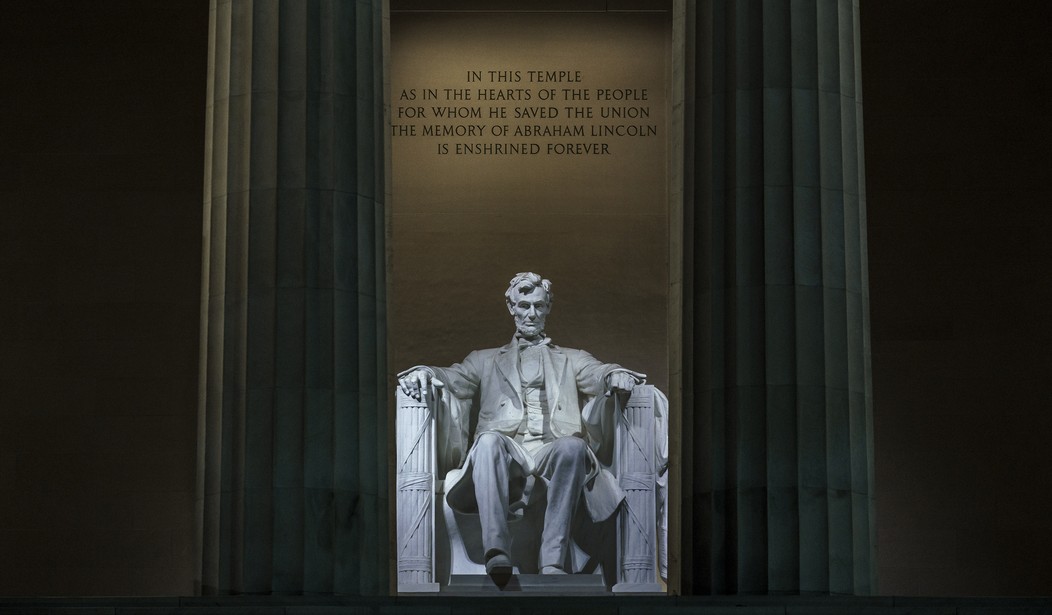
As the 250th birthday of the United States of America gets closer, we know that a country that has survived rebellion, war, depression, terrorism, cultural upheaval, and its own repeated habit of making a mess of things has much to be grateful for.
That’s why this Independence Day is more than just a birthday party or an occasion for self-congratulation. We should also be looking at what made this country great, including the principles that guided our founding and aided us during our darkest hours. Let’s take a look at one of those moments where the timeless truths of scripture comforted a weary, divided nation.
March 4, 1865, started out damp and dreary. It was a fitting setting for a nation that civil war had worn down. Tens of thousands of Americans gathered on the muddy ground around the east front of the Capitol, where President Abraham Lincoln took to the platform to give his second inaugural address.
The president spoke briefly; the address clocks in at only about 700 words. (I edit pieces longer than that every day.) But that short speech, which historians believe probably took about seven minutes for Lincoln to deliver, packed a theological punch that no presidential speech has seen before or since.
Now, we’ll have to admit that Lincoln had a rather complicated relationship with Christianity. According to historian and author Allen Guelzo:
Many religious people, many Christians… experience a sense of disappointment, because they may have read in a number of other places or heard from a number of other quarters that Abraham Lincoln was a Christian.
Well, the truth of the matter is that, no, he was not. He was exposed to Christian influences all through his life. He knew Christian people. He worked with Christian people, worked with Christian ideas. But Lincoln never joined a church, never was actively involved in any kind of Christian organization; in fact, really had only the most minimal religious profile in his own day.
Side note: Guelzo relates a story that Lincoln was reportedly set to become a member of the New York Avenue Presbyterian Church in Washington on Easter Sunday, 1865. But John Wilkes Booth shot and killed him on Good Friday.
Lincoln did believe in Providence, and he was obviously well-versed in the Bible. And his biblical familiarity showed all through the speech.
Everyone knew that the war was drawing to a close, though it wasn’t certain how long the war had left. The president recalled what the last four years had brought and suggested that the war was necessary to purge the nation of the sin of slavery.
Recommended: Faith All Over the Place, Episode 35: Praying for the Greatest Nation on Earth With Ashley McCully
One particularly poignant passage reminded his audience that both sides in the war called on the Lord for help. “Both read the same Bible and pray to the same God, and each invokes His aid against the other,” he said. Of course, only one side could win the war, but God was also executing His judgment on both sides in four bloody years of warfare.
That sentence launched a theologically rich stretch:
It may seem strange that any men should dare to ask a just God's assistance in wringing their bread from the sweat of other men's faces but let us judge not that we be not judged. The prayers of both could not be answered ~ that of neither has been answered fully. The Almighty has His own purposes.
Here, Lincoln invoked the curse that sin brought upon mankind from Genesis 3:19: “By the sweat of your face you shall eat bread, till you return to the ground, for out of it you were taken; for you are dust, and to dust you shall return.” He repurposed this curse upon humanity to condemn slavery — forced labor — as a profound moral offense.
Then he called to mind Matthew 7:1: “Judge not, that you be not judged.” In other words, the North and South shared the burden for the moral sin of slavery; thus, neither side needed to judge the other too harshly.
'Woe unto the world because of offenses for it must needs be that offenses come but woe to that man by whom the offense cometh.' If we shall suppose that American slavery is one of those offenses which in the providence of God must needs come but which having continued through His appointed time He now wills to remove and that He gives to both North and South this terrible war as the woe due to those by whom the offense came shall we discern therein any departure from those divine attributes which the believers in a living God always ascribe to Him. Fondly do we hope ~ fervently do we pray ~ that this mighty scourge of war may speedily pass away.
The verse the president quoted there was Matthew 18:7: “Woe to the world for temptations to sin! For it is necessary that temptations come, but woe to the one by whom the temptation comes!” (It also echoes in Luke 17:1: “Temptations to sin are sure to come, but woe to the one through whom they come!”) Lincoln used those verses to indicate that the Civil War was retributive justice and atonement.
Recommended: Sunday Thoughts: Atonement
Yet, if God wills that it continue until all the wealth piled by the bondsman's two hundred and fifty years of unrequited toil shall be sunk and until every drop of blood drawn with the lash shall be paid by another drawn with the sword as was said three thousand years ago so still it must be said 'the judgments of the Lord are true and righteous altogether.'
That last quote is a direct citation of Psalm 19:9: “…the fear of the LORD is clean, enduring forever; the rules of the LORD are true, and righteous altogether.” Lincoln submitted to God's sovereign purposes, affirming that divine justice is perfect even when humans can’t make sense of it.
Finally, there are some nuggets of theology in Lincoln’s closing:
With malice toward none with charity for all with firmness in the right as God gives us to see the right let us strive on to finish the work we are in to bind up the nation's wounds, to care for him who shall have borne the battle and for his widow and his orphan ~ to do all which may achieve and cherish a just and lasting peace among ourselves and with all nations.
In this last section of the speech, Lincoln invoked Psalm 147:3 (“He heals the brokenhearted and binds up their wounds.”) and James 1:27 (“Religion that is pure and undefiled before God the Father is this: to visit orphans and widows in their affliction, and to keep oneself unstained from the world.”). It was a call for compassionate reconstruction as restoration — mercy after judgment.
No one fully knows a man’s heart; maybe President Lincoln was a true believer in Jesus. Whether or not he was, he delivered a short speech full of lovely scriptural grace notes to encourage a divided nation to reunite after immense suffering, blending Old Testament themes of judgment and justice with New Testament calls for charity and non-judgment.
As we celebrate and commemorate the founding of this nation, let’s remember that patriotism should include gratitude disciplined by truth, repentance, courage, and charity. We should love our country, but we should also love and worship the God whose principles guided the founding of the United States of America and lean on Him to sustain us into the next 250 years.
Lincoln’s Second Inaugural Address took about seven minutes to deliver, but it still speaks plainly to a country trying to remember what patriotism, repentance, mercy, and national healing actually look like.
At PJ Media, we’re not interested in treating America’s 250th birthday like a cue for empty slogans or obligatory fireworks commentary. We’re digging into the history, faith, ideas, and hard truths that made this country worth preserving in the first place.
Become a PJ Media VIP member today and get 60% off with the promo code FIGHT. You’ll get ad-free access, exclusive columns, podcasts, and the kind of honest commentary that does not wilt when the cultural weather gets rough.
America has endured worse than this. Help us tell the truth about why—and where we go from here.

Join the Conversation
VIP members get the ability to comment on articles.