Did you know we actually have eight seasons?
Well, sort of.
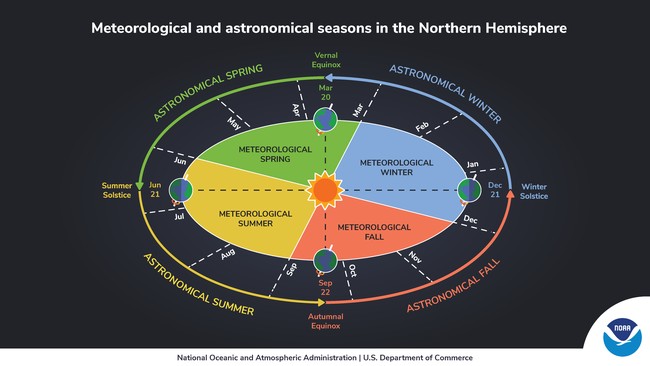
Meteorology says we have the usual four seasons: spring, summer, autumn, winter — but they start on the first of the month. Spring is March through May; summer, June through August; autumn, September through November; and winter gets the rest, December through February.
Astronomy says instead that spring starts at the vernal equinox, which comes next year on March 20, 2027 (my sister's birthday, coincidentally), Summer at the summer solstice, next year on June 21, 2027. The autumnal equinox this year is on September 22, and the winter solstice comes on December 21 this year.
But why, you ask?
It's because they are measuring different things. Meteorologists use the months because, first of all, it makes keeping statistics much easier, but second, because the way the climate "feels" matches those months — Memorial Day and June 1 feel like the start of summer, Labor Day and September 1 like the start of fall.
Astronomically, it's different. The Earth's equator is tilted to the plane of Earth's orbit around the Sun, so over the course of a year, the sun's high point during the day moves up and down. The equinoxes happen when the Earth crosses the plane of Earth's orbit, so the Sun is exactly overhead at the equator and the length of the day and night are equal; the solstices happen when the sun's direction reverses — "solstice" means "sun still."
Seeing Spots
Astronomy and our knowledge about the universe in which we live have changed a lot in the last 50 years, and, moreover, more in the 36 years since the Hubble Space Telescope was launched than in all the years before.
Related: Sunday Supplement: Nancy Grace Roman Edition
The James Webb Space Telescope has contributed massively to that, because by having a big mirror, and seeing into the middle-infrared (wavelengths of 5-28 µm), it can see objects that date back to only hundreds of millions of years after the Big Bang.
The most exciting phrase to hear in science, the one that heralds new discoveries, is not “Eureka!” (I found it!) but “That’s funny…”
— /usr/games/fortune, attributed to Isaac Asimov.
JWST has provided a lot of "that's funny" observations, and among them, possibly the biggest one is the discovery of tiny, compact, very red sources in 2022. Based on their redshift, those are objects from when the universe was about 1.5 billion years old (z ∼ 4) to about 550 million years old (z∼ 9).
The z there measures that stretch: the observed wavelength is 1+z times the original, so z∼4 means that the light is five times longer than when it left. The technical term for these sources is "little red dots," and "that's funny" is the least of what astronomers were saying about them.
Four years later, one plausible explanation has been suggested: that at least some of the little red dots are an observation of what had been just a hypothetical object, a black hole star.
Black holes, of course, are pretty well known now, if still not very well understood. Somehow, maybe by a supernova, a mass gets compressed so much that the escape velocity of the mass exceeds $c$, the speed of light. Since nothing can go faster than light (see Einstein, A) anything that falls close enough can no longer escape.
Then things got weird. It turned out that another one of astronomy's big puzzles, active galactic nuclei first observed as quasars, were best explained as super-massive black holes. But how does a super-massive black hole grow so big in a mere billion years — or as little as half that?
That's funny...
So, one explanation was that in the chaotic, extremely hot, and generally messy environment that was the universe, some areas just randomly turned out to be so dense that they turned immediately into black holes. Surrounding them would be larger clouds that didn't quite become part of the black hole.
Now, you might think at first that the black hole would just eat up all that surrounding stuff, but it turns out that there's a limit to how fast gas can fall into a black hole. It’s called the Eddington limit. Gas falling in heats up and shines; past a certain brightness, that light shoves new gas back out as fast as gravity can pull it in. That caps how quickly a naked hole can grow.
A black hole star is a growing black hole wrapped in a huge, dense cloud of gas — an envelope the size of a solar system, thick enough that the light from the center can’t just blow the fuel away. Fusion in its core heats a normal, well-behaved adult star. The hole eating at the center heats a black hole star. From the outside, it can look like a swollen, glowing star; the furnace is accretion, not fusion.
So it's possible — just possible — that those supermassive black holes that form the cores of galaxies started out as black hole stars in the very early universe, and galaxies formed in the material around them.
Vera Rubin
JWST is not the only observatory getting exciting new stuff:
The Vera C. @VRubinObs Observatory has captured a deep image of the COSMOS field and its surroundings, revealing more than half a million galaxies and over 50,000 foreground stars.
— Erika (@ExploreCosmos_) September 12, 2026
Located in Sextans, this extensively studied region provides a valuable reference for comparing… pic.twitter.com/MJfElS2uAg
That's it this week. I'm trying to include biology and medicine, archaeology, and space flight, but this week, there was just too much astronomy. We'll see what we get next week. So plan on coming back next Sunday for the Sunday Supplement, and if you missed it, look back at Friday's Sky Candy.