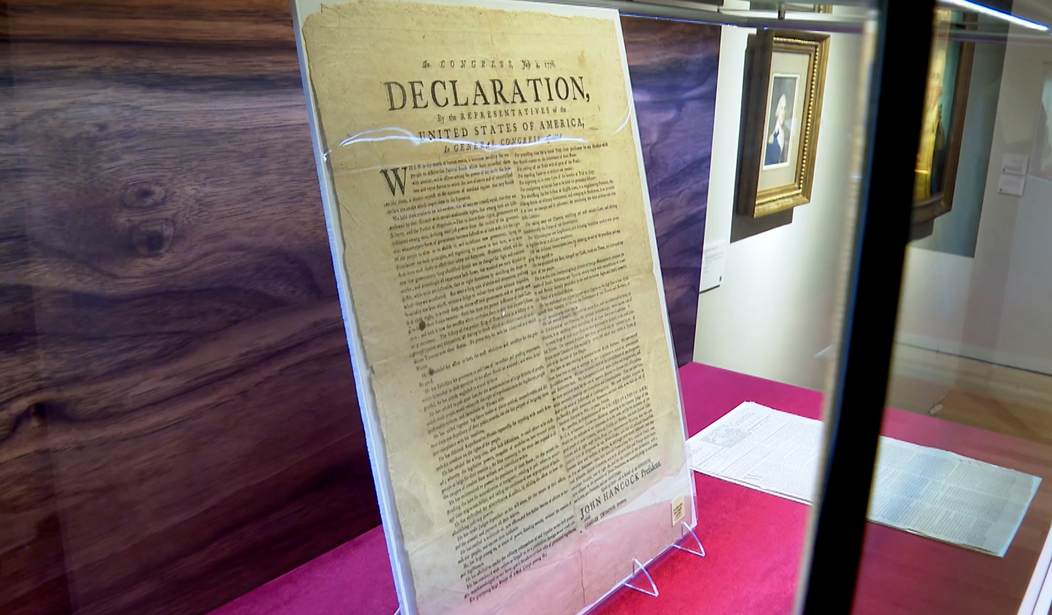

If you're an American, native or naturalized, you've heard these words thousands of times, so many times that the meaning has been washed out of them in your day-to-day life.
Today is the 250th anniversary of the adoption of the Declaration of Independence, and I think it's a worthy effort to reread these first paragraphs and consider what they mean.
So here we go. Refresh your memory while we discuss, and just to warn you, there will be a test.
We hold these truths to be self-evident, that all men are created equal, that they are endowed by their Creator with certain unalienable Rights, that among these are Life, Liberty and the pursuit of Happiness.
—That to secure these rights, Governments are instituted among Men, deriving their just powers from the consent of the governed,
—That whenever any Form of Government becomes destructive of these ends, it is the Right of the People to alter or to abolish it, and to institute new Government, laying its foundation on such principles and organizing its powers in such form, as to them shall seem most likely to effect their Safety and Happiness.
The Declaration is structured as an argument — in the formal sense, not something yelled back and forth in a heated exchange. An argument in logic is a sequence of statements intended to support or establish a conclusion.
The Founders, and Jefferson in particular, were educated men in the liberal tradition: the Trivium and Quadrivium. The Trivium are grammar, rhetoric, and logic, drawn largely from Aristotle. Among the topics of the Quadrivium is geometry, based on Euclid's elements.
Jefferson wasn't alone in composing the Declaration — while his argument was rigorous, Franklin was frankly the better writer. So after Franklin's suggestions, we got the final wording:
We hold these truths to be self-evident,...
This is arguably the central and most important phrase in the Declaration, and it is the most explicitly a statement of the logic of the argument. When an argument states premises that are self-evident, they are what we now call axioms. The elegance of Euclid's Elements comes from starting with ten statements that form the basis of everything else that Euclid then proved.
Educated men in the Colonies were familiar with Euclid, whether by formal education, as in the case of Jefferson, or self-study, as in the case of Franklin. In that sentence, Jefferson stated facts that he asserted required no proof; they were the basic statements from which all following proofs would derive.
... that all men are created equal, that they are endowed by their Creator with certain unalienable Rights, that among these are Life, Liberty and the pursuit of Happiness.
This was a bald statement that precisely and concisely summarized a century of the European Enlightenment, from Locke and Burke, and going back to Spinoza. It also explicitly renounced the underlying theory from which European rulers asserted their right to rule. It didn't just claim that the Colonists were justified in ruling themselves; it rejected the whole notion of a hereditary aristocracy and a Divine Right of Kings.
It made another revolutionary statement: that these rules were unalienable, that no one could remove or modify those rights.
It then goes on to say that while we may agree to some restrictions on those rights through government, the government exists and has authority solely through the consent of the governed. If a government violates those rights, the people have the right to withdraw that consent and change the government.
The rest of the Declaration enumerates the offenses of the Crown of Great Britain, which evidences the ways in which the Crown was violating those self-evident truths. We don't need to go through them; we just know that the Colonists won the argument.
Humans usually have some collection of statements by which we declare our beliefs. We Buddhists have the Refuges, in Buddha, Law, and Community. Most Christians have some variant of the Apostles Creed or the Nicene Creed (and infinite arguments over the correct interpretation).
Americans have their own statement, in the Declaration of Independence and the Constitution. There are minor variations, but the key to all of them is to "preserve, protect and defend the Constitution of the United States.”
And now we come to the promised quiz: do we accept the self-evident truths declared on July 4, 1776?