





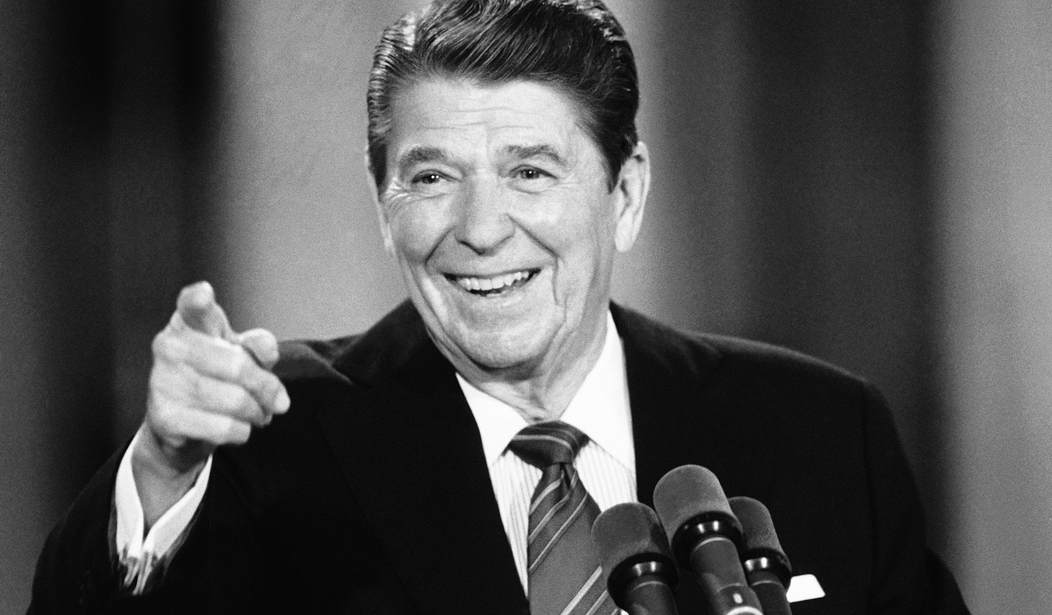
The evening of Aug. 19, 1976, was hot and muggy in Kansas City, where the Republicans were wrapping up their convention. Gerald Ford was scheduled to give his speech accepting the Republican presidential nomination for what is probably the last contested party convention in American history.
While exact totals varied slightly depending on uncommitted state delegations, Ford entered the convention with approximately 1,100 to 1,110 committed delegates, while his challenger Ronald Reagan held around 1,030 to 1,040. Because neither candidate had reached the 1,130-delegate threshold outright, roughly 90 to 100 uncommitted delegates held the balance of power.
It had been a bitter primary season, with Ford racking up several key early victories and building a large lead in delegates. With Reagan on the ropes and preparing to concede, Sen. Jesse Helms (R-NC) engineered a stunning upset for the Gipper in his state's primary. Reagan had changed tactics and begun attacking Ford's foreign policy as naive and weak.
It proved a winning formula. Reagan won North Carolina and never looked back. The victory propelled Reagan to a string of major primary victories shortly after in states like Texas, Indiana, Georgia, Nebraska, and California, stretching the nomination battle all the way to the convention floor.
Reagan made a critical tactical error when he named the liberal Pennsylvania senator Richard Schweiker as his running mate. The move alienated his base, and he lost whatever momentum he carried into the convention.
Ford ultimately secured the nomination on the first ballot with 1,187 votes to Reagan's 1,070.
On August 19, Ford stepped up to the microphone to deliver his acceptance speech. About half the convention (including some prominent Ford supporters) believed they had nominated the wrong man. Ford gave "the best speech of his life," according to political reporter Fred Barnes, but the president knew that the gathering would be seen as a failure unless he could entice Reagan to speak.
The behind-the-scenes maneuvering to get Reagan to that podium was intense. Nancy Reagan was dead set against it. Reagan's instincts were to pass on the opportunity. "It's Ford's night," he told aides.
Then, unexpectedly, Ford invited Reagan to the podium. “Hey, Ronnie, bring your lovely wife Nancy down and maybe say a few words to the convention.”
Ford had sent his aide Bryce Harlow to ask Reagan to speak, saying, “It would be a terrible thing for the Republican Party if Ronald Reagan left the convention hall without speaking to the delegates.” Reagan tried to decline the invitation. Footage of the event shows Reagan, in his skybox, shaking his head “no” to Ford’s invitation. Nancy Reagan clearly says, “Ronnie, don’t go.” But Ford was insistent, believing it was important to unite the GOP going into the general election contest. Then the crowd got involved, chanting “We want Ron!” Reagan, reluctantly, came down to the stage.
The unexpected events meant that Reagan would give one of his most important and memorable speeches with almost no preparation. As Black recalled, “He went totally off the cuff.”
What makes a great political speech? All great speeches have a few things in common. 1.) The moment. The exact time in history when the speaker's words will resonate. 2.) The backdrop. The place the speech is delivered amplifies its meaning. And 3.) The words. All great speeches are as inspiring when read as they are when delivered orally.
Lincoln at Gettysburg. King at the Lincoln Memorial. Patrick Henry on the floor of the Virginia House of Burgesses. The man, the moment, and the words came together to allow the spoken words to echo down through the ages.
Reagan has given several notable speeches, many written by Peggy Noonan (the Challenger disaster, Point du Hoc) and Tony Dolan ("Evil Empire" speech). But his Aug. 19, 1976, speech was given "cold," with no teleprompter and no preparation.
After remarking about the welcome given to him and Nancy when they walked into the convention, Reagan graciously thanked Ford. "That, plus this, plus your kindness and generosity in honoring us by bringing us down here will give us a memory that will live in our hearts forever."
Yes. It was a different era.
Then, Reagan talked about being asked to write a letter for a time capsule to be opened in 2076. He riffed off that topic to deliver what some thought was his most inspiring speech. That it proved to be prophetic was a bonus.
He spoke of the challenge in writing it and how he wrestled with what to say to those men and women 100 years in the future. Where Ford had spoken eloquently of the problems facing the U.S. domestically, Reagan turned his attention to the existential threat of "nuclear weapons that can in a matter of minutes arrive at each others country and destroy virtually the civilized world we live in."
The Free Press:
The existential issue that the people of 2076 would be looking back to was whether America would have survived its struggle against Soviet communism in the Cold War. As Reagan put it, “And suddenly it dawned on me; those who would read this letter a hundred years from now will know whether those missiles were fired. They will know whether we met our challenge.” He wondered: “Will they look back with appreciation and say, ‘Thank God for those people in 1976 who headed off that loss of freedom? Who kept us now a hundred years later free? Who kept our world from nuclear destruction?’ ”
After posing these important questions, Reagan finished with a resounding conclusion. He told those assembled in the hall that “This is our challenge” and that “We must go forth from here united, determined. And what a great general said a few years ago is true: There is no substitute for victory.”
The speech was just 771 words. But it landed like a bomb. “I don’t really remember questioning if Ford was the right man exactly beforehand, but Reagan’s speech was just one of those that caught your breath," said Ford supporter Zorine Shirley, a volunteer with Ford’s youth group.
"America won the battle against Soviet totalitarianism, but the fight to safeguard liberty and civilization continues," writes The Free Press's Tevi Troy, a senior fellow at the Ronald Reagan Presidential Foundation. "With 50 years left before America’s tercentenary, the questions Reagan asked will challenge every generation."
Forgive me, gentle readers, but I am not optimistic that much will be left of the America we know in 2076.
Editor's Note: President Trump is leading America into the "Golden Age" as Democrats desperately try to stop it.
Help us continue to report on President Trump's successes and combat Democrats' lies. Join PJ Media VIP and use promo code FIGHT to receive 60% off your membership.

Join the Conversation
VIP members get the ability to comment on articles.