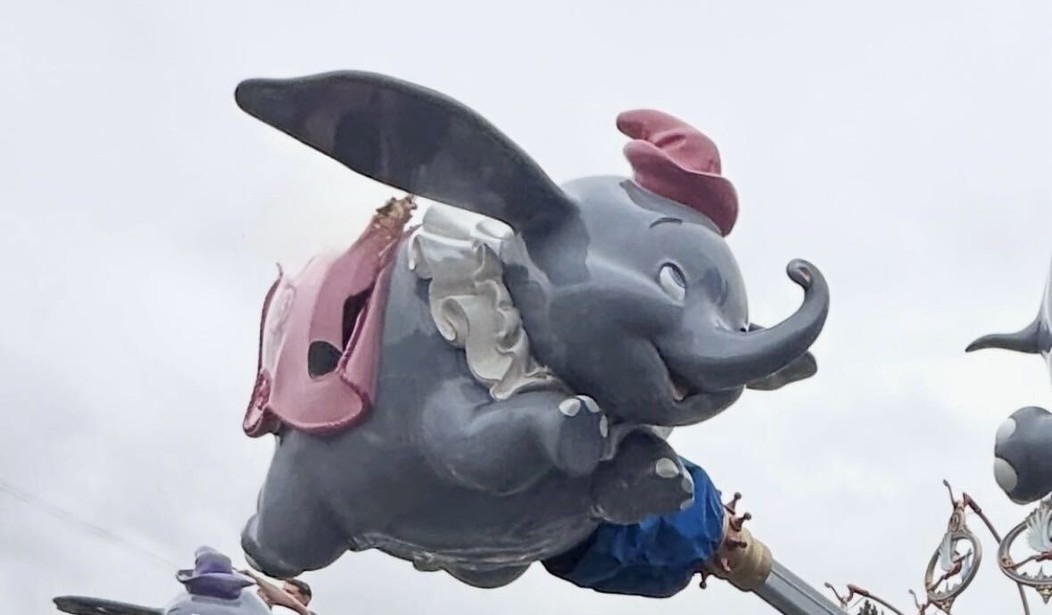

On Oct. 23, 1941, a little elephant with very big ears flew off the silver screen and into Americans’ hearts.
Now, 85 years later, Dumbo has long been an established part of the canon of classic Disney films that always show up in anniversary tributes, theme park shows, and classic soundtrack compilations. What a lot of people don’t know is that the film saved the studio from financial catastrophe.
Bambi, Pinocchio, and Fantasia are all magnificent works of art, but they didn’t have box office success, and Fantasia was actually a financial disaster for Walt. Dumbo didn’t require nearly as much money to produce, and it was a box office success — a badly needed one. It helped ensure the Disney studio made it through World War II.
Dumbo was innovative in its way. The scene where Dumbo and Timothy Mouse accidentally get drunk and hallucinate pink elephants was a cutting-edge experiment in psychedelic animation. But Walt still aimed to save money throughout the production, and it paid off. People Magazine noted that the film was a major hit with audiences.
Polygon explains:
Fantasia’s box-office failure was one of a few aspects that contributed to Dumbo having a drastically lower budget of $950,000 — half the cost of Snow White and the Seven Dwarfs, and two-thirds the cost of Pinocchio, per animation historian Michael Barrier. At the time, World War II was wreaking havoc on European culture, which further emphasized the need to limit spending… The economizing paid off. Dumbo well outgrossed its production budget upon its initial release, and was easily the studio’s most financially successful film of the fairly lean 1940s.
And perhaps the pink elephant scene was not the only innovative aspect of the film. When I say that Dumbo fights prejudice, maybe you were thinking about how the message of the movie is not to judge people by their appearances. After all, Dumbo struggles through so much of the movie because of his comically and unusually large ears, only to discover they are precisely what make him so special. But the movie also helped promote black performers and undercut racism at a time when that was still a huge issue in Hollywood and America.
If you just search the Internet, or look at activist comments, you will hear a lot of propaganda about how incredibly racist Dumbo is. Some people are furious that the voice for one of the crows (who all sound like Southern black men) was a white man’s, that the crow song sounds like a traditional minstrel show tune, and some people will even go so far as to claim preposterously that the film whitewashes slavery. But if you ignore all the propaganda and just look at the film and the facts, Dumbo was actually an extraordinary film for its time in featuring black performers and undermining racial stereotypes.
First of all, from my research, the voice actors for all the crows except one were black men, and the fact that they had accents is probably much more about accuracy to the characters they represent than about stereotypes. The people who assume that any Southern man with a heavy accent must be stupid are the real racists. Cliff Edwards, the lead singer among the crows, was also the voice of Jiminy Cricket, and Walt Disney almost certainly chose him because he always loved Edwards’ voice work — not because Edwards was white.
Disney’s first black animator, Floyd Norman, with whom I had the privilege to meet and talk, totally rejected the allegation that his boss, Walt Disney, was racist and argued that his studio actually broke sexist and racist restrictions over and over. Among the voices of the other crows were Jim Carmichael and James Baskett. Walt later brought Baskett back to star as Uncle Remus, for which Baskett became the first black man to win an Oscar.
Related: James Baskett: History-Making Actor and ‘Uncle Remus
In fact, in Dumbo, it is the crows who come up with a brilliant idea for giving the depressed and abused Dumbo his confidence and his ability to fly at will. Indeed, without the cleverness and empathy of the crows, the happy ending of the film is impossible. As faithful a friend as Timothy Mouse is, he is not able to give Dumbo the full psychological and literal lift he needs. The crows have to swoop in and save the day. So much for the idea that the film caricatures black people as stupid.
But the crows are certainly not the only black performers in the film. It is undeniable that almost every human depicted in Dumbo is shown as an ugly and highly caricatured cartoon person. All the humans who are cruel to Dumbo and his mother, including the clowns, the ringmaster, and the bratty boys, are white. The only normal-looking and normal-sounding humans featured in the movie are the black circus workers who sing as they put up the circus tents in a rainstorm. That’s likely because Walt hired the all-black Hall Johnson Choir not only to provide voices for the crows but to contribute vocals for the song below. The Hall Johnson Choir also worked with Walt on Snow White and the Seven Dwarfs and Song of the South.
So don’t fall for the woke propaganda. Rediscover the joy of Dumbo that made it such a success 85 years ago and turned it into the beloved classic we should still love today.