
President Donald Trump issued a message ahead of Columbus Day over the weekend, praising the Italian-American community. He was highlighting a fact that Democrats would like all Americans to forget, which is that this holiday was actually specifically a response to ethnic prejudice. Remembering that would undermine the Democrats’ egregiously anti-historical narrative that all white people are basically the same and have always been privileged.
“HAPPY COLUMBUS DAY TO ALL, in particular our great Italian American Community which was forced to suffer as the Radical Left Dumocrats, Socialists, and Communists rampaged through our cities and towns ripping down almost all of the beautiful statues of Christopher Columbus,” Trump posted on Sunday. “Well, those days of plunder are over, and the statues are back, more magnificent than ever. This is a big day for our great Italian American Community, and the Country of Italy itself, maybe the biggest. Congratulations!”
Irishmen, Germans, Native American Indians, Jews, Africans, and other immigrants and different racial or religious groups all fought for the founding of America during the Revolution. But despite that, certain Americans of Anglo heritage had major prejudices against any Europeans whom they considered inferior and any racial groups with darker skin. Some Protestants were also prejudiced against Catholics and Jews, while some Catholics expressed antisemitism. In short, while America’s ideals were always aimed at religious freedom for all and equality under the law, and our greatest leaders and citizens championed these ideas, not all Americans always lived up to that standard. It was a problem that had concerned Founders like George Washington from the beginning.
Whenever a large number of people come in from a country whose people have not previously been part of America, there will always be assimilation difficulties. Sometimes the concerns about immigrants are very legitimate, for instance, worrying that fundamentalist Muslims have different views on violence and sexual morality. In other cases, the concerns take the form of extreme and irrational ethnic or racial prejudice. Did you know that the biggest lynch mob in U.S. history targeted a group of Italian-Americans? The bloody incident shocked many Americans who were not racist and ended up spurring the creation of Columbus Day.
In October 1890, New Orleans Police Chief David Hennessy — who had investigated a Sicilian feud — died by assassination, and allegedly whispered an Italian slur as he expired. While there were quite a few genuine suspects, the New Orleans City Council and the “Committee of Fifty” set out specifically to convict Italian-Americans. New Orleans, a hub of immigration, and previously a slave-owning area, had a serious racism problem.
Related: Trump Urges Americans to Honor the ‘Unrivaled Greatness’ of Christopher Columbus
Several of the Italian suspects (Joseph Macheca, Antonio Bagnetto, Antonio Marchesi) went on trial and secured acquittals. Others had a mistrial (Pietro Monasterio, Emmanuele Polizzi, Antonio Scaffidi), while still others never even had trials (Rocco Geraci, Charles Traina, Loreto Comitis, James Caruso, Frank Romero). Macheca was a (Democrat) politician, as was Romero. The others were laborers, peddlers, and craftsmen. Unfortunately, regardless of the trial results, quite a few New Orleans racists were convinced Italians were guilty, and that the suspects — acquitted or not — had to die. A large lynch mob formed. History.com describes the heinous scene:
Shots rang out—hundreds of them. Eleven men’s bodies were riddled with bullets and torn apart by the crowd.
Outside the jail, the larger mob cheered as the mutilated bodies were displayed. Some corpses were hanged; what remained of others were torn apart and plundered for souvenirs.
Many people in New Orleans were stunned at the bestial brutality, and when the news spread, so were many other Americans across the country. Unfortunately, other Americans defended the massacre, sparking heated debate. Then the crisis became international, as the Italian government recalled its ambassador and broke off diplomatic relations. President Benjamin Harrison, a moderate Republican, realized he had to do something to combat hatred of Italian-Americans, honor their contributions, and remind Americans that all of us — except the native tribes — are descendants of immigrants.
For Our VIPs: Leif Erickson, Columbus, Pulaski, San Francisco, and America’s Roots From Around the Globe
In October 1492, Genoese explorer Christopher Columbus landed in the New World and opened it up for European exploration and colonization. Harrison decided to honor this Italian visionary whose name is on our national capital (District of Columbia) and reassure Italian-Americans at the same time. The first Columbus Day in 1892 had a big parade in New York City and included the unveiling of a Columbus statue. The date did not, however, become a permanent national holiday until 1934, following lobbying by the Knights of Columbus.
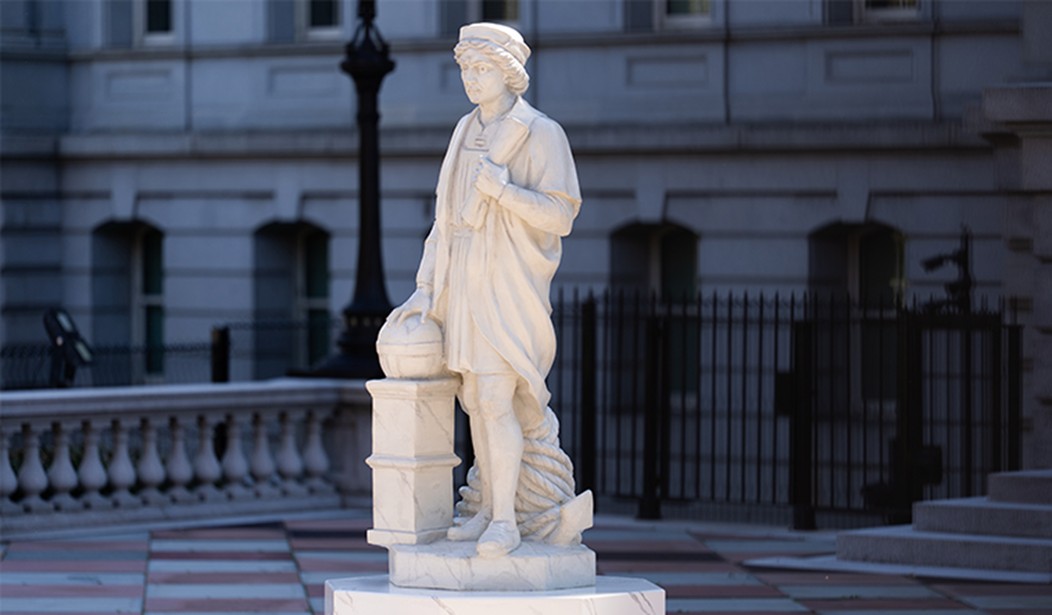
President Donald Trump hosted a Columbus Day celebration at the White House on October 9, recognizing Italian-American heritage and reaffirming his administration’s support for the federal holiday. During the event, Trump praised the contributions of Italian Americans and unveiled a historic Italian marble sculpture of Christopher Columbus that is expected to be placed in the White House Rose Garden. The announcement follows the installation of another Columbus statue on White House grounds earlier this year. The celebration comes amid continued national debate over Columbus Day, which remains a federal holiday, and Indigenous Peoples’ Day, which the Biden administration previously recognized alongside it. Columbus Day will be observed on Monday, October 12. 🇮🇹🇺🇸
— Hardcore Italians (@HardcoreItalian) October 10, 2026
Democrats sometimes call this holiday Indigenous People’s Day, ignoring both how Columbus helped natives victimized by cannibals and how this holiday is already a statement against ethnic prejudice. Trump is reviving the true history of this holiday.
For a fun 1950s pop song honoring Columbus, watch here.