


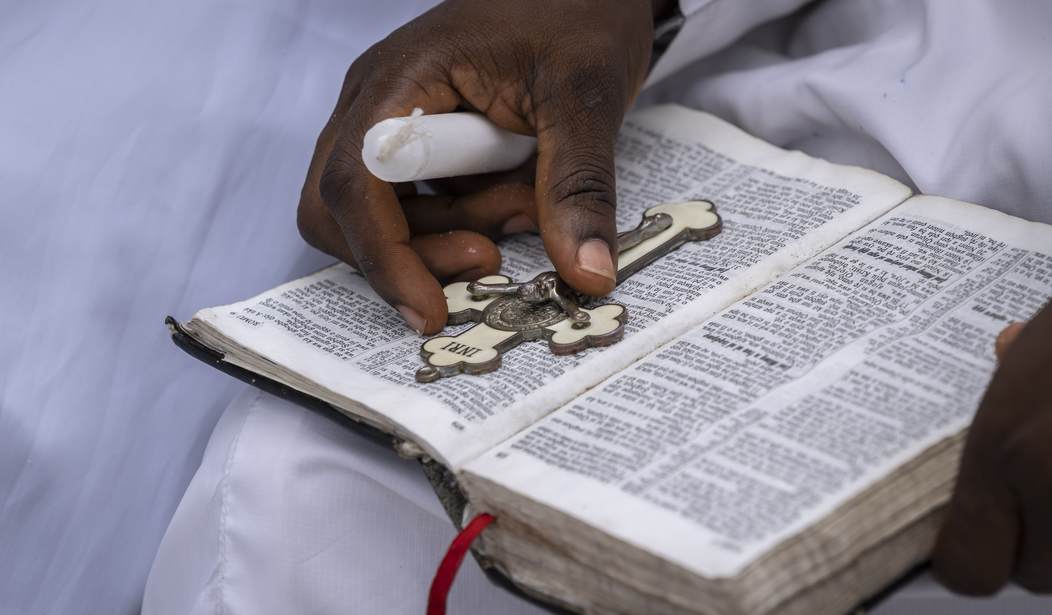
When 19th century slave traders captured the nine-year-old girl in Sudan and sold her in a slave market, it must have seemed laughably unlikely that Christians around the world would one day pay tribute to her memory. But little Bakhita would defy all the odds, and her story is an epic of redemption, heroism, and unshakeable faith.
She once said, “If I were to meet the slave-traders who kidnapped me and even those who tortured me, I would kneel and kiss their hands, for if that did not happen, I would not be a Christian and Religious today.” In that one quote we see the extraordinary generosity, charity, and faith that brought Josephine Bakhita through all her horrible sufferings with a pure heart.
From slavery to sainthood, St. Josephine Bakhita shows us the power of Christ’s freedom. Her life is a living testimony that hope can flourish even after great suffering.
— The Pontifical Mission Societies in the U.S. (@TPMS_USA) February 8, 2026
St. Josephine Bakhita, pray for us!#StJosephineBakhita #HopeInChrist #TPMS pic.twitter.com/ofuFym4tYF
There are multiple important historic anniversaries today, including the murder of Catholic Mary Queen of Scots on the orders of her cousin Elizabeth I and the birth of the great Civil War Union general William T. Sherman. But rather than dive deep into the complexities of controversial historical events, I want to highlight an inspiring story of how one woman overcame tragedy and abuse to become a beloved saint and a shining example of forgiveness.
Bakhita’s story begins in Sudan, where she was born into an important family, as her uncle was a tribal chief of the Daju people, according to Catholic.org. She recalled her young childhood being very happy. But when she was only nine, Arab slave traders stole her and marched her barefoot 600 miles to be sold at the slave market in El Obeid. Even before she reached the market, she had changed hands more than once.
For Our VIPs: Mr. Casby: A Dickensian Villain With a Suspicious Similarity to Leftists
She was resold in Khartoum, and indeed over about 12 years masters sold her or gave her away a dozen times. In fact, she forgot what her original name was, and the name "Bakhita" is actually Arabic, given by one of her many owners. Ironically, it means "Lucky." But for a long time, Bakhita's "luck" was appalling. For example, one wealthy Arab owner made her a maid to one of the daughters of the house, but when she offended the girl's brother somehow, the beating she received was so bad it incapacitated her for a month.
A different owner was a Turkish general, whose wife and mother-in-law were severely physically abusive on a daily basis, according to Catholic.org. The general's wife had someone cut a complicated pattern into Bakhita's skin and rubbed the knife-wounds with salt -- reportedly because the pattern matched the house's furnishings. Bakhita had 114 scars from such obscene torture.
At last, Bakhita finally did get lucky, or Providence intervened. Callisto Legani, an Italian vice consul, bought her and treated her so well that she requested he take her with him to Italy. There, Legani gave her to a family where she served as a nanny (slavery still existed in Italy into the 20th century). Her mistress went on a journey to Sudan, but instead of taking Bakhita with her, she placed the girl with the Canossian Sisters of Venice.
This was the great turning point in Bakhita's life. With the sisters, for the first time since her childhood, she felt that she was at home. Catholic.org says that she learned about Catholicism from the sisters, so apparently her Italian masters hadn't bothered to instruct her. Indeed, Bakhita was so happy at the convent that when her mistress came to claim her, Bakhita daringly refused to leave. The Canossian superior, instead of forcing Bakhita to leave, appealed to Italian authorities on behalf of the slave girl.
Ultimately, an Italian court ruled that as slavery was outlawed in Sudan before Bakhita's birth, she could not lawfully be considered enslaved. For the first time since her early childhood, Bakhita was free.
She knew exactly how she wanted to use her freedom -- in doing good to others through dedication to Christ. She received baptism, Holy Communion, and Confirmation in 1890 and took the name Josephine Margaret Fortunata (fortunata is the Latin translation of Bakhita). The archbishop who gave the sacraments to Josephine would go on to be Pope Pius X.
Within several years, Josephine became a Canossian novice and took her final vows in 1896. For 42 years, she was the convent's cook and doorkeeper, though she also sometimes traveled to other convents to share her extraordinary story and train other sisters who were going as missionaries to Africa. People always remembered how gentle her voice and smile were. They called her the "little brown sister" or the "black mother." Wherever she went, she inspired people. During WWII, the village of Schio believed that she interceded with God to keep them safe, and indeed not a single citizen died in the bombings there.
Even at the end of her life, when she was confined to a wheelchair, she was perpetually cheerful. Her response to questions about her health was always, "As the master [Jesus] desires." She died on Feb. 8, 1947, while calling upon Jesus's mother. Pope John Paul II named her a venerable (the first step toward officially proclaimed sainthood) in 1978 and in 2000, she was canonized. Josephine Bakhita is the patron saint of Sudan and human trafficking victims.
Josephine Bakhita could understandably become bitter after the atrocities she suffered. Instead, she chose to use her freedom and her experiences to help and heal others. Like her master Jesus, she forgave her enemies and lived out the Gospel in the most uplifting way.
Editor’s Note: Support and follow PJ Media’s coverage of cultural events and other key news in this midterm election year. Join PJ Media VIP and use promo code FIGHT to get 60% off your membership.







Join the conversation as a VIP Member