





The U.S. Supreme Court issued its decision on the historic birthright citizenship case, Trump v. Barbara, on Tuesday morning.
In a 6-3 decision, the court struck down President Donald Trump's executive order, which had ordered that U.S. citizenship not automatically be conferred upon children born on U.S. soil whose parents are illegally present in the United States, or whose mother is visiting here legally but temporarily and whose father is not a citizen or lawful permanent resident.
Justices Sotomayor, Kagan, Barrett, and Jackson join the Roberts opinion in the full decision. Justices Thomas, Alito, and Gorsuch dissented.
"Roberts concludes that children born to parents who are in the United States unlawfully or temporarily are 'born in the United States' and 'subject to the jurisdiction thereof.' 'Under the Constitution, they are citizens at birth,'" wrote Supreme Court expert Amy Howe at SCOTUSblog's live coverage of the announcement.
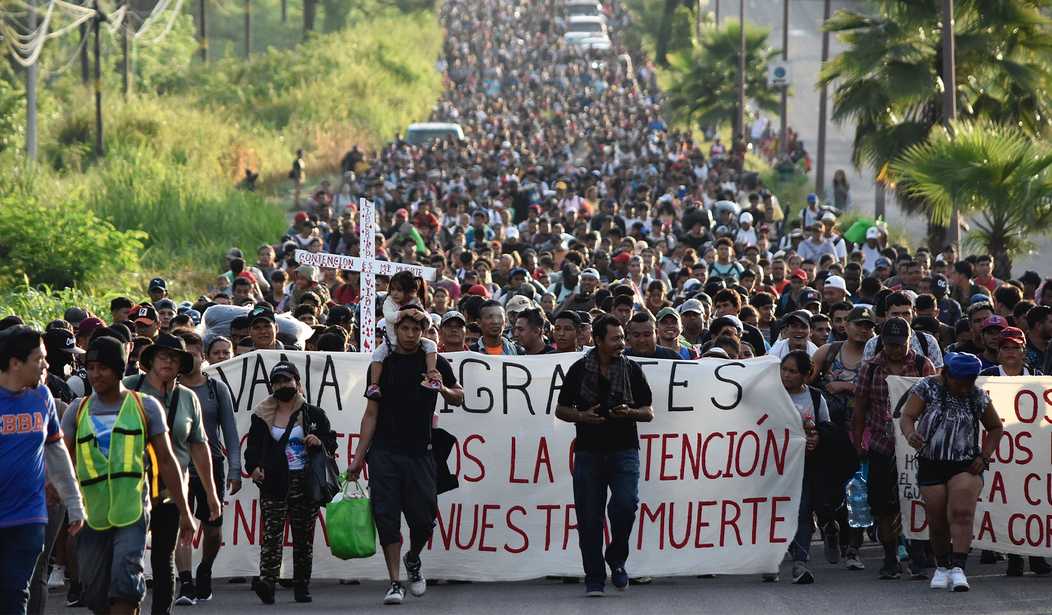
In practice, the ruling means nothing changes, and the nation will continue as it has been doing. Namely, every baby born on U.S. soil is automatically a U.S. citizen, regardless of the status of the parents. Apparently, it's too much to ask that parents have at least the most basic allegiance to or standing in our country before we bestow its greatest gift — citizenship — on their offspring.
Howe added, "As others have noted, Kavanaugh writes that Trump's EO conflicts with the federal law '[u]nless and until Congress enacts new legislation," potentially leaving the door open for Congress to tighten up citizenship rules.
The ACLU originally filed the suit as a class-action lawsuit (Barbara v. Trump) on behalf of affected families. The lead plaintiff, “Barbara,” is a pregnant "asylum seeker" from Honduras, though the suit also represents other families of various residency statuses. Lower courts ruled for the plaintiffs, sending the case up the chain to the Supremes.
The court heard arguments in the case on April 1, 2026, notes a Congressional Research Service (CRS) legal sidebar:
The question before the Court was whether Executive Order 14160 (E.O. 14160, or the E.O.), "Protecting the Meaning and Value of American Citizenship," is constitutional under the Fourteenth Amendment's Citizenship Clause and authorized by 8 U.S.C. § 1401(a), a provision of the Immigration and Nationality Act (INA) that codifies the Citizenship Clause.
The EO stated that:
The Fourteenth Amendment has always excluded from birthright citizenship persons who were born in the United States but not “subject to the jurisdiction thereof.”
Beyond the 14th Amendment, the case further examined the meaning of the phrase “domiciled residents" from the 1898 decision in United States v. Wong Kim Ark. In that case, Wong Kim Ark's parents had maintained a legal, permanent domicile in the U.S. for over 20 years. Though not citizens (people born in China were prohibited from naturalizing at that time), the parents were legally present and conducting business here, and not serving in diplomatic roles. The Trump administration argued that this situation contrasts with that of foreign nationals who are illegally present in the country.
Trump’s signed E.O. 14160 on Inauguration Day 2025. The CRS sidebar explained the intent of the original order:
The E.O. seeks to interpret "subject to the jurisdiction thereof" in the Citizenship Clause to limit who may be considered a U.S. citizen from birth.
[…]
The E.O. outlines two categories of persons that, in the view of the executive branch, are not "subject to the jurisdiction" of the United States and therefore are excluded from the Fourteenth Amendment's grant of birthright citizenship: (1) a child whose mother was not lawfully present in the United States, and whose father was not a U.S. citizen or lawful permanent resident, at the moment the child was born; and (2) a child whose mother was lawfully but temporarily in the United States, and whose father was not a U.S. citizen or lawful permanent resident, at the moment the child was born. The E.O. asserts that children born in the United States to parents in either of these categories are not "subject to the jurisdiction" of the United States within the meaning of the Fourteenth Amendment.
This is a developing story that will profoundly impact the future of America. Check back with PJ Media for additional details and analysis.

Join the Conversation
VIP members get the ability to comment on articles.