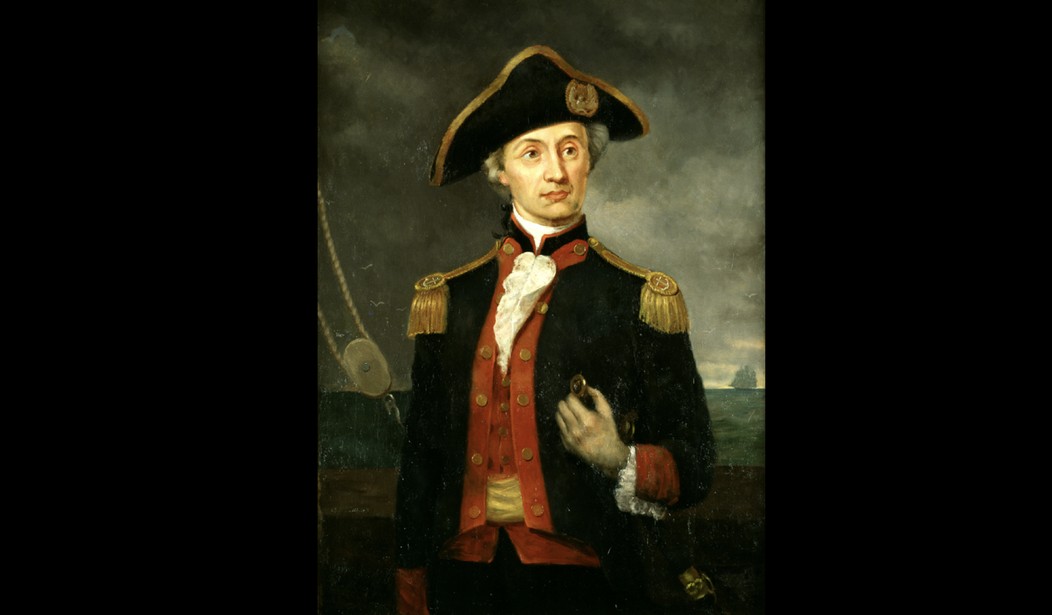
In the last installment of this series, we referred to John Barry as the father of the U.S. Navy, but in this case, American success actually had more than one “father.” More to the point, in doing research on John Barry, John Paul Jones came up quite a bit as another formative leader for the early U.S. Navy. To be sure, in some resource material, Jones, too, is listed as the “Father of the U.S. Navy.”
With this in mind, we need to learn more about Jones, who is buried at the U.S. Naval Academy Chapel in Annapolis, Md. His remains lie beneath an impressive sarcophagus, reinforcing his importance to the history of the Navy.
He was born in 1747 in Kirkcudbright, Scotland. His birth name was John Paul. Later in life, he added “Jones.”
During the Revolutionary War, he served as a commander in the Continental Navy, known best for commanding the Bonhomme Richard, which in 1779 defeated the crown’s HMS Serapis off the English coast. Jones’ ship had suffered serious damage and still won the battle.
Jones was known for aggressive strategy and tactics on the water, with an insistence on discipline that contributed to the creation of the U.S. Navy’s culture and identity.
His naval life began when Jones was 12. That’s when he became a British merchant marine. Like so many at the time, he got his start as a cabin boy.
In 1764, John Paul was 17 and signed onto a slave brigantine named King George, based at Whitehaven in Great Britain. Over a period of two years, he rose from third mate on the King George to first mate on the Two Friends, which sailed out of Kingston, Jamaica. At that point, he decided to leave what he described as an “abominable trade.”
As fate would have it, the ship he took back to Scotland lost both its captain and chief mate due to sickness during the voyage. Paul had to step up and get the vessel to Scotland. That's when he earned the title of master.
In 1773, in self-defense, he killed the leader of a mutiny onboard his ship somewhere near Tobago in the West Indies. To evade British authorities, trial, and possibly death, he went on the run as a fugitive. John Paul ended up in Virginia in the American colonies.
To mask his identity, he added “Jones” as a surname. His timing could not have been better. The Americans were on the cusp of a full-blown rebellion against the British, and it needed mariners like Jones to lead the war effort on the sea.
In 1775, Jones enlisted in the Continental Navy in Philadelphia. The Continental Congress and the budding rebellion’s leaders commissioned Jones as a lieutenant on what is described as America’s first flagship, Alfred. The boat had been called Black Prince, but was renamed Alfred. Jones first hoisted the Grand Union Flag on her deck at her commissioning.
Continental Union Flag, also known as the Grand Union Flag, was used between 1775 and 1777. pic.twitter.com/X2WLGUi1wz
— The Rubber Banned Man (@BannedMan1776) March 22, 2025
Soon after, Jones earned the rank of captain, and in 1776, he assumed command of the sloop Providence. As captain of that ship, he captured 16 British warships and destroyed British fisheries in Nova Scotia.
From there, Jones went on to command a ship called Ranger in 1777 and 1778. The name “Ranger” now has a long and storied history in the U.S. Navy. In America’s long naval history, eight Navy vessels have been called “Ranger.”
The first was a sloop under Jones’ command. It had 18 guns and was launched on May 10, 1777. This was the first ship to hoist the “stars and stripes” flag on a Continental Navy ship. Its name was inspired by Roger’s Rangers, the militia out of Portsmouth, N.H., which was also where the ship was built.
One of many famous quotes from Jones is, "I wish to have no connection with any ship that does not sail fast, for I intend to go into harm's way."
The Ranger and its 150-member crew seemed suited to Jones’ personality, as he was able to use her to sink two British ships, harass several British towns and villages, and in April 1778, face off with the HMS Drake, embarrassing its crew by forcing it to strike the ship’s colors after one hour of fighting. This took place off the coast of Ireland.
Today, April 22, 1778🗓
— Mike Niezgoda (@cwoniezgoda) April 22, 2024
Revolutionary War | Volunteer sailors from the American Navy Ship & sloop-of-war (USS) Ranger, commanded by Captain John Paul Jones, snuck ashore at Whitehaven, England—and burned some of the Royal Fleet ships in the harbor and spiked the guns of the fort,… pic.twitter.com/YhHWxLU7DQ
Jones marked another symbolic milestone in Ranger, sailing to Quiberon Bay in French waters, receiving the first formal salute at sea from the French navy. This was also the first official salute to America’s “stars and stripes” flag on a Navy ship.
After this, American and French leadership entrusted Jones to command a fleet of five French and American ships. His was the Bonhomme Richard. It was aboard this vessel that Jones saw some of the bloodiest actions on the water during the war. On Sept. 23, 1779, Jones’ ship, along with two other frigates, engaged with the HMS Serapis, which had 44-50 guns and a convoy of 41 ships.
The Bonhomme Richard and the Serapis collided during the fighting, and Jones lashed his boat to the other as the battle raged. As the Bonhomme Richard burned and started to sink into the sea, Pearson demanded that Jones surrender. That’s when Jones replied, “I have not yet begun to fight.”
The two ships fought for four hours under a moonlit sky until it was the Serapis that surrendered. In the wake of the battle, both ships were badly damaged, and each lost half its crew to both injury and death.
While the Bonhomme Richard sank two days after the battle, Jones commanded the Serapis to Holland, where it received repairs and Jones rechristened it and gave it to the French as a goodwill gesture.
Depending on the source, Jones has had a certain charisma and a prickliness attached to his name. Almost universally, he was described as “daring” in his command of warships. He used speed and audacity to attack and defeat the enemy. He would do things that the enemy either could not imagine or would not risk. A famous quote attributed to Jones is, "It seems to be a law of nature, inflexible and inexorable, that those who will not risk cannot win."
As news of his escapades reached American society, his reputation became larger than life, which was ironic because Thomas Jefferson had referred to him by the nickname “little Jones.” Jones was said to be about 5’5” tall.
Related: ‘America 250’ Tuesday: John Barry Was the Father of the U.S. Navy
Still, tales of John Paul Jones were the stuff of pirate stories. Within the Navy, he was known for carrying himself with professional decorum. His style of leadership required discipline from top to bottom. Honor and duty mattered so much that he dealt with violations of his expectations promptly and harshly.
As for his personal life, historians say he was anything but a recluse. He often wrote poetry and letters to friends and acquaintances – more so than many in his position. He was never married nor had children, though several accounts of Jones’ life indicate he had a very active romantic life.
After the Revolutionary War, Jones briefly provided service to the Russian navy, and then he moved to Paris, where he was appointed to be U.S. Consul to Algiers. He died in July 1792 before he could assume that role.
Originally, they buried him in Paris. Over 100 years later, President Theodore Roosevelt oversaw the removal of Jones’ remains from France and their reinterment in Annapolis in 1913.