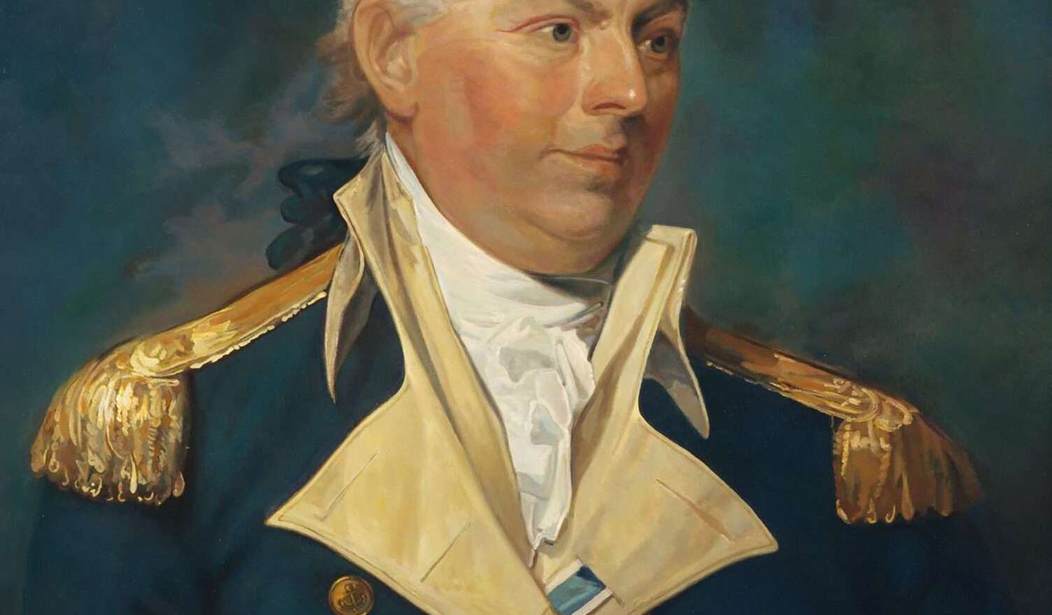
If Gen. George Washington was the father of the U.S. Army (and the country), who was the father of the U.S. Navy? It was John Barry.
Barry was born in 1745 in Tacumshane, County Wexford, Ireland. According to historians, his parents were Jams Patrick John Barry and Mary Ellen Cullen, although there are some accounts that list Catherine Kelly Barry as his mother.
John Barry’s father was a tenant farmer in Ireland, which is an important thing to understand if you want to know where so much of the animosity between Ireland and Great Britain is rooted. Tenant farmers in Ireland had to rent the land they used to grow crops. Regardless of what kind of growing season those tenants endured, when rent came due, their British overlords demanded every penny — or else: debtor’s prison.
The Barry family’s farm didn’t do well, and so a British landlord evicted them from the property he owned. The family moved a few miles away to Rosslare, which was next to the ocean. This introduced young John to his future on the water.
John’s uncle Nicholas was a ship master in the harbor. He hired John to serve as a cabin boy on commercial boats in the beginning, which was before John secured enlistment in the Royal Navy.
It’s not exactly clear how he did it, but by the time Barry was 15, he had landed in Philadelphia. By thew time he turned 21, Barry was captain of a schooner called Barbados, in which he made a number of trips to the West Indies.
While it’s said he had a fanatical love of the sea, the love of his life was Mary Cleary, whom he married sometime around 1767. The wedding took place at St. Joseph’s Church in Philadelphia, where by this time Barry had a home near the Delaware River.
John was offshore in 1774 when his young wife died at the age of 29. Details surrounding her and her death are sketchy, though it is known that the two had no children.
Not long after Mary’s death, the American Revolution started. Not only was Barry loyal to his new country, but he remembered how the British treated his own family when his dad was a tenant farmer. The Continental Navy appointed Barry a captain on Dec. 7, 1775, after hostilities in the war had started.
Related: ‘America 250’ Tuesday: Five Irishmen Who Helped Shape the American Revolution
When the Continental Congress commissioned its first ship, it named it the USS Brigantine Lexington. This was the first to fly an American flag, and it was under Barry's command. The ship was fast, it had two masts, and it had 14 guns. It was able to break through British blockades to deliver gunpowder to the Continental Army. It captured the British supply ship Edward, and it engaged in skirmishes in the Chesapeake Bay and along the Delaware.
On July 7, 1777, Barry married a well-connected woman in Philadelphia society named Sarah Keen Austin, who went by “Sally.” In his second marriage, Barry and his wife found that they could not have children. They did raise two boys, however. When John’s sister Eleanor died, John and Sarah took in Eleanor's sons Patrick and Michael as their own.
That same year, Barry was assigned to command the USS Delaware, which was a larger, heavier frigate that had 24 guns. Impressive as the boat was, the Continental Army and Navy could not secure victory in operations on the Delaware River.
Next up, Barry was assigned to command the USS Raleigh, another frigate, only bigger. It had 32 guns, but it was more nimble than the Delaware. That boat was run aground on Sept. 27, 1778, as Barry and his crew fled the British.
While he was injured while capturing the HMS Atlanta and sister ship the Tepassey, he was able to recover in time for he and his crew of the USS Alliance to participate in the final battle of the Revolutionary War, a victory for the patriots, on March 10, 1783.
Barry stayed on in the Navy after the war, rising to the rank of commodore on Feb. 22, 1797. He oversaw the U.S. Navy until his death on Sept. 13, 1803, in Philadelphia at the age of 58. The cause of death was complications from asthma.
Reaction to his passing was a reflection of the impact Barry had on the Revolutionary War, his peers, his sailors, his family, and the country. The nation honored him with statues, special holidays, the naming of government facilities, the naming of ships, and even the Commodore Barry Bridge, which crosses the Delaware River.